

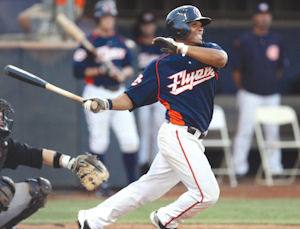
This could be the last season of minor league baseball in Fullerton, and perhaps Orange County.
The Orange County Flyers, which have played at California State University, Fullerton’s Goodwin Field since 2005, have a 50-50 chance of moving after their season ends in September, according to Alan Mintz, president and chairman of the team’s holding company, Fullerton Flyers LLC.
“At the end of the season, we’ll assess what went right and wrong,” said Mintz, who assembled 25 investors to buy the Flyers from the Golden Baseball League in early 2007.
Mintz and his partners, who range from Hollywood types to lawyers and accountants, have three key questions to answer in the offseason: Is Fullerton the right place for the team, is Cal State Fullerton the right venue and is OC the right region.
Everything is on the table, including relocating the team to Honolulu, Palm Springs, Long Beach, Las Vegas or another West Coast city.
“I would like to stay in Fullerton and do something in the downtown area,” Mintz said from his home in Las Vegas, but “we need critical mass.”
Attendance
The Flyers have a loyal but small following. Not nearly enough fans pass through the turnstiles at Goodwin Field, which also is home to Cal State Fullerton’s champion Titans baseball team.
The Flyers draw 800 to 900 fans a game at Goodwin, which puts them in the middle of attendance in the 10-team Golden League.
By comparison, the Titans draw about 1,900 people per game to the 3,500-seat stadium.
Most Flyers tickets are $7. A few behind home plate, which include a wait staff, are $11. General admission tickets are $4.
The Flyers, which take their name from a train, play 45 games at Goodwin, which is dubbed “The Station” on game days.
The team, which has yet to turn a profit, needs 1,200 fans a game to break even.
“In order to make a profit in minor league baseball, you really need to have a strong fan base,” said Daniel MacLeith, chief operating officer and general manager of the Flyers, during a break in a recent doubleheader. “Our fan base is not there yet. It’s growing, but it takes time to develop that.”
In a few minutes, MacLeith gets back to announcing the second game of the doubleheader as he fills in for the regular game caller.
In independent minor leagues such as the Golden, which isn’t affiliated with Major League Baseball, executives wear more hats than ones emblazoned with their team logo.
It’s not uncommon for an assistant general manager to rake and water the field if the ground crew doesn’t show, or for an owner to flip burgers and fill beers to skinny concession lines.
“Everybody works and participates. Doesn’t matter who you are,” MacLeith said.
Fans pitch in, too. They throw $1 bills into collection baskets to give to players after they hit homeruns.
The Flyers and their fans are a close community, from the neighbors who come to the park together to players who share apartments.
Parents play catch with their kids in the outfield during intermission. Goofy races and other contests entertain fans in between innings.
“The key to success for a minor league franchise is developing a sense of community inside the stadium. That’s vital,” MacLeith said.
The Flyers try to draw fans with giveaways, fireworks, family movies and promotions. In the second game of the recent doubleheader, KROQ 106.7 FM afternoon disc jockey Ted Stryker batted lead-off. Later that night, a Toyota Tundra was raffled off.
The team also leverages its Hollywood tie. Actor James Denton of “Desperate Housewives” is an investor. He often is dressed in Flyers gear and brings celebrities to games. Bert Ellis, owner of Santa Ana’s KDOC-TV, also is a partner and organizes cross promotions.
All this entertainment, coupled with cheap concessions—16-ounce domestic beers are $4, hot dogs, snacks and ice cream are $3—still hasn’t drawn enough fans to break even.
Winning hasn’t helped either. As of last week, the Flyers were vying for first place in their league’s South division and are hoping to clinch a playoff spot.
Manager Paul Abbott, a Fullerton resident and former pitcher with the Minnesota Twins and Seattle Mariners, has a .605 winning percentage in his first year at the helm.
But dealing with casual Southern California sports fans is a challenge for the team.
“They don’t show up before the second inning and they don’t necessarily want to stay late into the night,” MacLeith said.
The Flyers aren’t alone. It’s the same story across the entire league, which includes teams from Chico, Tijuana, Honolulu, Tucson, Yuma, St. George, Utah, Calgary and Edmonton in Alberta and Victoria, British Columbia.
Earlier this month, the St. George RoadRunners said they were ceasing operations because of low attendance and lack of business support. The league took over the franchise the next day.
The Chico Outlaws are the only profitable team, according to league sources. Like the Flyers, the Outlaws rent the field they play on.
Owning a stadium is the ultimate goal for a minor league team. Without one, revenue is limited to game sales and sponsorships, and a big chunk of revenue goes for lease payments.
The Flyers have been in talks with Fullerton officials for years to build a stadium in the city’s hopping downtown. The team also has approached other OC cities.
Time is running out as Flyers investors wind down their fourth season without a profit, even after winning a championship in 2008.
Sponsors
The team has 40 to 50 sponsors, including household names such as Schlotzsky’s, Wienerschnitzel and Tony Roma’s. There also are mom-and-pops Davey’s Locker Sportfishing and Alex Moving and Storage Co.
Sponsorships make up 30% to 40% of revenue.
The 2008 financial crisis and ensuing recession wiped out top sponsors in auto, banking, insurance and real estate. Sponsorship revenue plummeted 70% after the crash.
Before the downturn, the Flyers were fighting for discretionary dollars with the Los Angeles Angels of Anaheim, Disneyland and Knott’s Berry Farm, among many other Southern California entertainment sources.
Now “we’re competing against car and house payments, food and education,” Mintz said. “It devastated us.”
The Flyers are below the league’s $90,000 salary cap for its 22-man roster. The minimum salary is $500 a month. The maximum is about $2,500. Baseball is the players’ only job during the 100-day season.
Mintz knows about investing in minor league baseball. In the late 1970s, he bought a Boston Red Sox affiliate in Elmira, N.Y., for $350,000. He sold the team for more than $500,000 a few years later.
Shortly after moving to Irvine in 1985, Mintz began looking for minor league clubs in California, which were going for $300,000 to $1 million. He made an offer on one franchise, but later rescinded it.
He tabled the prospect for nearly two decades.
In 2005 he read an article about the Golden League, which is based in San Ramon. He dropped a note to founder David Kaval, congratulating him on launching the league and told him if an ownership position opened to keep him in mind.
At the time, the league intended to own and operate all of its teams. Two years later, the league deviated from that plan and wanted a crop of owners with minor league experience.
Mintz expressed interest and set out to raise $1 million to purchase a team. Within a week, 23 investors signed on, many from Hollywood, including entertainment lawyer Harris Tulchin.
The deal closed in early 2007.
The investors had the option to move the Flyers to Long Beach or San Diego or keep the team in Fullerton. The other cities had lease issues, and Long Beach has failed numerous times to sustain a minor league team.
So the owners chose to stay in Fullerton because it had an established name, bustling downtown, train station and a great baseball program in the Titans—which have overshadowed the Flyers since their inception.
“We’re just considered second-class citizens,” said Mintz, who recently moved to Las Vegas after living in Irvine and Newport Coast for nearly 25 years.
The partners made one mistake after taking ownership of the team, and it’s plastered on every jersey and hat. The team was called the Fullerton Flyers when they entered the league. But Mintz wanted to expand the brand to millions—beyond the team’s loyal following within five miles of the stadium—and renamed it Orange County Flyers.
The move, after years of observation, backfired. Fullerton is a largely middle-class town of more than 130,000 people who know and enjoy baseball. Many of them felt slighted.
Similar to the Angels changing their name to include Los Angeles, the move angered true fans who don’t consider themselves part of the “Orange County” portrayed on TV shows.
But unlike the Angels, the Flyers haven’t financially capitalized on the name change—and that may be the team’s death knell.
“I alienated the fans the league built in the last few years,” Mintz said. “All we need is a thousand or so and we have a profitable business. If I had to do it over, I wouldn’t have changed the name.”
Owners
Dissent seems to be growing among investors. Some attend games every week, others rarely ever. Silent partners might work in the majors, but they don’t help attract fans in one of the most competitive regions for entertainment.
MacLeith began running day-to-day operations for the Flyers last year. When he’s not crafting roster moves or doing play-by-play, he runs Anaheim-based Pacific Westline Inc., a restaurant builder.
He was the first season ticket holder in 2005 and jumped at the chance of owning a professional baseball team, fulfilling a dream.
MacLeith doesn’t want this year to be the last in OC.
His enthusiasm spills over when he talks about the Flyers and wants residents from the county to share his enjoyment at the ballpark.
“Come out. This is Orange County’s team,” MacLeith heralds from the press box, taking in the action below.
They may not be much longer.
Team
Orange County Flyers, started as Fullerton Flyers in 2005
League
Golden Baseball League, one of 10 teams
Record
24-7 (second half, as of Aug. 27)
22-23 (first half)
Most Recognizable Player
Former Chicago Cubs pitcher Mark Prior
Stadium
CSUF’s Goodwin Field
Attendance
800 to 900 fans a game
Ownership
Group including businessman Alan Mintz, actor James Denton, KDOC’s Bert Ellis
