

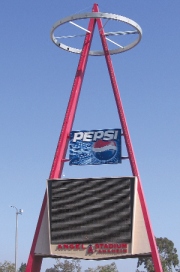
The Los Angeles Angels of Anaheim’s most prominent landmark is getting a makeover and digital upgrade.
The “Big A” alongside the Orange (57) Freeway in the parking lot of Angel Stadium of Anaheim is getting a $1 million facelift, largely in preparation for Major League Baseball’s 2010 All-Star Game next summer in Anaheim.
Last week, workers hoisted by a crane were applying a fresh coat of red paint to the faded 230-foot tall structure.
A full-color high-definition video display board—similar to the one in the parking lot of neighboring Honda Center—is set to be installed in the center of the Big A.
“We’re really excited to be bringing it back to life,” said Tim Mead, spokesman for Angels Baseball LP, operator of the baseball team.
The overhaul is expected to be done by year’s end, according to Mead.
The guts of the Big A are being improved to support the weight of the new video board along with a complete electronic overhaul.
The Big A’s current electronic sign—a one-color display that sends messages from the stadium and its advertisers—shut down earlier this year in preparation for the overhaul.
The current display is visible only to southbound drivers on the freeway. The new board will be visible from both sides of the freeway.
An estimated 95 million vehicles drive the 57 freeway each year, according to the California Department of Transportation.
The new video display will serve as an electronic billboard for advertisers and stadium events. It’s set to be larger than the video board installed in late 2006 at Honda Center, home to hockey’s Anaheim Ducks.
Angels owner Arte Moreno is putting up the team’s money to renovate the Big A.
Moreno, who made a fortune in billboards before buying the team in 2003, has transformed much of Angel Stadium into prime advertising space.
The team hasn’t lined up advertisers yet for the new screen, Mead said. Advertising rates haven’t been announced yet either, he said.
“(The sponsorship department) is now able to move forward with our sponsors on those details with the knowledge that the board will be up and running sooner than later,” Mead said.
History
The Big A has a long history at the stadium since its 1966 opening.
It served as the stadium’s scoreboard until it was moved to its current spot in 1979, when the stadium was enclosed on all sides to accommodate the then-Los Angeles Rams.
The Rams moved to St. Louis in 1994. The stadium was opened up again in 1996, making the freeway visible beyond centerfield, though the Big A stayed in the parking lot.
Angels President Dennis Kuhl and David Cohen, director of legal affairs and risk management, worked out the Big A renovation plans with the city of Anaheim and Caltrans.
“It has been very positive once the decision was made and the process has been very swift,” Mead said.
The Angels and the city are expecting a big boost from the All-Star Game in July.
Two years ago, when the All-Star Game was held in New York, it brought nearly $150 million in business to the city. Even in the midst of the downturn this year, the midseason classic brought an estimated $60 million to St. Louis.
“We’re looking to have a triple-digit number, if possible, given our proximity to the greater Los Angeles area,” said Thomas Morton, convention center, sports and entertainment executive director for Anaheim.
Anaheim has hosted the All-Star game twice before: in 1967 and 1989.
Other parts of the stadium also are being upgraded.
Tube televisions throughout the stadium and concourses are being replaced with high-definition flat screens, according to Mead.
The screens also will display advertising and could be sponsored by particular advertisers.
