

A number of Orange County companies are among the many to stake claims to a trend that appears likely to define technology this year: convergence.
That was clear in the wake of demos by Irvine-based chipmaker Broadcom Corp. and networking equipment maker D-Link Systems Inc. of Fountain Valley and other locals at the recent International Consumer Electronics Show in Las Vegas.
Convergence is the technology that lets users sync their TVs, tablets, cell phones and other gadgets. It’s poised to alter consumer habits in entertainment and across a range of retail segments and elsewhere
D-Link recently launched gear that allows users to access the company’s wireless local-network cameras from smart phones and tablets. The product is aimed at parents, pet owners, small-business owners and others who use network cameras for monitoring or security purposes.
D-Link also unveiled a cloud router, set to retail for about $40, that lets users view systems running on their home computer from remote locations.
“This is what we’ve really been focused on in terms of a cloud initiative for the last several years,” said D-Link associate vice president Dan Kelley. “We want to make it affordable, and that’s part of our strategy.”
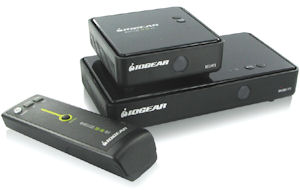
Foothill Ranch-based Iogear introduced a $350 wireless 3D media kit that allows up to five devices-and two simultaneously-to stream HD or 3D content up to 100 feet.
The company’s technology works through standard walls, enabling multi-room viewing, and the USB port can connect a wireless keyboard and/or mouse to control a home theater, PC or laptop.
Full Display
Broadcom is known for making communications chips for Wi-Fi, smart phones, TVs and other devices. The company’s technology was on full display at CES at the company’s private viewing area for customers, partners and media.
Its executives demonstrated Wi-Fi chips in mobile set top boxes, such as AT&T’s U-Verse, that allow users to view content anywhere in their home while eliminating clunky wire installations. Broadcom also is working with auto manufacturers to implement Ethernet over thin, lightweight cables for new applications such as multiple cameras or speakers around a vehicle, networked entertainment and safety features.
“It’s a whole different way to look at wiring and entertainment systems, cameras and other types of applications for your car,” spokesperson Dana Brzozkiewicz said. “In the past, there could be hundreds of miles of cables in your car to do all of this. This is much more efficient way to do it, saving cost and weight.”
Leo Kaplan, a senior product line manager with Broadcom’s mobile and wireless group, said consumers will soon be able to download a movie from a kiosk right to a 5G enabled tablet and play it back through Wi-Fi connected devices, eliminating a trip back to the kiosk.
“The whole concept of the video rental can actually change because of fast-sync technology,” Kaplan said.
Broadcom gave a hard push behind its connectivity technology in smart TVs, tablets, smart phones and other devices during the show in Las Vegas.
“Management spent a significant amount of time verbally defending its dominant position in combo chips and even suggested its market share in 2012 could increase, as competitors continue to struggle with combo chip development,” Craig Berger, an analyst at Arlington, Va.-based FBR Capital Markets Corp., wrote in a note to investors last week after meeting with Broadcom’s top executives at CES.
In one demonstration, a Broadcom executive swiped his smart phone over a Samsung TV with a smart tag that launched a video. He swiped it again and the video was displayed back on the phone and ready to travel.
Near field communication chips, or NFCs, have gained traction in the retail sector and among a few large financial companies offering the technology for transactions.
Broadcom’s latest line of home connectivity chips are billed as doubling network bandwidth, enhancing the quality of video distribution and saving power. The suite of chips is being used by Comcast, Cox Communications, DirecTV, Dish Network, Time Warner Cable and Verizon, among others.
Another set of Broadcom chips turn non-connected digital TVs into smart TVs.
Between Devices
Wi-Fi demand has quickly moved from getting content from a network to devices to sharing content between devices. The evolution of the home-entertainment network is projected to push Wi-Fi enabled video device shipments to 600 million by 2015, according to Scottsdale, Ariz.-based market tracker In-Stat, part of NPD Group Inc.
“We really envision the connected home of the future to have all these standards in it,” Broadcom’s Brzozkiewicz said.
