

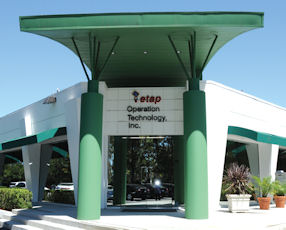
Nearly every nuclear power plant in the U.S. relies on a little-known software company in Irvine to manage its power system and prevent possible cataclysmic failures.
Operation Technology Inc., better known under its brand name, ETAP, has dominated market share in the key energy segment for more than two decades, selling its power analysis software to 60 of the nation’s 64 nuclear power plants.
It took ETAP years to earn its standing.
“The validation we go through is very time-consuming, it’s very rigorous,” said Chief Executive Farrokh Shokooh.
That means initiating thousands of tests and simulating entire life cycles, minor and major disturbances, and frequent yearly audits. It’s not uncommon for independent regulators to scour everything from clean rooms to spreadsheets every few months at ETAP’s 30,000-square-foot headquarters in Irvine.
The quality and assurance process, which has extended development on some products by more than five years, is a big reason defense agencies, national laboratories and security departments in some 20 countries buy ETAP’s software.
“It’s part of our DNA for development now,” said Shervin Shokooh, ETAP’s chief operating officer and senior principal electrical engineer, who also is Farrokh Shokooh’s nephew.
The nuclear power segment makes up a small slice of the company’s 5,000-plus customers, which pay a one-time fee for its software and more for upgrades and maintenance.
Nuclear power plants account for about 5% of the privately held company’s estimated $50 million in annual sales.
ETAP’s software was used in the original design of the electrical system at San Onofre power plant, but it was not the cause of the facility shuttering in early 2012. Southern California Edison announced in June that the facility would close permanently due to structural issues.
Consultancies comprise ETAP’s largest customer base and include some of the biggest companies in the world, including Halliburton Inc., KBR Inc. and Bechtel Corp.
About 70% of its annual sales come are outside the U.S.
ETAP offers more than 50 calculation versions of software for customers in the oil and gas, education, industrial, and distribution sectors, among others.
Its real-time software—which is based on predictive modeling to minimize outage risks, short circuits, or electrical accidents triggered by design flaws—automatically takes corrective action if problems arise.
The product line targets operations with limited power supply or those with a greater chance of power loss, such as mining plants, loading vessels and cogeneration plants, as well as oil and gas exploration and analysis.
ETAP competes against different companies in different verticals.
Redondo Beach-based SKM Systems Analysis Inc. specializes in the industrial segment; Synergy Software Systems and PowerWorld Corp. in distribution; and General Electric and Siemens AG compete against the company’s real-time products, even though Siemens uses ETAP’s software in other applications.
ETAP employs about 400 globally in offices in Houston, the United Arab Emirates, the Netherlands and other international locations, and plans to open locations in Mexico and Europe this year, according to Farrokh Shokooh.
It has about 110 employees in Irvine, which would place the company among OC’s 20 largest software companies in terms of local employees.
Its Irvine office building houses all product development, corporate personnel, and its newly built power grid system, which not only showcases its core product at work but manages energy use at its headquarters and at University of California, Irvine, which launched a project last year with the company to manage its power use.
“As far as I know, we are the only software company with a system like this,” said Principal Electrical Engineer Tanuj Khanelwal, “so we can get hands-on experience of the challenges faced by the customer and to verify and validate the tools.”
That knowledge could improve energy efficiency on a larger scale for other areas that want their own power grids.
The company spent about $1 million to design, build and meter the micro-grid system and link it to its analysis software, which measures the power input and output on everything within the grid’s boundaries, from solar panel installations in ETAP’s parking lot to UC Irvine’s humanities building and student union.
The newer segment for ETAP is pinned for big growth.
London-based market researcher Technavio forecasts a 17% annual growth rate in the micro-grid segment to more than $5 billion through 2022.
Sales in the campus/institutional micro-grid segment during the same period are expected to see the biggest jump —nearly 19%.
“Smart grid and micro-grid has been the front-tier development for us right now,” said Farrokh Shokooh, who established the company in 1986 after leading power system software evaluation at Fluor Corp., which was formerly headquartered in Aliso Viejo.
ETAP’s first office was on Dupont Street less than 10 miles from its current headquarters. Its first products, developed by Farrokh Shokooh while he attended Louisiana State University in the 1970s, simulated electrical power systems and analyzed short circuits, cable sizing, load flow and transient stability, among other factors.
His early work proved good training for ETAP’s core product offering, which company executives say is put through the ringer before release, even after it’s validated testing.
“We do not release anything before its time,” Farrokh Shokooh said. “Like a good wine.”
