

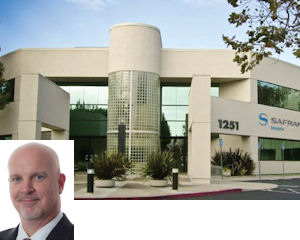
The U.S. unit of a French conglomerate has opened a new research and development center in Santa Ana, where the company will work on explosives- and narcotics-detection systems technologies it hopes will help speed up airport security lines.
Anyone who has checked baggage at an airport has used one of Morpho Detection Inc.’s machines, according to company spokesperson Scott Factor.
“What we’re doing in Santa Ana now—we’re bringing the kind of efficiencies that we brought to checked-baggage lines to passenger-screening checkpoints,” Factor said.
Morpho Detection, which is headquartered in Newark, Calif., has 800 employees companywide, with about 500 in the U.S. It is part of Paris-based Morpho, the security arm of French conglomerate Safran SA.
The company’s research and development center in Santa Ana has 30 employees, with plans for new hires.
It’s a good place to recruit from because of the high-tech industry here and the area’s convenient transportation links, said Chief Technology Officer Cameron Ritchie.
Morpho Detection first entered Orange County in July 2011, when it acquired Tustin-based Syagen Technology Inc. and renamed it the Mass Spectrometry Center of Excellence.
The Tustin subsidiary and the company’s Quantum Magnetics Center of Excellence, formerly in San Diego, have been moved to the Santa Ana center at 1251 E. Dyer Road.
“This facility will serve as a hub for innovation,” Chief Executive Brad Buswell said in a statement. “As a result, future passenger checkpoint, military and critical infrastructure explosives-detection solutions will be developed in Orange County.”
Currently in the works in Santa Ana are shoe-scanning device prototypes.
Morpho Detection earlier this year received two research contracts from the Department of Homeland Security. The agreements call for prototypes of the shoe-scanning device, and have a combined value of about $1.4 million.
“The development of the prototypes will end in a month or so, and we’ll send [them] off to Transportation Security Administration in New Jersey, and they’ll test them and compare the two,” Ritchie said. “As far as when you’ll see it in the airport, it all depends on how well the testing goes and if the government decides to integrate it.”
Morpho Detection’s Paris-based parent operates the detection, identification and e-documents divisions, and recently had annual revenue of about $1.8 billion. It employs more than 7,200 workers across 40 countries. It spends more than 8% of its sales on research and development efforts, according to the company.
Airports are just one of the several markets that use the detection systems made by Morpho Detection. Others include government agencies, military, ports and borders, sporting venues and other high-security organizations throughout the U.S. and abroad.
Morpho Detection supports OC-based organizations and education programs, including Orange Country Professional Firefighters Association and chemistry seminars at University of California, Irvine, according to the company.
