

A startup in the crowded field of no-contract wireless carriers has been drawn to Orange County by the vibrant base of telecom talent and industry service providers here.
Ultra Mobile is targeting urban centers with large immigrant populations with its wireless service plans that include international minutes as part of a basic package.
“There’s 40 to 60 million people who live in the U.S. who weren’t born here,” said cofounder Chris Furlong, who runs product development and marketing. “That’s a lot of people who have loved ones abroad, family, friends and business connections they need to keep in touch with.”
Targeting immigrant populations in big cities is nothing new for prepaid carriers, but offering international calling as a standard service might be a first.
Calling Cards
Customers typically buy a calling card for such access and have to dial another phone number before calling someone. Most of the cards have hidden fees, expiration dates, and charge as much $1.50 per minute, according to Furlong.
“It’s an inconvenient experience, and it didn’t make sense to use,” said Furlong, who launched the company with four partners last October.
Ultra Mobile plans, which cost between $19 and $59 per month depending on minutes and data, include 4G, voice mail, unlimited global texts and up to $20 worth of international calling credits.
The time allotted for the credits varies dramatically from one country to the next, as wireless infrastructure, tax surcharges, competition, nation stability and political leanings affect rates.
The $20 credit gives users calling Mexico, Canada and China about 2,000 minutes per month.
Calling residents in Cuba costs about 72 cents per minute, the highest of any country.
Rates in countries with emerging technology are dictated less by the cost to carry services and more by the level of competition. South Asia is generally less expensive to call, with India priced at 1 cent per minute and Bangladesh at 2.5 cents.
The Persian Gulf, which includes Saudi Arabia, Kuwait and United Arab Emirates, is slightly more costly, at 10 cents to 20 cents per minute. In Ethopia and Somalia, where civil unrest is constant and infrastructure is lacking, it’s much more expensive.
Ultra Mobile won’t release subscription or employee figures, but Furlong said the company has sold more than 750,000 subscriber identification module, or SIM cards, which are needed to activate service and can be transferred between mobile devices.
Ultra Mobile would generate more than $85 million in revenue in its first year of business if half of those SIM card buyers stay with the company for 12 months on the $19 plan.
“We have very good cash flow coming in,” said Furlong, who is based in the company’s Brooklyn, N.Y., office.
The company recently expanded from TechSpace on Bristol Street in Costa Mesa—the company provides some shared services for startups—to a 12,000-square-foot office of its own on nearby Red Hill Avenue.
Ultra Mobile has largely been self-funded, although it did secure a “small round” of private equity earlier this year.
Cofounder David Glickman is a former chief executive of Los Angeles-based TelePacific Communications, which has raised $225 million from investors and grown annual sales to some $500 million since it started in 1998.
Ultra Mobile President David Schofield, a resident of Huntington Beach, cofounded Brooklyn-based Hometown Telecom, which provides international long-distance services to India. Hometown Telecom spun off Ultra Mobile.
Little Saigon
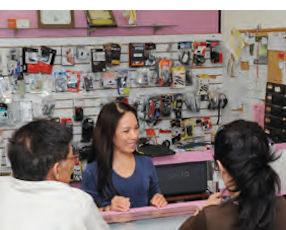
Holly Hoang has been selling Ultra Mobile services in her Pager Cell Services store on Beach Boulevard in OC’s Little Saigon district for more than six months.
More than half her customers are Vietnamese-American and seem to like the calling plan, which includes about 76 minutes of talk time to Vietnam per month, she said.
“If they have any problems, customer service is there to help them,” said Hoang, who opened the Westminster store in 1996 to serve an area that includes significant numbers of immigrants from the Philippines and Mexico.
Her store focuses on prepaid wireless services and sells plenty of competitor offerings from Telcel, H20 Wireless, Net10 Wireless and Airvoice Wireless, among others.
“They like to have the freedom of using the SIM card,” Hoang said. “They travel all over the country, and it’s easy to use.”
Ultra Mobile operates in one of the most competitive telecom segments.
No-contract customers are free to leave carriers and choose other providers at any point without penalty.
The largest no-contract service provider based here is Boost Mobile, one of three Sprint-owned, no-contract, prepaid carriers.
The company, which employs about 140 in Irvine and has 3,000 branded retail stores across the county, targets lower-income consumers, typically in urban markets, with unlimited texting and stable monthly rates. Boost Mobile declined to comment on Ultra Mobile’s entrance in the market.
Ultra Mobile chose Orange County because of its history as a telecom hub that has groomed engineering talent and spawned a bevy of subcontractors in the printing, advertising and information technology sectors that cater to the industry.
“There’s a great network of subcontractors that support us,” Furlong said.
The country’s largest wireless carriers—Verizon Communications Inc., AT&T Inc., Sprint Nextel Corp. and T-Mobile USA Inc.—employ thousands of people in Orange County and have invested hundreds of millions of dollars into the communications infrastructure here in the race to 4G supremacy.
Ultra Mobile is known as a mobile virtual network operator, since it pays T-Mobile to use the larger company’s airwaves.
But it has already lured talent away from larger telecoms, according to Furlong.
