

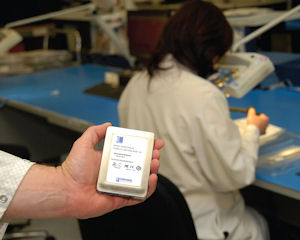
Another Orange County maker of computer memory products has been quietly stepping up its game.
Foothill Ranch-based Viking Modular Solutions Inc., part of San Jose’s Sanmina-SCI Corp., is making a diversification push.
It’s also developed a more, well, Viking spirit in the past year or so.
“My philosophy is you either need to be No. 1 in your field or the best No. 2,” President Hamid Shokrgozar said. “If you’re No. 3 or No. 4, just pack it up, because you aren’t going to survive. There are too many players and only the best will win in this market.”
Shokrgozar was brought in to run Viking in mid-2009 after years of cooling growth. The company makes high-end memory boards and flash memory-based drives that go into corporate storage networks, networking and telecommunications gear and gambling machines.
He’s recently pushed the company to gain customers in defense, aerospace and high-end data storage.
“Diversification is the key,” Shokrgozar said. “In this market, you cannot just survive by selling into one market. You need to be able to focus on selected big players and you need to be the best.”
Viking’s sales more than doubled from 2009 to 2010. It’s on track to see sales grow another 20% this year, Shokrgozar said.
The Business Journal estimates Viking sees about $150 million in yearly sales.
It competes against Santa Ana’s STEC Inc., Northern California’s Smart Modular Technologies Inc., Irvine’s Netlist Inc. and others.
Viking doesn’t now compete with Fountain Valley’s Kingston Technology Co., the top maker of memory products for computers, digital cameras and cell phones.
“Kingston is a behemoth, but their customer base is not our customer base,” Shokrgozar said. “They are selling to consumers ultimately.”
Kingston claims nearly half the market for memory boards that go into computers. It also makes flash memory for consumer electronics and computers, and niche solid state drives for consumers.
Products
Viking, which has 200 local workers and does manufacturing here, keeps a low profile.
The average person never sees its products.
Viking designs and makes memory modules—circuit boards loaded with memory chips.
The company buys chips from big suppliers in Asia, Europe and North America, including Toshiba Corp., Samsung Group, Hynix Semiconductor Inc. and Micron Technology Inc.
Viking’s modules get built into products by Cisco Systems Inc., Juniper Networks Inc., NetApp Inc. and others.
The company also makes high density, stacking memory modules for use in storage networking and high-performance computing.
Viking last year started making solid state drives, which are made up of flash memory chips and have no moving parts.
Solid state drives are seen replacing traditional spinning disk drives in places where the higher cost is justified by reliability, power and time savings.
The move put Viking in direct competition Santa Ana’s STEC.
Publicly traded STEC, which had a recent market value of about $1 billion, has enjoyed an early lead for solid state drives with big customer wins from EMC Corp. and others.
Viking is close on its heels, according to Shokrgozar.
The company is a few months into the qualification process with EMC and other potential customers, he said.
“Obviously, (STEC) had the lead and they’ve been in that market for a longer time,” Shokrgozar said. “I can say that that we are engaged with every manufacturer out there. We are three to four months into the qualification stage with seven partners. It’s been going very well.” At one point, Viking was among the area’s top three memory products makers, with some $300 million in sales.
Sanmina-SCI, a contract electronics manufacturer with some $6.5 billion in yearly sales, nabbed Viking in a fire sale amid a memory slump in 2001. It paid about $15 million in cash and stock for Viking.
After the acquisition, Viking retrenched and exited the commodity memory business, which Kingston dominates.
The company moved from its longtime Rancho Santa Margarita headquarters, where it went by Viking Interworks Inc., to Foothill Ranch a few years ago.
Sanmina-SCI has sprawling operations across the globe, with about 47,000 workers and nearly two dozen separate divisions.
Viking operates as a subsidiary of Sanmina and is fairly independent, Shokrgozar said.
He reports to Hari Pillai, Sanmina’s president and chief operating officer.
Viking has its own management team, finance people, operations managers and a direct sales force. It also has some engineers in India and a small office in Singapore.
On the product side, Viking does everything on its own—from design and development to production, testing and inspection.
It operates out of some 75,000 square feet of space.
The company can keep manufacturing here because its products are more expensive and specialized.
“Supporting higher-end applications and higher-end markets, our margins are somewhat better than the commodity players,” Shokrgozar said.
Exec Background
Shokrgozar, 50, replaced Ralph Kaplan as Viking’s top local executive a few years ago. Kaplan stayed on as an executive vice president.
Shokrgozar previously spent nearly two decades at Phoenix-based White Electronics Corp., which designs, assembles and tests anti-tampering chips used by the military.
Irvine-based chipmaker Microsemi Corp. bought White Electronic last year for $100 million. Shokrgozar stepped down from his post as chief executive in 2008, after the company’s board decided to pursue a buyer.
He first got acquainted with Viking when White Electronics looked to buy the unit from Sanmina-SCI in 2005. The deal fell apart when the companies couldn’t agree on a price, he said.
A native of Iran, Shokrgozar went to high school in France and moved to the U.S. in the late 1970s. He has bachelor’s and master’s degrees in engineering from California State University, Fullerton.
He lives in Anaheim Hills with his wife and three sons.
