

CTC Global Inc. is making a comeback after several years of missteps that included a fizzled stint as a public company, an ill-timed wind farm acquisition and two bankruptcies.
The Irvine-based company last week formed a partnership with the world’s largest utility to develop a key component in power generation for the Chinese market, where it has had the most success.
The deal with China-based State Grid Corp. marks the first time CTC will produce conductor core—the tightly wound carbon and glass fiber backbone of electricity lines—outside of Orange County.
The Chinese utility was attracted to CTC’s technology as it aims to strengthen the country’s large and growing electricity network, according to company executives.
State Grid controls nearly 75% of China’s power lines.
“Our product improves efficiency, reliability and capacity of the grid,” said Dave Bryant, CTC’s director of technology. “That’s why China is so keen on the technology.”
The nation of roughly 1.3 billion has launched several initiatives in recent years aimed at easing the country’s taxed energy grid, which supports its large base of global manufacturers.
CTC has a 49% stake in the newly formed entity Jiangsu NARI CTC Composite Material Co., based in Eastern China, and will manage production, equipment and supply chain, according to Bryant.
The core will be sold exclusively to Chinese customers, expanding a potentially lucrative market for CTC, which has done more than 260 projects in dozens of countries. It recently finished a project for the city of Riverside.
Other customers include Las Vegas-based utility NV Energy Inc. and American Electric Power in Columbus, Ohio. More than 100 of its projects were in China.
The quasi-governmental State Grid posted revenue of $300 billion last year and controls the world’s largest power grid. It expects to begin production on the conductor core this year.
“This is just another step forward in our evolution,” Bryant said.
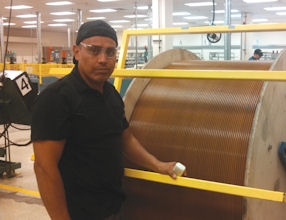
CTC’s proprietary conductor core, commercialized in 2005, is made in its 110,000-square-foot headquarters near John Wayne Airport. The property also houses corporate personnel, research and development, a machine shop, quality control, distribution, packaging and several labs.
It typically sells and ships the lightweight, high-strength composite core—made of the same materials used in compressed natural gas storage tanks and Boeing’s new Dreamliner aircraft—to “stranding partners,” primarily manufacturers or utility customers, who wrap the core with aluminum strands to produce the finished conductor.
The product is billed as increasing energy capacity two-fold; reducing corrosion and line power loss compared to conventional cables; and eliminating the sag caused by the high-load, high-temperature reaction of electric currents, a phenomenon that fueled the cascading power outages on the East Coast and in the Midwest a decade ago.
CTC expects to post sales of $50 million this year, up from about $38 million in 2012, as demand surges in overseas markets to stabilize or replace existing power lines with its product. The conductor core’s easy, quick and less-expensive installation compared to prevalent technologies make it particularly attractive.
“We’re gaining momentum,” Bryant said.
The China deal and growing business will bring more hiring, according to Chief Executive Jason Huang, who implemented a strategy for “rapid growth” by targeting emerging economies in China, India, Russia, Brazil and South Africa when he took the top post nearly two years ago.
Growth, Changes
CTC hit profitability for the first time in 2012 and has grown employment to about 100 today.
It’s a new company with new owners and management and better market traction, according to Huang.
“This company has viability and stability, which it never had before,” he said.
That’s a marked turnaround from two years ago, when the company emerged from bankruptcy protection after private investors acquired its cabling technology and related assets for about $15 million, according to filings with the Securities and Exchange Commission.
Its convoluted history in Orange County has been littered with setbacks, heavy debt and misaligned efforts in the power industry.
The company started out as Composite Technology Corp. in the early 2000s.
Its shares were traded on the Over the Counter market and spiked after the East Coast blackout in 2003, but litigation and mounting debt forced management to put the company into bankruptcy protection in May 2005.
It emerged from Chapter 11 six months later after transferring some 6.5 million shares to settle claims.
In June 2006, the company acquired U.K.-based EU Energy PLC and its line of DeWind turbines for $60.7 million.
The plan centered on bringing the German-engineered wind farm technology to the U.S. The company even signed a deal with TECO Westinghouse Motor Co. to establish generator manufacturing factories in Round Rock, Texas, armed with a $50 million investment from Credit Suisse.
But the global financial crisis took hold, and “banks stopped loaning money to wind farm developers,” Bryant said.
High overhead costs and cash flow shortages prompted the company in August 2009 to sell DeWind Inc. and its subsidiaries at a loss to South Korea-based Daewoo Shipbuilding & Marine Engineering Co., which acquired assets and liabilities for $46.5 million.
The recession, coupled with the time and resources spent building out the wind farm unit, ultimately fettered its core conductor business.
The company had assets of $19.3 million and liabilities of $52.8 million by the end of 2010, according to regulatory filings. It posted a net loss of nearly $20 million in the 12 months through September 2010, the end of its fiscal year.
Its share price fell to a record low of 4 cents when it filed for bankruptcy protection in April 2011.
Within four months, the management team and board were replaced, its common stock on the OTC Bulletin Board was delisted, and it emerged from Chapter 11 bankruptcy proceedings with a new ownership group.
The company sold its cable division to private investors to settle debt and was renamed CTC Global in January 2012.
