

Irvine’s Solarflare Communications Inc., one of the area’s best-funded chip startups, is carving out a niche selling its speedy data networking circuit boards directly to finance-related companies.
It’s a marked shift from the company’s initial strategy, which was to sell chips to server manufacturers themselves.
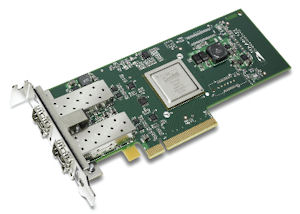
Instead, Solarflare now is selling its chips—loaded onto circuit board cards that go into data center servers—directly to banks, hedge fund operators, stock exchanges, brokerages and other financial institutions.
“Something we didn’t expect happened,” Chief Executive Russell Stern said. “These end users didn’t want the (server) manufacturers to supply them, they wanted to do it themselves. They feel that they understand the technology well enough.”
Solarflare makes chips that allow faster networks to link with slower ones, helping companies save on power and replacement costs.

Its chip design uses less power and boosts performance by canceling out interference from other signals. It also cuts down the number of circuits, allowing signals to be received and transmitted from just one pair of wires—following a recent trend dubbed “converged networking.”
Some of Solarflare’s customers include Britain’s Barclays PLC, Canada’s Active Insurance & Financial Management Ltd. and others.
The old adage “time is money” definitely keeps such institutions on the hunt for faster data transmission.
“Our technology is very important for high-frequency trading machines,” Stern said. “We can quadruple their message performance. That means dollars to our customers.”
Solarflare’s chips help companies send data faster than their competitors can.
“It becomes sort of an arms race,” said Bruce Tolley, Solarflare’s vice president of marketing. “They are competing with each other to find a faster mechanism of getting trade orders in.”
Demand from financial institutions is one of the reasons why Solarflare got into the board-making business early this year.
The company contracted with a company in Thailand to manufacture the boards, which use Solarflare’s designs and chips. The Thai company also tests and ships the boards, via distributors, to Solarflare’s customers.
The other reason for the strategy shift: boards net better profits than chips alone.
“We get higher profits and higher revenue,” Stern said. “We have been having wonderful success with this new strategy. We are on top of ourselves trying to make and deliver more boards.”
One factor driving demand is that several companies have come out with switches that allow Solarflare’s chips to work with slower 8 gigabit systems—expanding its potential customer base to those who aren’t ready to upgrade systems yet.
The market for 10 gigabit Ethernet is expected to double this year and then double again next year, according to industry watchers.
“We have been waiting for this 10 gigabit market to happen,” Tolley said. “With a number of new switch platforms that are lower in cost, all of these financial institutions are looking to upgrade.”
Solarflare is also looking at fibre channel over Ethernet technology as a potential for new business by making Ethernet-networking chips. The technology promises to bridge everyday Ethernet networks with heftier data storage networks.
Solarflare expects to see around $10 million in sales this year and turn a profit next year. It could look to raise another venture round to add to its cash coffers.
The company, which has raised nearly $200 million in venture funding to date, has been eyeing a public offering for a few years now.
“It’s certainly still in the cards,” Stern said. “The opening of the IPO market and our growth trajectory is promising. With a little wind at our back, we could do it maybe toward the end of next year.”
Solarflare’s investors included Westport, Conn.-based Oak Investment Partners, Britain’s Acacia Capital Partners, Santa Monica-based Anthem Venture Partners, Corona del Mar’s Miramar Venture Partners and Intel Corp.’s venture arm, among others.
