

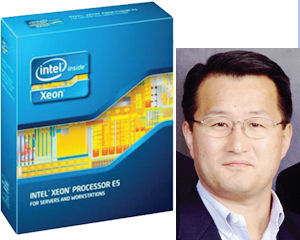
Several Orange County technology companies stand to benefit from a new line of chips recently debuted by Santa Clara-based Intel Corp.
The world’s largest chipmaker is targeting data centers with cloud services, memory-product makers and others with a new line dubbed the Romley platform that’s touted to boost performance while lowering operating costs.
“Romley is a huge event for the server and computing industry,” said C.K. Hong, chief executive of Netlist Inc. in Aliso Viejo, which released two products in conjunction with the Intel launch.
Netlist makes memory boards with specialized controller chips to manage server memory. Both of its new products are designed to handle traffic and storage needs in high-volume servers amid rising demand fueled by the proliferation of video and data streaming.
Intel forecasts the number of worldwide cloud servers to more than triple by 2015.
HyperCloud
Netlist’s HyperCloud product, which handles large memory capacity, is billed as improving performance by 25% compared to the industry standard. Hong likened the product to expanding a highway from two to four lanes and said it allows data to flow back and forth quickly.
The company’s Planar-X memory module adds memory to servers while reducing power consumption and cooling costs.
Both products have been adopted in servers from New York-based IBM Corp., which helped Netlist during years of development.
Netlist also is working on a data-restoration product with Intel targeting storage systems that’s expected to debut this year. The product aims to recapture server data after power outages.
“As server speeds get faster and faster, our technology becomes more valuable,” Hong said.
The product push and Romley launch come amid an ongoing shift in the industry, as computing moves from server rooms at companies to the cloud and data centers requiring much more memory and better performance.
Global data center IP traffic is forecasted to grow 33% annually through 2015, when some 3 billion users and 15 billion devices are expected to be connected to the spectrum.
At that rate users will generate more than 4 gigabits of traffic every day–the equivalent of a four hour HD movie−increasing the amount of data that needs to be stored annually by nearly a 50% clip, according to Framingham, Mass.-based market researcher International Data Corp.
The new Intel chips unclog the bottleneck between computers and memory in servers, allowing data to move more efficiently.
Irvine-based Solarflare Communications Inc. is another local company getting a lift from the Romley launch. Intel chose Solarflare as its exclusive launch partner in London because its technology “shows off the product better,” Solarflare Chief Executive Russell Stern said.
Solarflare makes networking equipment that speeds up data transfer and improves performance. The company has carved out a niche in the last few years selling its speedy data networking circuit boards directly to banks, hedge fund managers, stock exchanges, brokerages and other financial services companies.
Stern said the Intel chip set combines with Solarflare’s latest product lines to improve message reliability rates and speeds delivery, which are key in handling the influx of trading data on public exchanges and other financial systems.
“You have a lot of customers out there waiting for this Romley refresh,” Stern said. “We will benefit from them shipping that new platform out.”
The company expects to see a jump in sales beginning in the second quarter from the Intel launch, he said (see related story, page 7).
Local-storage equipment makers QLogic Corp. in Aliso Viejo and Costa Mesa-based Emulex Corp. also should benefit. The new Intel processors should boost adoption of 10-gigabit Ethernet connectivity in data center racks and towers, gradually replacing 1-gigabit connections.
“I think the acceleration is about to happen,” QLogic spokesperson Chris Humphrey said.
High costs and infrastructure complexity has stymied a greater shift to 10-gigabit convergence, but data center, virtual, and cloud servers running on the new Intel chips should make it the standard over time.
“This means more input-output flying across the network,” Humphrey said. “That’s good for us.”
QLogic and Emulex make electronics such as switches and adapter cards that speed up the flow of data on corporate storage networks.
Aliso Viejo-based Quest Software Inc. also can expect to see a boost from the Intel chips, according to Brian Freed, an analyst with Memphis-based Wunderlich Securities Inc.
Its software suite that helps operating systems migrate to Redmond, Wash.-based Microsoft Corp.’s soon-to-be-released Windows 8 “should drive a significant uptake for Quest in the second half of 2012” and position the company as a potential target for strategic buyers such as Microsoft and Redwood Shores-based Oracle Corp., Freed wrote in an investors note.
Quest is pegged to go private in a $2 billion sale to New York-based private equity firm Insight Venture Partners.
The Insight Venture purchase, announced on March 9, could be revoked if other interested bidders enter the fray by May 7 (see story, page 1).
Kingston
Elsewhere, Fountain Valley-based King-ston Technology Co.—top maker of memory products for computers and consumer electronics—envisions opportunities fur- ther down the road in its server memory business.
“Memory is just one component of this new technology, and it could be some time before there is adequate adoption in companies and organizations in order for Kingston to benefit,” spokesperson David Leong said.
