

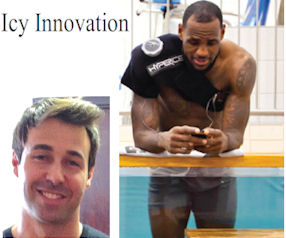
A few years ago, Anthony Katz was preparing lectures on the industrial revolution and Civil War.
Now he’s rubbing shoulders with some of the top athletes in the world.
The reason: his startup’s modern-day spin on icing achy joints and muscles.
“I wanted to come up with a portable ice compression device,” said Katz, founder of Anaheim-based Hyperice Inc.
So the former history teacher at Laguna Beach High School quit his day job and set out to make one, despite his lack of experience.
The avid surfer started buying large $50 sheets of neoprene, a common material in wet suits, and basically embarked on a “total arts project.”
He spent weeks using an X-acto knife to cut 6-by-4-foot neoprene sheets into smaller shapes and sizes for the knee, shoulder and back.
Then he set out to find a company that could design an air-release valve to compress ice against the body, creating an “ice cast” around the body part.
33%
A friend introduced him to engineers at Marton Precision Manufacturing, a Fullerton machine shop that has supplied components for Gulfstream’s corporate jets and the Mars Curiosity rover.
They could handle the job, but it would cost Katz a third of the company.
“It was still crude, but we needed to know if the concept would work,” said Katz, who grew up in Laguna Niguel watching Oakley founder Jim Jannard tinker in his garage with what would become the company’s first bike grips and sunglasses.
Katz reluctantly agreed to a deal that gave Marton a 33% stake. Katz held on to a third of the company, with the rest of the equity earmarked for investors.
Hyperice had its first prototype available in late 2010, about a year after beginning development.
Katz made a list of 50 professional athletes and “influencers” he wanted to test the product. One of the first to try it was Kobe Bryant, whose trainer went to school with Katz.
Bryant provided some feedback, and Hyperice tweaked the product.
Katz caught his first big break in January 2011 after a friend got the icing device into the hands of Pittsburgh Steelers safety and former University of Southern California star Troy Polamalu.
Torrance-based Arenda Capital Management LLC, which represents Polamalu’s financial interests, called for a meeting.
Polamalu and his partners became minority investors, taking a 15% stake for some $500,000.
Hyperice had yet to rack up a sale.
But the deal with Polamalu helped Katz get the product to other A-list athletes, including the Miami Heat’s Lebron James, Los Angeles Clippers star Chris Paul and Carmelo Anthony of the New York Knicks.
“The Boss”
Katz received a text message from James’ representatives in August 2011 that read: “The boss wants to meet you” at the Peninsula Hotel in Beverly Hills.
He arrived at the poolside meeting and greeted James, who was seated at the head of the deck, accompanied by his manager Maverick Carter, agent Rich Paul and Lynn Merritt, Nike Inc.’s top global basketball marketing executive.
James had been using Hyperice through the summer following the Heat’s upset loss to the Dallas Mavericks in the finals.
He told Katz that other players were using the product and invited him to his October charity game in Miami, an event that attracts about 20 of the top players in the game.
Memphis Grizzlies forward Rudy Gay was among them. He was using the product for his knees but wanted one for his shoulder during rehabilitation.
Katz met Gay in Los Angeles a few days later.
“I really felt that it helped me,” Gay said. “As an athlete, when you see an invention like this you immediately understand it because icing is something we do every day.”
Gay put about $100,000 into the company, and Hyperice had its second professional athlete investor.
“I wanted to be involved in the growth of the brand and not just someone paid to endorse something,” said Gay, who was traded to the Toronto Raptors in January.
Gay said he used multiple Hyperice sets at the Raptors home training facility and on road trips in the recently ended season to speed up recovery.
“We don’t have our trainers with us all the time during the off-season, but it’s so easy to use that you can just do it yourself,” he said.
Blake Griffin
It wasn’t long before other stars, including the Clippers’ Blake Griffin, were calling Katz for more than icing tips.
“We moved quickly on a deal to make Griffin the face of the company,” Katz said.
That deal, announced in July 2012, essentially gave Griffin equity in the company in exchange for sponsorship. The company chose Griffin because of his rising star power and local connection.
Hyperice recently inked a similar deal with Minnesota Vikings running back Adrian Peterson, who was introduced to the product by Griffin, a fellow Oklahoma Sooner. Peterson used the product to rehab from an ACL and MCL tear in his left knee in the off-season a year ago.
New York Knicks broadcaster Spero Dedes also is an investor.
The exposure has helped Hyperice carve out a growing niche in a segment that hasn’t changed much since the days of Cy Young and Red Grange.
The company is shipping about 1,500 Hyperice products a month from its 2,000-square-foot Anaheim headquarters, where it also runs production and assembly.
The products cost about $100 each.
Hyperice employs about 10 people, including the Marton engineer who helped design the air pressure release valve.
The company is eyeing a move to Irvine and looking for manufacturers in Asia to scale the business.
It has secured about half of its $1 million fundraising campaign that’s set to close in June. Jets quarterback and Mission Viejo native Mark Sanchez is among the investors.
Hyperice has also inked deals with athletic departments at USC and University of Oregon. Distribution through national and local retailers is slated to begin in July.
Its products were used by more than 50 U.S. athletes in the 2012 summer Olympics, including women’s soccer goalie Hope Solo, who underwent major shoulder surgery in late 2010.
“One of the USA Soccer staff gave me a Hyperice to try for my shoulder, and I really liked it,” said Solo, who also has a minority stake in the company. “It was so easy to use and just worked so much better than wrapping plastic ice bags around your body. It just became part of my routine and still is today.”
