

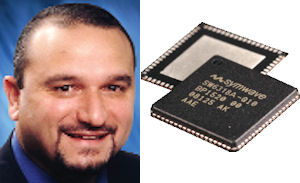
Laguna Niguel-based Symwave Inc., a maker of chips started by Broadcom Corp. alums, could be nearing the end of its days as a startup.
The company, which got off the ground in 2008, expects to sell itself in coming months.
“My expectation is that we will be selling the company by the end of the year,” said Chief Executive Yossi Cohen, who joined Symwave from Irvine-based Broadcom. “That’s based on the fact that we have been a lot more successful on the revenue side than people had expected.”
Symwave makes chips for the next generation of universal serial bus ports, the most popular way of connecting consumer electronics to a PC.
The latest version of the ports, USB 3.0, transfers data about 10 times faster than previous versions.
Symwave’s chips, which went into full production late last year, are geared toward portable external disk drives.
The company has made quick work of its technology, snagging roughly 80% of the market for USB 3.0 chips for devices that link to PCs, according to Cohen.
Its biggest customer is Lake Forest-based disk drive maker Western Digital Corp., which has a sizeable lineup of external storage drives that it markets to consumers as a way to store photos, music and other files.
Other customers include Western Digital’s top rival, Scotts Valley-based Seagate Technology LLC, France’s LaCie Group SA and Hitachi Global Storage Technologies Ltd., a unit of Japan’s Hitachi Ltd.
Symwave expects to close out the third quarter with $5 million in revenue and projects fourth-quarter revenue of $10 million.
The biggest reason Symwave is looking for a buyer: a lack of financing to expand, according to Cohen.
The company needs to grow quickly to produce enough chips to meet demand, he said.
“This steep ramp of going from $200,000 to $5 million (in sales) is extremely exciting but also very challenging from a financing perspective,” Cohen said. “We are trying to figure out what is the right thing to do—bringing in additional financing or perusing opportunities for mergers. Going out there and getting $10 million is harder to do.”
Symwave is backed by a handful of investors, including venture capital firms Kodiak Venture Partners and CMEA Ventures.
The Business Journal estimates the company has raised around $25 million in funding.
Investor
Last year, Hauppauge, N.Y.-based Standard Microsystems Corp. took a stake in Symwave with a $4 million investment.
The investment came with an option for Standard Microsystems to acquire Symwave if certain conditions are met.
Standard Microsystems isn’t necessarily going to pull the trigger, according to Cohen.
There are other suitors in the running, he said, declining to name names.
Symwave, which was started in 2001, is in some ways a spinoff of a spinoff.
Its founders, a handful of engineers and executives, hail from Newport Beach-based Conexant Systems Inc., which spun off from Rockwell International Corp. in 1999.
The company floundered for awhile with a technology that was being phased out in favor of USB.
Cohen left an executive post at Broadcom in 2008 and took a critical eye to Symwave’s chip lineup.
He also moved the company from San Diego to Orange County and opened a large development center in China.
Before Cohen came onboard, Symwave’s primary business was designing chips for FireWire, a port for linking camcorders and other devices to a computer for quickly transferring data.
Cohen decided to stop investing in FireWire and look for growth in USB 3.0.
Market
A potential Symwave buyout coincides with USB 3.0 hitting the mass market.
The transition from USB 2.0 to USB 3.0 is expected to happen by the end of the year, with many big tech product makers onboard.
“All of the leading storage guys have adopted USB 3.0 and many are completely revamping their portfolios,” Cohen said. “You will see a big transition from USB 2.0 to USB 3.0 being the dominant display on retail shelves during the fourth quarter.”
Symwave’s chips are “backward compatible,” meaning they still can work and deliver some speed benefits for devices with USB 2.0.
“On the external storage side, the adoption has been pretty much spot on in what we envisioned 2.5 years ago,” Cohen said. n
