

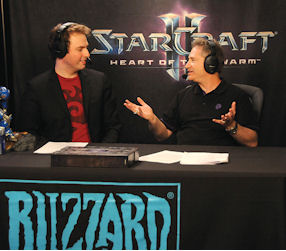
The credits for Blizzard Entertainment Inc.’s newest video game roll 200 deep and cover dozens of jobs, from writers, lighting directors and sketch artists to composers and voice actors.
The production behind StarCraft II: Hearts of the Swarm rivals the work of Hollywood studios—and so does Blizzard’s 14-acre, iron-gated campus in the Irvine spectrum.
The nature of the production process is akin to another segment of the movie business. Pixar Animation Studios’ Technical Director Andrew Payton once called Blizzard and his Bay Area animation studio “mirror images.”
That was a nod to Blizzard’s painstaking attention to detail, from the exact placement of a pebble on a ledge to StarCraft protagonist Jim Raynor’s tattooed and bulging biceps.
No wonder Blizzard, OC’s largest software maker, with $1.6 billion in sales last year, took nearly three years to release Heart of the Swarm, the first expansion set for StarCraft II: Wings of Liberty, which sold a record 1.5 million copies in its first 48 hours of release in July 2010.
The title has sold more than 6 million copies to date.
A recent visit to Blizzard’s sprawling campus shed some light on the guarded creative process and expansive roster of highly skilled talent behind one of its most successful franchises.
Production
“Production here at Blizzard works differently than it does at some other gaming companies,” says Chris Sigaty, production director for what Blizzard insiders dub Team 1, essentially the engineering crew behind StarCraft II.
His 80-member team—one of five Blizzard development units scattered across the U.S., Europe and Asia—is comprised of designers, producers, programmers and various artists.
“The heart and soul of the game starts there, and then we have a lot of teams that really finalize it all,” says Sigaty, who considers himself the “chief facilitator” in keeping the teams on track.
Blizzard’s iterative culture makes chronicling Heart of the Swarm’s development as difficult as navigating its sci-fi fantasy world for a “newbian” traveler. It’s hard to pinpoint the game’s origins, but it likely traces back to a conference room at Blizzard’s Irvine headquarters, where a who’s who of company visionaries gathered for a preproduction brainstorming session.
The small group, considered Hall of Famers in the industry, include Sigaty; Chris Metzen, senior vice president of story and franchise development; Rob Pardo, chief creative officer; Art and Cinematic Development Vice President Nick Carpenter; Art Director and 3-D guru Sam “Samwise” Didier; and Russell Brower, audio director.
Chief Executive Mike Morhaime also has a seat at the table.
But Morhaime’s role in game development has eased over the years as Blizzard—a unit of Santa Monica-based parent Activision Entertainment Inc., ultimately part of Vivendi SA in France—became the largest PC game maker.
“The team doesn’t need a whole lot of direction from me,” he says hours before Heart of the Swarm’s recent midnight launch event at the Irvine Spectrum shopping center.
His office—adorned with Blizzard and comic book characters, weaponry, and personal photos—is more kid cave than corporate.
“Some of these guys have been working on real-time strategy games at Blizzard going back to the Warcraft II days (in the mid-1990s),” Morhaime says. “They understand the Blizzard culture; they understand our values.”
Metzen, a 20-year Blizzard veteran who wrote some of the scripts for the company’s first games, is still the primary storyteller. He counts on lead writer Brian Kindregan to assist on plot lines, dialogue, and scene setting for scripts that run thousands of pages and are key components to the game’s winding narratives and character development.
Metzen and Kindregan go back and forth with software engineers and other colleagues, editing scripts to accommodate technical requirements and other aspects of production.
“Madness”
Metzen calls the development process for Hearts of the Swarm madness.
“Everybody has to buy in, all the reps of the sciences, from art to tech to game play,” he says. “If 10 guys down the hall don’t get it or don’t like it, back to the drawing board. It is supremely frustrating at times.”
The other departments have dozens of employees spread over cinematics and audio, as well as engineers and level designers, who lay out the environment of the game, balancing the blend of cinema with how it plays.
The quality assurance department, for instance, counts more than 40 staffers who test and retest the game to clear it of bugs and other unwanted intruders before the global launch date.
The cinematics department—one of the largest at Blizzard with more than 150 people—is divided up into modeling, animation, lighting and effects.
Their work, all done in Irvine, begins with a storyboard detailing some scene or segue in the game that beckons dramatic effect.
The mock-ups, or “animatics,” are then handed off to preproduction, a group consisting of modelers, concept artists, animators and other personnel who devise some quick 3-D renderings.
Modelers, Animators
Modelers sculpt clay figurines in the likeness of characters and settings. The models are sent to the rigging team, whose members build digital skeletons and add muscle tones—hallmarks of Blizzard’s noted artistry.
Animators manipulate the models to provide realistic movement.
These animations are delivered to the lighting department, which takes the digital artwork and adds interactive effects for real-time applications.
Rendering frames in computer graphics, commonly referred to as CG, could take 15 minutes to several days, depending on complexity.
The effects department adds the bells and whistles, or in this case, explosions, magical spells, cosmic trails or laser beams.
Matte painters provide 2-D and 3-D renderings for landscapes and panoramics that capture the vast universes StarCraft’s main characters navigate.
The lighting department takes all these compilations and brings them together in the final frames.
“We try to replicate realism but take it to the extreme,” said Jeff Chamberlain, visual effects supervisor for cinematics. “The work from our cinematics team really helps get attention from casual gamers and the general public.”
Cinematics works closely with Blizzard’s sound department.
The creative side is made up of sound designers and engineers, composers, directors, musicians and others. The production side handles planning, scheduling and logistics.
“All these specialists are at the top of their game,” said Brower, an Emmy award winner on the Batman animated series who’s spent 33 years in the music and sound industry working on feature films, theme parks, cartoons and TV shows.
His staff of 40 works closely with what Blizzard calls “localization” teams around the globe that help translate the game into as many as 12 different languages.
It’s all part of Blizzard’s game-release strategy honed in dozens of launches over the last two decades.
“We are known for not releasing a game until it’s ready,” Brower said.
Voice-Over Team
The voice-over team is charged with casting actors, preparing character summaries for them, and sending out inquiries to casting agents, a delicate dance since Blizzard keeps its games under wraps until they’re near release.
Andrea Toyias, a talent director and producer for Blizzard, casted dozens of voice actors for characters and creatures on Heart of the Swarm.
Robert Clotworthy, who counts voice-over roles on Two and a Half Men and The Big Bang Theory among dozens of other feature films and sitcoms, has provided the voice for Jim Raynor since StarCraft: Brood War, the game’s first installment in 1998.
Dee Bradley Baker, a sought-after A-list voice actor with roles on SpongeBob SquarePants and Seth McFarlane’s American Dad!, provided the alien sounds and dripping snarls of many of the Zerg creatures.
Sound and voice effects have greatly evolved since StarCraft’s early days when the company relied on staffers around the office to pitch in.
Blizzard employs three full-time composers.
For the most part, the musical composition is done in-house in Irvine, although the company did contract Hollywood composer Neil Acree for some of the cinematics. Acree, who counts dozens of feature films on his resume, has worked on numerous Blizzard titles.
“The soundscape has to be as interactive as the game itself,” Brower said. “It definitely takes a village.”
