

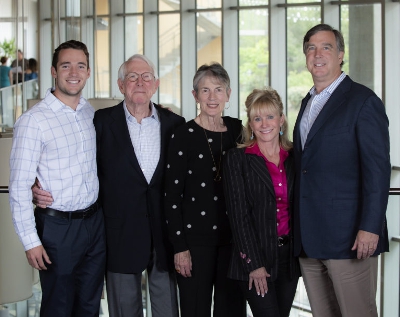
Elliot Botvinick, Ph.D., a University of California-Irvine professor who is involved in two startups, took home the prize of Entrepreneurial Leader of the Year at UCI’s Applied Innovation’s second annual award ceremony on May 29.
About 50 people attended the evening event that also honored Chris C.W. Hughes, Ph.D., of Aracari Biosciences Inc. as Innovator of the Year and Mo Li, Ph.D., as the Young Emerging Innovator award.
The Beall Family Foundation helped Applied Innovation create the awards to celebrate researchers and faculty across the campus who are working actively to promote the commercialization of the university’s intellectual property.
“We started to see the research efforts accelerate” at the Applied Innovation center, Ken Beall told the Business Journal.
In the past 20 years, The Beall Foundation has donated nearly $30 million to different colleges at UCI. Last month, it announced a new donation—reportedly in excess of $16 million—to fund the school’s entrepreneurial incubator program.
The center is being renamed UCI Beall Applied Innovation.
Ken Beall—son of Donald Beall, former chairman and chief executive of Rockwell International—said his family foundation saw a need “to move the research out of the classroom and into the lab.”
All nominees, who currently operate out of UCI’s Applied Innovation facility at The Cove, will be moving to a new 100,000-square-foot facility at UCI Research Park in October.
The amenities at the new facility will include a fully operational wet lab that provides lab equipment so startups can spend their funding elsewhere.
Solving Ear Problems
Botvinick co-founded Cactus Medical LLC to make a non-invasive way of detecting fluid in a child’s ear.
Medically known as a middle ear effusion, it’s often a misdiagnosed condition that can lead to overprescribing antibiotics.
Botvinick recently received a National Science Foundation grant of $225,000 and the support of the Consortium for Technology and Innovation in Pediatrics.
He also co-founded Fieldionics Inc., which focuses on the rapid detection of lactic acid to detect damage of internal organs of a person whose outward symptoms appear fine.
“If the infusion set works, we have every intention of disrupting the infusion set market; it’s a multibillion-dollar maket,” Botvinick told a UCI website last month.
Botvinick, the owner of over 20 patents for various medical devices and applications, said he wants “to keep the snowball going” to help save people’s lives.
Other Winners
Aracari Biosciences’ Hughes won his prize for simulating the interaction of drugs, thereby reducing the typical time frame used in real-world studies.
His research can be used to improve drug screening for drug development and patient treatment in personalized medicine.
“All tissues receive their nutrients and most drugs through the vasculature [blood vessels] and so we figured it would be a good idea to include this in our models,” Hughes said. “Our hunch has proven correct—cells behave quite differently to drugs when they are in the complex 3D environment we create compared to standard 2D plastic plates.”
Hughes, who has received almost $15 million in federal funding, works with UCI professors Wes Hatfield and Abe Lee, who is the current chair of the school’s biomedical engineering, as well as Steve George of University of California-Davis.
Sustainable Materials
Mo Li, a UCI professor of civil and environmental engineering, focused her award-winning research on more durable, sustainable materials that would reinforce current structures and improve their longevity, while also seeking to reduce environmental impact.
