

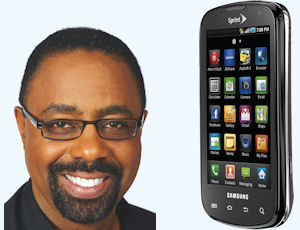
Sprint Nextel Corp. has much of its turnaround ambitions placed on a new wireless network—and industry veteran Matt Carter.
This year, Carter moved to his third post within the country’s third-biggest wireless service provider. His current charge: heading up Sprint’s effort to roll out its fourth-generation network, which promises to boost download speeds and allow people to do more with their smartphones.
“More people are using smartphones and doing more things with them,” Carter said. “The iPhone has had a significant influence in consumer behavior. We wanted to make sure we were well positioned to take advantage of where the hockey puck is going.”
Sprint, which is based in the Kansas City area, has a lot riding on 4G. The company is looking to the enhanced service to stem customer defections and reverse persistent financial losses.
In January, Carter was tapped by Sprint Chief Executive Dan Hesse to be a sort of lightening rod for all of the company’s efforts surrounding 4G—including brand marketing, product development, software development and physical construction of the network.
“One of the most important strategic things we need to do as a company is continue to extend our leadership around 4G and to make sure we are executing on that strategy in rolling it out,” Carter said.
Team
In Carter’s new role, he heads a small team at Sprint’s local offices in the Irvine Spectrum.
He travels a lot and works closely with executives who run Sprint’s consumer, business, network and product groups.
“My role here is to really integrate all our various efforts to ensure that we are deploying the network, developing the products and working with the marketing organizations to drive awareness,” he said. “I work with every single function within the company.”
Carter also works with Kirkland, Wash.-based Clearwire Corp., a joint venture that provides the technology behind much of Sprint’s 4G push.
In 2008 Sprint and others formed Clearwire, which backs a particular set of industry standards and owns a set of airwaves.
Sprint owns 54% of Clearwire, but Hesse and other Sprint executives recently stepped down from the company’s board.
Some expect Sprint to sell its Clearwire stake.
Sprint has been investing in 4G since 2006 when the company said it would commit some $5 billion to build out the equipment needed to upgrade its network.
“Of the four major carriers, we are the only ones right now that offer 4G,” Carter said. “That tells you the difficulty of being able to get the spectrum, the equipment and everything you need to do to build the network. It takes a lot of time and effort.”
Sprint now offers 4G service in some 55 markets. It expects to launch in parts of Orange County by the end of the year, though there have been sporadic reports of users here coming across Sprint’s 4G signal.
“We will have, essentially, a nationwide blueprint for 4G by the end of the year and be live in most of the major markets around the country,” Carter said.
Verizon Wireless, part of New York’s Verizon Communications Inc., and Dallas-based AT&T Inc., are close on Sprint’s heels.
Last week, Verizon said it’s readying a 4G network that runs on a standard developed in Europe that’s called LTE for “long-term evolution.”
Verizon plans to launch in 38 metropolitan areas by the end of the year.
AT&T is set to roll out its LTE network in 2011.
Carter said he sees himself as a sort of “brand evangelist” for the speedy powers of 4G. He compares surfing the Internet on a 4G network to watching high-definition TV.
“Regular TV was just good enough until you tried watching in HD,” he said. “Once people have a chance to have a 4G experience in browsing the Internet, they become hooked.”
Boost
Before taking on the 4G post, Carter ran Irvine-based Boost Mobile LLC, a prepaid phone operator acquired in 2003.
Carter was tapped to come to Sprint because of his work in the past two years at Boost, which bills itself as a young, hip brand.
“Dan wanted me to lead this initiative precisely because of the kind of cultural benefits he saw at Boost,” he said. “We are entrepreneurial, innovative and think outside the box. I also know how to work effectively with the rest of the organization.”
Boost was folded into Sprint’s prepaid group last year after the company bought Virgin Mobile USA Inc., a prepaid competitor, for $483 million.
The deal made Sprint the second-biggest prepaid carrier, after Florida’s TracFone Wireless Inc., a unit of Mexico’s América Móvil SAB de CV.
Carter came to Boost in 2008 from yet another Sprint executive post, where he was senior vice president of base management.
He lives in San Diego, works in Irvine and reports to Sprint’s headquarters in Overland Park, Kan.
