

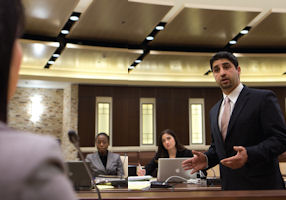
Whittier Law School is working on closing the practice-readiness gap, which the legal industry claims is a real threat to young lawyers entering a field where on-the-job learning is becoming more and more cost-prohibitive.
The Costa Mesa-based law school launched a curriculum this fall that integrates practical training with traditional, theory-based knowledge.
“The employment market is changing, and our law school wants to keep up,” said Martin Pritikin, Whittier’s associate dean of experiential learning.
Practical instruction, including lawyering skills, has always been part of laws schools’ curricula, but today’s market makes significant hands-on experience a must because law firm clients with strapped post-recession budgets require it.
More than half of Whittier’s “Experience the Law” curriculum’s 56 required semester units—29—are experiential classes.
A third of the school’s students are participating in the new program’s roughly half a dozen classes. Full implementation is expected in the fall of 2014, with 12 units to be earned in the first year of law training and a combined 17 units in the second and third years.
School administrators say hands-on learning should be part of students’ training from the time they arrive on campus.
“Our faculty and management believe that students learn better if you expose them to [challenges], so if this is what helps students, why not start preparing them for what they’ll be doing from the first day?” Pritikin said.
Putting It Into Practice
Students in experiential classrooms learn new concepts and immediately put them into practice. For example, they grasp civil procedures—rules by which courts conduct civil trials—by conducting simulated litigation of pretend contracts or property cases at the school’s Kiesel Advocacy Center, a recently finished courtroom.
The concepts covered in other first-year classes are also relearned in a practical setting.
“When you’re litigating a case, it has to be about something,” Pritikin said. “They get an opportunity to integrate the substance of the law, to apply things they are doing in other classes and see how different topics relate to each other. They also get a sense of professional identity, of how you handle yourself in the business of being a lawyer.”
Second-year students concentrating on business law are tasked with drafting contacts and other documents, such as an LLC agreement or articles of incorporation. Third-year students are required to spend a semester litigating a case, specializing in a particular area of law, Pritikin said.
In addition to the new curriculum, the law school continues to offer other opportunities for hands-on experience, such as its on-campus legal clinics on children’s rights, domestic violence, special education and the recently established Coastkeeper Environmental Water Law Clinic. Clinics give students a chance to represent real-life clients in legal proceedings under the close supervision of faculty members.
“Our top priority is to graduate students who are fully prepared with the knowledge, skills and professionalism needed to successfully practice law,” said Penelope Bryan, dean of the law school.
New Requirements
Whittier’s new curriculum exceeds the requirements set forth by the American Bar Association’s Standards Review Committee, which voted in August to require law students to complete at least six units of experiential coursework, such as clinics, externships or simulation courses. The State Bar of California has proposed new bar admission requirements that include a significant practical skills component—15 units, a requirement legal industry leaders expect it to adopt in 2017.
The changes stem from the “rapidly changing landscape of the legal profession,” according to the State Bar’s Task Force on Admissions Regulation Reform, “where, due to the economic climate and client demands for trained and sophisticated practitioners fresh out of law school, fewer and fewer opportunities are available for new lawyers to gain structured competency skills training early in their careers.”
The Real World
Law students graduate with a hefty school loan, often more than $100,000, and are entering a dismal job market “as solo practitioners, without the solid foundation necessary to represent clients in a competent manner and with nowhere to turn to build that foundation,” the task force reported.
The UC Irvine School of Law is also on board with experiential education but puts more emphasis on law clinics and pro bono work than on simulating real-world cases. It requires students to complete six units in core clinical courses, and it says many students take more.
“I support having a mock trial and moot court. … Simulations can teach a great deal, but I think a lot more can be learned if somebody is representing a real client,” said Erwin Chemerinsky, dean of UCI’s law school. “The only way to learn how to be a lawyer is to practice law under supervision. Could you imagine (a) medical school that trained doctors where medical students never saw patients? Law schools need to train lawyers in the same way, so I strongly believe in our clinical programs, [which] give our students a chance to practice law under supervision of a faculty member.”
Like Whittier, UCI has well-established on-campus law clinics that support the experiential learning model, including clinics on environmental law, consumer protection, domestic violence and appellate litigation.
“All students have to participate in one of these, and we strongly encourage students to do pro bono work,” Chemerinsky said. “We’re proud that 90% of our students do pro bono work, and they average 100 hours of pro bono work each.”
Peter Zeughauser, a legal strategist and chairman of Newport Beach-based Zeug-hauser Group LLC, said Whittier’s experiential curriculum is “progressive” and “ought to translate into more jobs” for new law school graduates.
“It makes them more valuable to law firms and clients much quicker.”
