

MBA enrollment in Orange County once again is declining.
The 17 business schools on the Business Journal’s annual list reported a 4.6% drop to 3,045 students. Since 2017, enrollment has fallen every year on the Business Journal’s annual list, except for 2022 when it rose less than 1%.
Seven schools reported a decline this year while seven reported growth and three didn’t supply their enrollment.
The largest decline came from the University of La Verne, which reported a 30% decrease to 275.
The University of California, Irvine, whose Paul Merage School of Business is the largest in the region, also saw a decrease in enrollment of 18% to 500.
Declines in MBA enrollment may be following a national trend. The Wall Street Journal reported prestigious schools like Harvard, Yale and the Wharton School at the University of Pennsylvania are reporting double-digit declines in enrollment.
Cost was the biggest factor blunting demand, the WSJ said, citing a survey of 1,500 people who considered applying but decided against it.
The Business Journal’s list reports that students are paying $48,755 on average toward their graduate degree, up 22% from last year’s $39,834.
Increases are likely to continue at state schools for the time being. California State University trustees voted in September to raise tuition 6% annually for the next five years.
Some local universities are diversifying their program rosters with shorter, more specialized graduate programs to speak to shifting demand. UCI, for example, has a Master of Innovation and Entrepreneurship program that grants admitted California residents a $10,000 scholarship.
It also launched a 15-month Master of Data Science program in 2021. Chapman University also now offers a Master of Science in Real Estate that spans one year.
Schools are listed alphabetically on the annual list.
Some of the schools’ enrollment figures reflect graduate students taking classes at regional campuses outside of Orange County.
Evolving Job Market
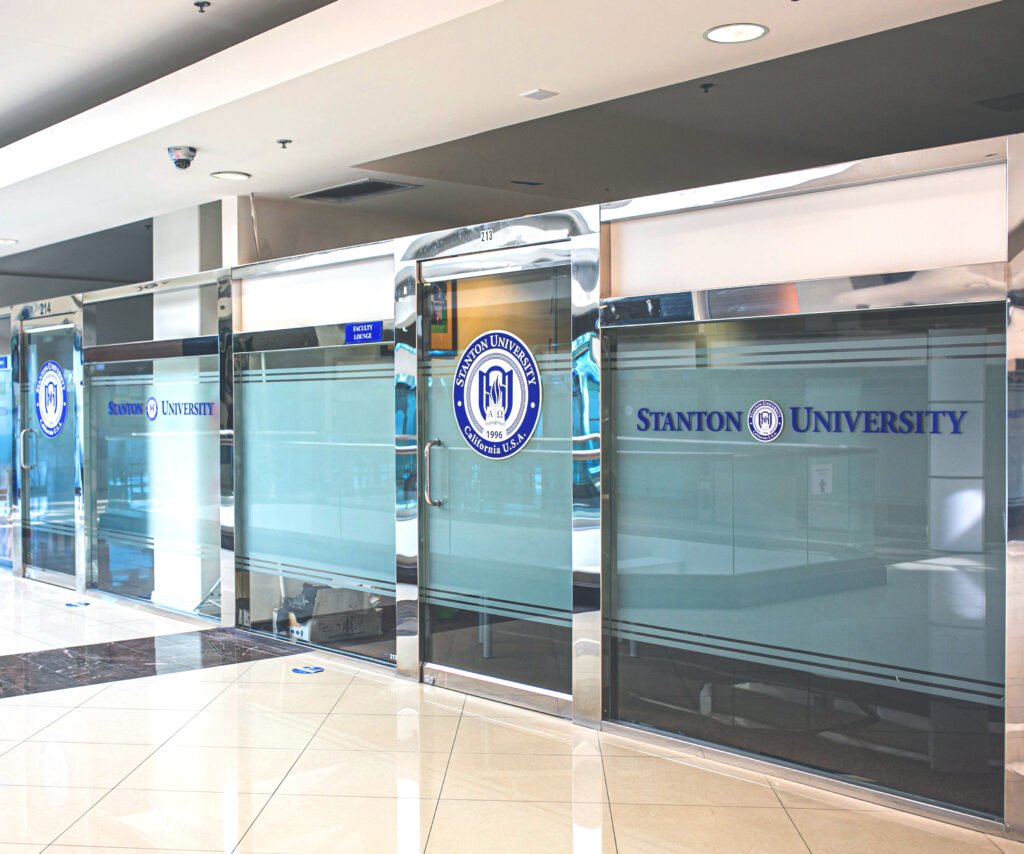
Stanton University witnessed a 39% boost to 160 students, the largest increase in enrollment.
The school bounced back after decreasing 29% to 115 students the previous year.
Daniel Kim, director of student affairs, attributed the growth in enrollment to the addition of new program offerings.
Stanton recently gained approval to add a degree in information systems management.
“This expansion into cutting-edge fields has drawn students interested in pursuing careers in technology and management,” Kim told the Business Journal.
Schools are investing in new technology to prepare students for the demands of the rapidly changing business world.
“Recognizing the importance of technology in the business landscape helps students prepare to succeed in the evolving job market,” Kim said.
Chapman University’s enrollment was stable at 197 students, up one from a year ago. Their students will soon be able to gain access to a new supercomputer (see story, page 1).
Schools are also fostering international partnerships to broaden opportunities for students.
UCI built an international research network studying AI and children with a $11 million donation from the Jacob Foundation (see story, page 20).
CSUF
California State University, Fullerton is entering the academic year with new interim president Sylvia Alva who assumed the role on Aug. 1, replacing Fram Virjee, who retired after five years on the job.
The second-largest undergrad business school in the country saw total MBA enrollment decrease 6.2% to 335. A positive factor is part-time enrollment.
“The College of Business and Economics has enjoyed a steady trend of increasing part-time MBA enrollment even as other programs across the U.S. and California have seen a decline over the past five years,” Sridhar Sundaram, dean of CSUF’s College of Business and Economics, told the Business Journal.
“We believe that our growth reflects an MBA program that meets the needs of today’s working professional—a high-quality, flexible graduate education at an accessible price point.”
