
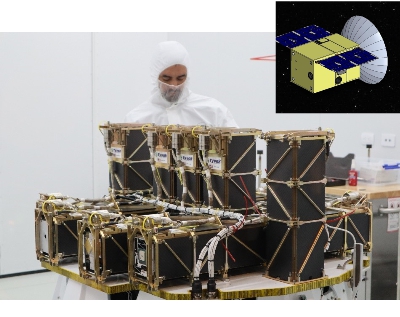
Small-satellite developer Tyvak Nano-Satellite Systems Inc. of Irvine will be playing a key part in a NASA-funded lunar-orbit project.
NASA said last week it had awarded a $13.7 million contract to Advanced Space LLC of Boulder, Colo., to develop and operate an extra-small-satellite mission to the same lunar orbit targeted for Gateway space station.
Gateway is an under-development orbiting spaceship, including living quarters and a research lab, which astronauts will visit before descending to the surface of the moon.
“This spaceship will be a temporary home and office for astronauts, just about a five-day, 250,000-mile commute from Earth,” according to NASA, which has proposed getting humans back to the moon as soon as 2024.
Clare Skelly of NASA’s Office of Communications in Washington told the Business Journal on Sept. 17 that Tyvak will provide the 12-unit CubeSat platform, referring to a specific class of small satellites.
The 12-unit CubeSat is about the size of a small microwave oven.
Other Tyvak satellites can run far smaller. Some nanosatellites it has worked on, for the deployment of Internet of Things-type applications, are the size of a computer tablet, weigh about 5 kilograms, and cost under $1 million.
Elliptical Lunar Orbit
The partnership with Advanced Space is part of a project called the Cislunar Autonomous Positioning System Technology Operations and Navigation Experiment, or Capstone, designed to test a nanosatellite that will orbit the moon and help monitor lunar communications.
The mission’s CubeSat will rotate together with the moon as it orbits Earth and will pass as close as 1,000 miles and as far as 43,500 miles from the lunar surface.
Onboard is a communications system capable of determining how far Capstone is from NASA’s Lunar Reconnaissance Orbiter and how fast the distance between the two spacecraft is changing.
The pathfinder mission could launch as early as December of next year, according to NASA.
Capstone is expected to demonstrate how to enter into and operate in that orbit, as well as test a new navigation capability.
This information will help reduce logistical uncertainty for Gateway, as NASA and international partners work to ensure astronauts have safe access to the moon’s surface.
The inter-spacecraft information will be used to demonstrate software for autonomous navigation, allowing future missions to determine their location without having to rely exclusively on tracking from Earth.
A number of launch options are possible for the mission, including being the primary payload on a small spacecraft launch vehicle. After launch, Capstone will take approximately three months to enter its target orbit and begin a six-month primary demonstration phase to understand operations in this unique regime.
$36M of Funding
Tyvak, formed in 2011, is no stranger to the small satellite work; it says it has been involved in more than 213 small-satellite launches around the world. It also supported preliminary work for NASA’s proposed mission to Mars.
It has headquarters along Barranca Parkway. Its website said the company’s facilities count some 24,000 square feet of clean room space, and 10,000 square feet of precision manufacturing space.
Tyvak parent Terran Orbital Corp. last year raised $36 million in a Series B round that included prior investor Lockheed Martin Corp. (NYSE:LMT), and new backers Goldman Sachs (NYSE: GS) and Beach Point Capital.
Small-satellite launcher Rocket Lab of Huntington Beach and Tyvac are trying to revolutionize access to space with frequent launches of smaller satellites.
The two OC companies have worked on several launches together.
The space race includes about 40 U.S. companies and several global competitors.