

More than 45,000 students are taking Peter Navarro’s economics class, even though 90% of them have likely never set foot on University of California, Irvine’s campus, let alone enrolled.
The business professor at the Paul Merage School of Business is teaching major principles of macroeconomics through what’s called a Massive Open Online Course model, which enables large-scale participation and free access.
The course content is similar to what’s offered through the university’s MBA program but provides no academic credit. School officials say students benefit by getting free training and the option of earning a certificate of completion for a nominal fee.
“It’s cool; I’m enjoying it,” Navarro said of two such classes he’s teaching this semester. “The students are greatly enthusiastic about learning and bring different perspectives.”
Method Gains Popularity
UC Irvine is among a growing number of public and private higher education institutions offering the learning model, including Stanford and Harvard universities. Some MBA schools in other parts of the country are using it for MBA classes. That hasn’t happened yet in Orange County, but it’s started a debate about the merits of the idea.
The University of Pennsylvania’s Wharton School, the oldest collegiate business school in the country, offers MOOCs on financial accounting, operations management, marketing and corporate finance—all mandatory classes for first-year MBA students there.
UCI has offered 12 MOOCs so far, covering topics such as finance, math and biology.
Its first course debuted in January, drawing 95,000 students. The count jumped to 255,000 when it added five courses the following month.
As the model gains popularity, so do questions about how to best use the relatively new form of online education in the MBA context.
Business schools, taking lessons from missteps of the newspaper industry, aren’t ready to give away all of their content online. The selection of free classes, meanwhile, gives them positive publicity.
Value Debated
But professors and other academic leaders say they worry convenience will replace classroom discourse and valuable networking opportunities.
“MBA students are sufficiently motivated, sufficiently mature, so that alternative ways of instruction which are not face-to-face are perfectly reasonable,” said Chapman University Chancellor Daniele Struppa. “So if that’s a good idea, why don’t we do everything through it? My response is that one-on-one personal interaction is a very important component (of the MBA program). You can study a certain amount of things on your own, but the learning that occurs when you and I sit around the table … that’s very difficult to replicate in a standardized (MOOC) method.”
Then there are professional connections to be made, which often continue after graduation.
MOOCs offer “plenty of interaction on discussion boards,” Navarro said, but it’s not the same as networking with faculty and fellow students. “If you’re in an MBA program just to get a grade, that’s dumb.”
Struppa expressed similar sentiments.
Chapman University often invites business executives to donate their time to teach its students, he said.
“I’m with you in a class and you’re an executive, and you really think I’m bright and I work hard and you enjoy working with me. It’s not unlikely that at the end if I ask you for a recommendation, you’ll say, ‘You know what, there is an opening you should apply for,’ ” he said. “So there is this personal connection that you cannot disregard.
“I’m skeptical when people say (MOOCs) will completely revolutionize higher education. I have to see that happen. If it was easy, I would give you 72 books to read, you wouldn’t have to come to class, you could read them from your bed, and at the end, you take a test. But it doesn’t work that way.”
Added Benefit
Still, neither professor expressed opposition to open learning systems. Rather, Struppa and Navarro said they see them as enhancing business schools’ offerings.
“We shouldn’t refuse any of the new ideas,” Struppa said. “We should study them and include the best parts in what we do.”
MOOCs can be used as prerequisite courses to help level the playing field for MBA students with nonbusiness undergraduate degrees, he said.
Next summer, Chapman University will offer a MOOC on storytelling for its Dodge College of Film and Media Arts, so that “when we start in September, we can hit hard and go quickly at what we need to do,” Struppa said.
It plans similar prerequisite MOOCs for its business school in the near future.
At UCI, Navarro’s two MOOCs—The Power of Macroeconomics: Economic Principles in the Real World, and The Power of Microeconomics: Economic Principles in the Real World—cover material aimed at undergraduate business majors, but MBA students take them to brush up on core economic principles, Navarro said.
Open-learning courses can also be used as auxiliary resources to implement what’s known in the industry as the “flipping the classroom” concept, where students watch lectures online followed by participation in live classroom discussion.
“ … the flip classroom is the best way, because it puts responsibility on the student but at the same time makes the class a very fruitful time,” Struppa said.
Similar ideas were discussed at a symposium on open learning systems that UCI hosted last month. Panelists discussed innovation in the online learning model, its benefits and pitfalls, all of which was streamed online.
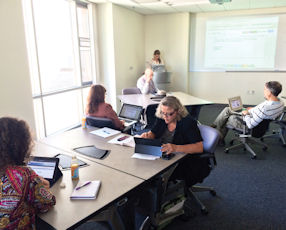
A group of volunteers created an MOOC in a daylong workshop.
David Theo Goldberg, director of UCI’s Humanities Research Institute and one of the event’s organizers, said the university as a whole is not pursuing open learning courses, but individual professors are.
In January, the state awarded the University of California system $10 million to develop technologically driven classrooms, and professors can apply for funds to develop courses, including open learning classes.
Not Without Problems
Some who’ve embraced open learning have run into obstacles.
For instance, open learning systems present professors with challenges they don’t encounter in traditional classes.
Richard McKenzie, an emeritus professor of enterprise and society at UCI’s business school, quit teaching the Microeconomics for Managers MOOC because of “disagreements over how to best conduct this course,” he wrote to his students in February.
Some students had complained that McKenzie required more of their participation than they thought necessary.
The class continued without him.
“It puts … pressure on a teacher to be something other than a sage on the stage,” Goldberg said. “Now instead of just lecturing, the teacher has to take on a role of a facilitator, or a conductor.”
Struppa said open learning systems, just like any new concept, should be looked at “with critical eyes.”
“That’s what universities do best. Our job is to look at the changes in the world and see what is good, what we can take advantage of and what doesn’t work.”
