

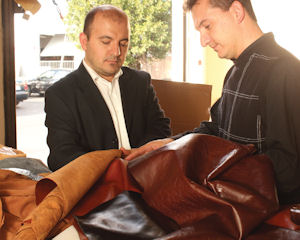
Ramsey Oten always had fashion sense.
He added some forethought and caught a bit of good timing to turn his idea of making leather cases for electronics into a viable business.
Oten was a systems engineer in the personal imaging division of Newport Beach-based chipmaker Conexant Systems Inc. when he set out to launch Sena Cases in 1999.
A jump into the luxury end of the still-new market for cell phone accessories seemed years away—especially from a leased one-room office in Costa Mesa, where the company first opened its doors.
Oten had a few other things going for him. He was a gadget enthusiast and quick to jump on the latest tech trends.
He also knew the leather business well, with a personal connection through his grandfather, a leather artisan from his native Turkey.
“We thought we could create products that were first-class quality, fashion-forward and functional,” Oten said.
A decade later, Sena, which now calls Irvine home, is the preferred leather vendor for Cupertino-based Apple Inc. That status was a big part of the company’s 369% jump in revenue, to $18.1 million, for the 12 months through June 30 compared to two years ago.
That got Sena the No. 11 spot on this year’s Business Journal list of fastest-growing private companies based here (see related stories, pages 1, 3, 6; this section; list on page 41).
Sena’s leather cases—individually hand-crafted from calfskin Napa leather from Italy, Turkey and South Korea—are made for cell phones, tablets, MP3 players and laptops. The company sells cases for more than 300 devices. They come in anywhere from five to 15 styles and more than 10 colors.
Turkish Import
The company, named after Oten’s daughter, brought in a master artisan from Turkey with 32 years experience, one of 19 employees. There’s a workshop at headquarters for developing prototypes and testing.
Most of Sena’s products are made in Turkey and distributed from Irvine, where it also operates a warehouse.
The company has deals with contractors in Turkey for European distribution and in Vietnam for Asian sales.
Landing a partnership with then-Palm Inc. about six years ago made the company a known player in the market.
“That was kind of the beginning of the smart-phone era,” Oten said.
The company leveraged its newfound success into deals with Palo Alto-based Hewlett-Packard Co. and Dell Inc. in Texas.
Coup
Then came Apple, its biggest coup to date.
Sena inked a deal in 2007 to sell cases in Apple stores, shortly before the company debuted the iPhone.
Apple stores and online sales now account for about half of Sena’s revenue. Two years ago Sena was named Apple’s preferred leather case vendor, a designation that carries cachet and more revenue potential.
“Instead of trying to distribute everywhere, we wanted to partner with premium outlets,” Oten said. “Our success in the smartphone industry helped us to secure a partnership with Apple.”
The company has begun talks with other retailers and some luxury brands, and has struck a deal with New York-based luxury apparel maker Michael Kors USA Inc.
Sena will soon need to expand from its 18,000-square-foot Irvine location, according to Oten. That’s nothing new—it’s taken more space for its headquarters about every two years since it started.
The next move might not be far off: the company is preparing for the expected debut of the iPhone 5, slated for this week.
