

That extendable bug vacuum, dryer lint alarm and noise-canceling headphones you spied in Skymall magazine on the redeye all have something in common.
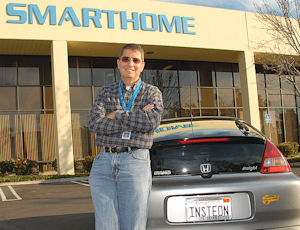
They’re brought to you by an under-the-radar Irvine company, Smarthome Inc., which has been in Orange County for nearly 20 years.
The bulk of what Smarthome sells isn’t as novel. Most products are designed to automate household electronics, including thermostats, pool filters, light switches, security systems, door locks, timers and monitoring gear of all types.
Smarthome’s best-sellers are things like remote control light-dimmers, programmable thermostats and keypads that allow you to control all the lights in the house from one spot.
The company stocks thousands of products big and small in a bid to appeal to customers—mostly weekend tinkerers and the RadioShack faithful.
Some products are seriously useful, such as safes, garage door openers and digital timers for a sprinkler system.
Others are more fun, such as a sensor that detects electrical fields for ghost hunting, a claw-like pooper scooper and a solar-powered mole and gopher zapper.
“We are like Sharper Image on Red Bull,” said Mike Scharnagl, director of marketing. “Our products are geared toward a DIY customer, a guy who wants to make his home a better place and likes doing it himself.”
Privately held Smarthome doesn’t disclose sales. The Business Journal estimates it sees roughly $150 million to $200 million in yearly revenue.
Own Technology
Some products use Smarthome’s own patented technology, dubbed Insteon, to send communications between devices in the home.
It developed the Insteon brand about five years ago, in a response to spotty radio-frequency communications used by most remote control devices.
In other cases, Smarthome resells products made by others.
Smarthome does some design, engineering and testing work locally, in addition to customer service.
It doesn’t make anything here. Most manufacturing is done in Asia by contractors.
The bulk of Smarthome’s sales come directly from consumers via its catalogue and online sales. The company’s Irvine headquarters includes a no-frills showroom, where buyers can pick up orders.
Smarthome does a portion of its sales through resellers and installers of home electronics.
It also sells products at various online stores, including Amazon, Crutchfield, Rockler, Tiger Direct, New Egg and of course, Skymall.
“We’ve had a relationship with Skymall for quite a few years,” founder and Chief Executive Joe Dada said. “That has helped a lot of customers recognize our brand.”
The company carries some 13,000 products in all and adds hundreds each week.
“We’ve amped it up over the past year,” said Kyle Mears, a new product supervisor.
Products range in price from just a couple of bucks to tens of thousands of dollars for an entire home theater system or a custom-outfitted man cave.
“Some of the products fall into the category of a neat widgety thing,” said Dan Cregg, chief technology officer. “Others are more practical.”
The company is seeing sales grow as “more and more people have become comfortable with technology,” Cregg said.
“People are becoming less technophobic,” he said.
A larger push for energy savings in the home is helping, according to Dada.
“For years people have used our products to control their lighting and appliances,” he said. “Now people want to control all aspects of their home, track the energy usage of these products over time and be alerted via e-mail or text message when the energy usage of those products is about to fall outside of a certain range.”
Cutting costs by monitoring energy use is nothing new for Smarthome’s target customer.
“Our customers were doing this stuff 10 years ago,” Scharnagl said. “The smart grid is just now becoming a hot topic.”
It’s tough to pinpoint Smarthome’s competitors. It has some crossover with RadioShack Corp., Home Depot Inc. and other home improvement and electronics stores.
Workers
Smarthome has about 100 workers at its headquarters near Von Karman Avenue and Barranca Parkway. It has a 30,000-square foot warehouse where it receives and ships products.
The company was started by Dada in 1992 in Costa Mesa as a catalog company.
Its earliest catalog was a four-page flier called Home Automation Systems that hawked products from the Seattle area’s X10 Wireless Technology Inc.
Smarthome ran one of the earliest online stores, which it started in 1993.
It was “essentially a bulletin board ordering service,” Cregg said.
Despite its tech credentials, Smarthome never ditched its mail order catalog.
“There was a lot of pressure to, but our CEO recognized that the combination of the catalog and online shopping was powerful,” Cregg said.
The catalog “has sticking power because it stays in your home and it’s easy to thumb through,” he said.
Founder Dada is an engineer by trade.
He’s billed as a home automation expert and often makes rounds doing public speaking. He’s a member of the University of California, Irvine extension program’s energy advisory board and is a speaker at the annual International Consumer Electronics Show in Las Vegas, among other trade shows.
