

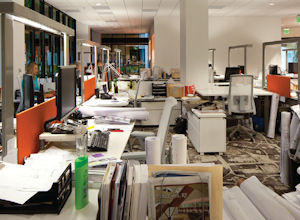
Function and flexibility are pervasive trends in interior design for commercial spaces.
“Almost every company we talk to is saying, ‘We want to be flexible and to be able to expand, change or contract, with the economy not quite solid and certain,’” said Rick Shlemmer, principal at Irvine-based design firm Shlemmer Algaze Associates.
Companies today are also working with less space for their employees, a development that presents both challenges and opportunities for designers. Square footage per employee has shrunk from up to 300 square feet per employee a decade ago to under 200 square feet per employee today.
Designers now have frank discussions with clients about businesses and growth projections, viewing themselves more as partners who can help their clients’ businesses grow through flexible design concepts and activity-based planning, rather than just a service provider.
“With the recession, there has been this goal to consolidate and reduce square footage,” said Rick D’Amato, principal senior designer for Irvine-based design firm, LPA Inc. “It has really created this need to dial-in and understand the work process, and it’s really enabling us to think more about that process with our clients. We have to really understand how they work and how we can help them work smarter.”
LPA was the design firm behind Irvine-based software developer Blizzard Entertainment Inc.’s recent remodeling.
The project involved remodeling space previously occupied by Irvine-based chipmaker Broadcom and was “anything but typical,” D’Amato said.
His firm designed custom work stations that enabled the company to fit a lot more people in a lot less square footage. LPA also honed in on Blizzard’s corporate culture, using color palates from Blizzard-developed video games throughout the facility, and creating gaming lounges and tiki bars in the space to make employees feel at home.
“The home and office are becoming a lot more synonymous,” D’Amato said. “Companies want to make their staff as comfortable as possible.”
Open spaces used for collaboration and shared stations for telecommuting employees who report into the office a few times a week to plug in their laptops and make a few phone calls are becoming more prevalent in offices, as are technology-driven spaces.
“We’re designing spaces around technology, rather than finding ways for technology to fit into a space,” said D’Amato, whose firm has a room in their own office dedicated to the use of media:scape, a technology-driven collaborative platform that allows people to work in a shared workstations on separate monitors and to share their work on centralized monitors that each project member can see.
“That’s really changing the whole complexion of how we’re looking at design,” D’Amato said. “Thinking about the future of technology, how we keep our workspaces as flexible as possible.”
LEED Lags
A trend that’s lost some of its luster in recent years is a move toward being certified under the Leadership in Energy and Environmental Design, or LEED, program.
Designers still work to educate their clients about the benefits and challenges of going green. But the recession has resulted in some organizations scaling back their green initiatives because of the costs involved and the time it takes to see a return on their investment.
“The number of companies that go through the [LEED] process is few and far between,” said Shlemmer, whose Culver City office is LEED-certified.
“It’s a process that encompasses a lot of different things in design and commissioning,” he said. “Fees are usually expensive, and a company has to be really committed to doing it.”
One of the challenges is calculating the return on investments, especially in office spaces, where the electrical and mechanical is shared between several companies.
But the younger generation of employees tends to be more socially and environmentally conscious, so sustainability initiatives may play a more important role, according to Heidi Hendy, principal of Newport Beach-based planning and design firm, H. Hendy Associates.
“I believe when you look at the millennium generation, it is going to be important to organizations,” Hendy said. “They’re very concerned about the environment.”
Sustainability
Green initiatives are also important branding and marketing tools for companies, particularly for those who do business with customers that are interested in sustainability.
“It’s more of an issue of company culture and a marketing opportunity,” Shlemmer said. “It’s a great way to say, ‘We’re just like you.’ ”
Another current trend, dubbed Third Space, involves the combining of disparate workspaces. Typical examples are lunch rooms that double as meeting rooms, or break rooms that are combining with lobby spaces.
“You’re seeing a lot of flexible space,” D’Amato said. “That’s where we’re seeing a big change. It’s making us think a lot more about the use of the space, and I think it’s making us better, more intuitive designers.”
Companies also are employing more telecommuting staff, and related trends include a continued move toward more and more video-conferencing arrangements.
“I believe the offices of today are going to the next level when it comes to collaboration and conferencing,” Hendy said. “The biggest growth area we’re going to see is video conferencing; space that everyone has the ability to Skype at their desk. The office of the future is going to have an increase in collaboration areas. And it’s not just one size fits all.”
Remodeled
The firm recently completed a remodeling of Irvine-based mortgage lender Network Capital’s office space, using a design that aims to convey a “totally transparent leadership style,” according to the H. Hendy Associates website.
Network Capital’s owners now work in an open space with employees. The lunchroom space has glass windows, so passersby have a view of what’s going on inside, and there’s even a pingpong table in the office.
“There’s a purpose to that pingpong table,” Hendy said.
The non-hierarchal design concept fits well with Network Capital’s core principle of transparency, she added.
“We have always believed that a facilities plan has to align with a business plan,” Hendy said. “Executives are now very open to change.”
Design firms must focus on clients’ long- and short-term goals, Shlemmer stressed.
“Companies are now, as much as ever, willing to think outside the box as long as it’s cost effective,” he said. “People have swallowed their egos and they want to be functional and competitive.”
