

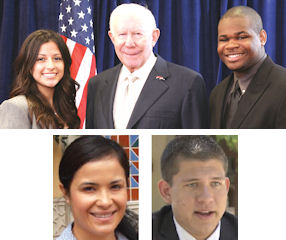
A constant in Isela Arias’ life while growing up in Santa Ana was her mother’s belief in education.
Arias came to the U.S. from Mexico with her mother and brother when she was 10. Her father joined the family a few years later.
Both parents worked at low-wage jobs, and the family struggled financially. Arias’ mother would gesture around the cramped single room the family called home and make her pitch for education.
“You don’t want to grow up and live like this,” she would say. “You need to live a better life.”
The constant reminder of the link between education and better prospects served its purpose.
“I always knew I wanted to go to college,” says Arias, who soon encountered another challenge: “But I didn’t know how to make it happen.”
Arias had good grades on her side. She was an honors student at Saddleback High School right off the bat, but the question of how to afford college loomed.
She learned about a new scholarship called the Simon Scholars Program during her sophomore year.
“As I listened to the counselor describe the kind of student they were looking for, I realized they were describing me.”
She applied—and was soon on her way along a new path that fell in line with her mother’s lessons on education and a better life.
Investing Early
The Simon Scholars Program takes a unique approach.
“For us, it isn’t enough just to write a check and send them on their way,” says Ron Simon, whose Newport Beach-based RSI Holding LLC includes a cabinet-making company and a homebuilding unit. “We realized it is really important to invest in [the students’] character.”
Simon also is founder of the Simon Scholars Program, a six-year scholarship, academic and life-skills program that aims to start early in a bid to take deserving students from difficult economic circumstances and prepare them for success in high school, college and their careers.
The scholars are chosen in tenth grade; the program begins the summer before their junior year in high school. Many of the students come from extraordinarily difficult backgrounds, including crushing poverty, abuse, drug-addicted parents and siblings, absentee parents and more.
Simon Scholars are the kind who have fought the odds to earn top grades, according to Simon.
“These are the kids who want to succeed,” he says. “We give them a way to do it.”
Dr. Laura Schwalm, the immediate past superintendent of the Garden Grove School District, describes herself as a passionate advocate of the program.
“These kids are survivors,” she says. “But no one has shown them how to succeed. Simon Scholars does that.”
The program started in 2003 and so far has helped more than 700 students from high schools in California, New Mexico, Georgia and Washington, D.C., graduate from high school and pursue their college degrees, according to the Simon Scholars website. The scholars have been accepted to some of the most respected institutions in the U.S., including Harvard, Columbia, MIT, Cornell, Pomona College, UCLA and Morehouse.
The goal now is to get more help to more kids by involving more companies and individuals in the program.
“The Simon Scholars Program is committed to building tomorrow’s leaders through academic support, life skills training and character building,” says Simon. “While the Simon Foundation’s endowment will continue to sustain the program, our plans are to continue to grow Simon Scholars based upon the success of RSI companies. In honor of our 10th anniversary, we are inviting like-minded prospective partners such as other foundations, corporations and individuals to invest in a Simon Scholar.”
More Than Money
Bringing a bright kid from a hardscrabble neighborhood onto a college campus doesn’t guarantee success, even if he has a lot of drive.
David Dukes, founding chief executive of the Simon Scholars Program, points out that the program teaches students the social graces that many in the general public take for granted.
For example, the proper way to shake hands, how to look someone in the eye when speaking with them, and how to engage in conversation with adults. The program provides the opportunity to meet and talk with successful leaders and entrepreneurs from business, education, medicine, and public service.
Schwalm said she hopes more campuses will be included as the program grows.
“You can’t imagine the ripple effect this program has,” she says. “The other students—even ones not in the program—are inspired by Simon Scholars.”
Plus, she says, Simon Scholars are great role models for their brothers and sisters.
Hail to the Chief?
Jonathon Espinoza is creating a ripple effect that—if all goes according to his plan—will eventually be felt throughout the world. The Georgetown University sophomore has a lofty goal: He wants to be the first Latino-American elected president of the United States. He’s studying economics and government and is getting involved in public service to build his leadership skills.
Espinoza’s greatest achievement so far is getting to college. He was born to a teenage mother and moved from place to place with her and his younger brother. They eventually settled in the attic of a home in Santa Ana.
Espinoza dreamed big amid his modest surroundings—he told his mother again and again, “I will go to college!” He laughs while describing how, in his naiveté, he thought there were only two colleges in the country—Harvard (“because everyone has heard of Harvard,” he says,) and UC Irvine, because it was in Orange County. He didn’t even know he had to take the SAT—he wasn’t aware such a test existed.
Then came the Simon Scholars Program.
“I needed guidance, support and confidence,” he says. “I was smart, but I didn’t have any direction.”
The program delivered.
And that has brought the “ripple effect.”
Espinoza’s younger brother has decided to enroll in community college. He plans to transfer to a four-year university and then enlist in the Marines and make a career of the service as an officer.
Each Simon Scholars recipient receives $30,000 in financial support, programs and services spread out over the six years of the program. The program has been funded solely by Simon to the tune of $23 million over the past 10 years.
The Simon Scholars Program operates with the same sort of exacting standards that have helped him amass a fortune in the cabinet-making business and carry his prowess over to homebuilding.
Now the program wants to expand its reach. It has expanded its board to help manage its growth and pursue relationships that will allow the program to expand to more schools and states.
Chapman University President Jim Doti is one of the board’s new members. Simon serves on the Chapman University board of trustees and is a fellow member of the Horatio Alger Association.
“Simon Scholars mentors the kids—they get a computer, SAT prep courses, they are recognized at award ceremonies, they visit college campuses—the program is designed to give students every opportunity to succeed,” Doti says. “Without Simon Scholars, these kids might not make it. Their potential may never be realized.”
Doti also helps the program build relationships with donors. He would like to see it expand to more Orange County schools.
“The program is in place,” he says. “Now, it needs to be replicated throughout the country.”
The replication is under way in Costa Mesa, where the foundation is working with public officials to bring the program to some schools there, with the goal of having it ready for the 2014-15 school year.
Better Life
Arias was in the first group of Simon Scholars, and 90% of them have gone on to graduate from college. She attended the University of California, Berkeley, where she graduated in 2009 with a bachelor’s degree in economics.
She spent several years as an auditor at PricewaterhouseCoopers before joining an investment firm in Los Angeles, where she now works in human resources.
“I would not be where I am today if it weren’t for Simon Scholars,” she says.
And that’s a long way from the days where her mother would give her constant reminders that education would allow her to “live a better life.”
“Now I do,” says Arias.
