

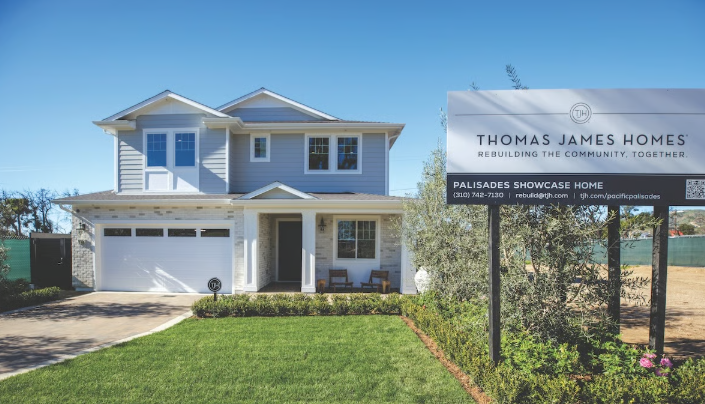
With the completion of its showcase home—the first rebuild in Pacific Palisades—and the opening of its Brentwood design studio, Thomas James Homes (TJH) is putting its hat in the ring to lead rebuilding efforts in the area.
Paramount to the Aliso Viejo-based developer’s Palisades efforts is a guaranteed date of one year or less to finish a rebuild from the time permits are approved and a firm $650-per-square-foot price pledge.
To reassure residents, TJH will pay homeowners a daily fee for each day a home is not completed after the 12-month mark. The firm’s model home, located at 915 Kagawa St., also shows rather than tells, as the nearly 4,000-square-foot house began construction in May and is already complete.
“The intention of this is to act as a showcase home that’s staffed so that the community can come in and look at the tangibility of the rebuild and hopefully be inspired (by seeing an) example of the path forward to build,” said Jeffrey Sandorf, vice president of division sales at TJH. “That’s the spirit.”
Sandorf also stressed that TJH’s priority is partnering with landowners for their rebuilds rather than buying up lots to develop and sell. The property where the model home was built was already under TJH ownership before the wildfires.
“We want to be the advocates and pathway for homeowners—period,” Sandorf said.
For Palisades clients, TJH offers nine home plans ranging from 2,350 to more than 4,000 square feet. Six architectural styles are being offered, though not every style can be applied to all nine plans.
Based on the roughly 5,000 residential homes that burned in the Palisades Fire, TJH Chief Executive Jamie Mead estimated that their plans will work for more than half of the affected lots in the area. As the rebuilding process continues, TJH intends to develop additional plans to fit any unmet demand.
Part of TJH’s selling point is its turnkey approach, in which the company handles permitting, slope and soil property evaluations, architecture, engineering and structural design services, and complete construction.
“We take care of everything internally,” Mead said. “You could sign the contract with us, go away and never come back to your home; and within a year, we would hand you the keys to the house.”
The goal is to break ground on 100 Palisades homes in the new year, he said. Based on the pricing offered and range of home sizes, this would result in a $152.8 million to $260 million development pipeline.
‘Professional Approach’
Mead acknowledged the public’s perception that the permitting process is challenging. Still, he said TJH’s average approval time has been less than 60 days. Leveraging the firm’s existing knowledge of the area has worked to accomplish this, he said. The firm built more than 65 homes in the Palisades before the fires, and since then, it has prioritized working with the city through the lens of rebuilding.
“We have a very consistent, highly professional approach to permitting,” Mead said. “It’s all in the way you package your description of the plans and how you present them to the city.”
To that end, Mead believes the criticism of current processing times stems from the number of unique builds, which he said can lead to much back-and-forth.
“It’s something brand new for the city to look at… That’s what really extends the time of permitting,” he said.
Currently, TJH has secured 14 rebuild permits in the Palisades, which has been “the fastest permitting we’ve been able to achieve as a company anywhere,” Mead said.
Aside from permit timelines, Mead sees TJH’s use of institutional contractors and subcontractors as a means to guarantee construction in 12 months or less, citing their “consistency” and vast experience. He also sees this construction segment as less susceptible to labor shortages stemming from immigration enforcement.
In addition to efficiency, Mead said TJH works “hand in hand with (its subcontractors) to develop the lowest cost,” informed by AI.
“At the core of that is an AI supported tool that helps us match our plan and our measurements with external costs,” Mead said.
This allows for a precise cost analysis, which TJH used to create its $650-per-square-foot price guarantee.
Securing Debt
Coinciding with the debut of TJH’s model home and its Brentwood Studio, Ascent Developer Solutions allocated a $400 million construction debt facility to TJH, aimed at supporting TJH’s growth initiatives in California, the Pacific Northwest and Arizona.
Robert Wasmund, founder and chief executive of Ascent, said he has had a 12-year relationship with TJH through prior ventures and that this new debt facility “is just another further iteration of two institutional companies that have been partnered for a long period of time.”
Both have ties to downtown-based Oaktree Capital Management, which owns TJH and previously invested in Genesis Capital, which Wasmund formerly led as chief executive.
“For us to be able to participate in actively funding the redevelopment of the Palisades is very important,” Wasmund said.
This comes at a time when the country is seeing a shortage of private debt, which Wasmund attributed to the impetus for Ascent’s founding in July 2024.
“Given the capital treatment on regional banks, who we compete mostly with, it’s very difficult to provide construction financing as a regulated bank today, and so we’ve continued to grow Ascent, feeding the need for the institutional certainty of capital in residential construction financing,” Wasmund said.
Where Wasmund sees TJH’s value, especially for Palisades rebuilds, is in the firm’s “certainty of execution, product quality and budget.”
Another point made by both Mead and Wasmund was the importance of having the expertise to execute single-lot builds at scale, rather than in master-planned communities.
“Every house is individually challenged by something… (and) has its own unique circumstances,” Mead said. “As a company, … our business model is to deal with these issues that come up when you’re building in an area where land topography or other aspects of the build are different from site to site.”
Fire Safety
That said, one thing is sure about all homes being rebuilt: the need for fire-resistant building measures. TJH designs will include ember-resistant ventilation, noncombustible materials and boxed eaves for the roofs.
Additionally, the plumbing for homes will be designed to allow for the installation of Frontline Wildfire Defense’s sprinkler system, which uses software to track wildfire activity. If the system detects a wildfire within 7 miles of the home, the sprinklers activate, spraying both water and what the company calls “biodegradable firefighting foam.”
While the sprinkler system is not included in the home plans, Adam Ganzell, national vice president of construction and quality at TJH, said the cost to add it is “incremental,” given that the plumbing for the homes will be proactively built to support installation.
Mead hopes that these safety measures, along with the general aesthetic of TJH home plans, will restore some positivity to the Palisades.
“What we’re trying to do is bring people across that grief threshold with all of those decisions and challenges … and to bring forward some sense of what can be done,” Mead said.
Rick Caruso, who has been outspoken about rebuilding efforts through the launch of his nonprofit Steadfast LA and his commitment to reopening Palisades Village, said TJH’s completed showcase home comes at a critical time.
Caruso said the progress is encouraging—something people need the most right now.
“Especially as we’re coming up to the one-year anniversary and people start feeling like they’ve been left behind and forgotten, this is really going to give a lot of people hope and excitement which is terrific.”
This story originally appeared in the Los Angeles Business Journal.
Beadel’s HVN Focuses on Affordable Homes
Tommy Beadel, who co-founded Thomas James Homes, is taking a different approach with his newest venture, HVN Development.
While Thomas James became well known for rebuilding older homes in nice neighborhoods, HVN is taking over dilapidated homes in Los Angeles’ poorer sections and turning them into affordable apartment complexes.
“We buy obsolete housing stock and repurpose it,” Beadel told the Business Journal.
“It’s a densification play to bring affordable housing to these core neighborhoods of Los Angeles.”
Beadel, whose LinkedIn profile lists his title as “housing disruptor,” sold Thomas James to Oaktree Capital in 2018 and stayed on as chief executive until 2023. Beadel still has a stake in Thomas James and is co-chairman on its board of directors.
In 2023, he began HVN, which with vowels sounds like haven, Beadel said, adding that his backers include a New York-based family office.
In this new venture, he’s using tax credits to help fund the construction of the apartment buildings. He said the recently enacted Big Beautiful Bill has expanded the capability for more affordable housing.
In his prior job, Beadel noticed that many low-income workers had to spend hours in traffic to get to their jobs.
“It’s about putting affordable housing in the neighborhoods that people work,” Beadel told the Business Journal. “It’s workforce housing.”
1,000 Units a Year
Thomas James has specialized in tearing down homes in older West Coast neighborhoods and building new ones, selling them from $3 million to $7 million each. It often carries $1 billion in for-sale value on its balance sheet at any time. The Aliso Viejo-based firm has a goal of rebuilding 100 homes in the next year in the Pacific Palisades, which was heavily damaged by fires.
While developers traditionally put four to five homes on an acre, HVN is designing an acre to hold 200 units in a 5-story mid-rise apartment complex.
Currently, it has 1,900 units in production in the city of Los Angeles with a goal of 1,000 units a year. The 16-person firm will be hiring project management staff in the coming year, he said.
Beadel knows the amount of housing won’t resolve the issue of affordability.
“You got to start somewhere to solve the problem. It’s a massive problem and we cannot solve the problem ourselves.”
—Peter J. Brennan
