Dustin Armer started working on a pediatric device prototype while working at Edwards Lifesciences Corp. when he met Eason Abbott. The two fellow R&D engineers effectively became Edwards’ experts on advancements in pediatric medical devices.
Abbott said it soon became evident that it made most sense to splinter away from Edwards, the maker of minimally invasive heart valves. A smaller company focusing just on treating pediatric patients could be more efficient in fundraising, innovation management and FDA relations.
“We had a great relationship with Edwards. We were able to have candid conversations regarding what really was the best way to look at pediatric needs,” Abbott told the Business Journal.
Edwards leadership allowed Abbott and Armer to create the foundation of Renata Medical. They left Edwards in 2019 to officially launch the Newport Beach-based firm.
“There was that core idea of can we run an efficient business in a different model than a large company would, to get pediatric products across the finish line,” Abbott said.
Over the past six years, Abbott and Armer have built a company that treats unmet pediatric needs.
The latest feather in the cap for Renata Medical: securing federal government reimbursement for its recently launched Minima Stent System, an expandable heart valve stent specifically tailored for neonates, infants and young children with congenital heart defects.
The device has the capability to expand over the course of a child’s life into adulthood, helping avoid the need for additional surgeries.
Renata Medical is also working on a device that would help patients avoid a surgery called the Fontan Procedure.
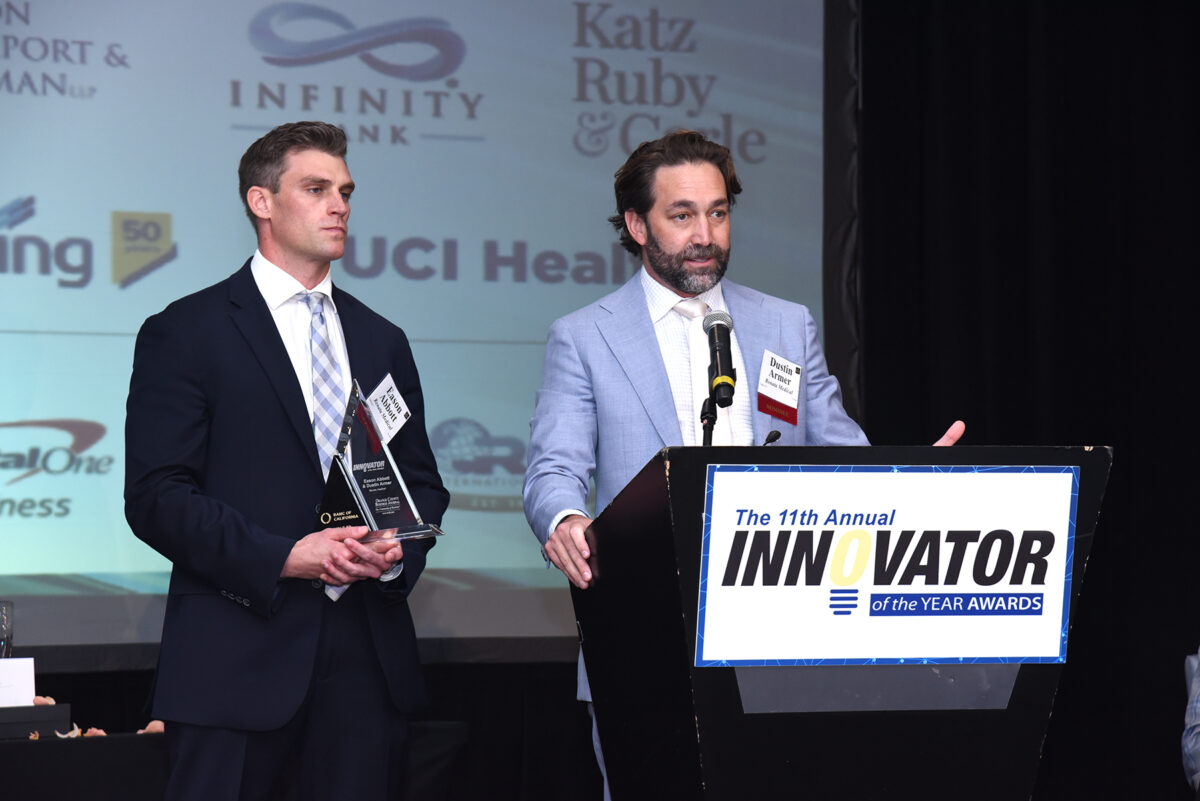
For these reasons, Abbott and Armer were recognized by the Business Journal this month at the 11th annual Innovator of the Year Awards event.
Staying Ahead of the Curve
Armer said innovation in the pediatrics world can be slow. Manufacturers, he said, often make one device but then don’t innovate anything new for another 10 years.
“Some of the most classic cardiovascular products have not been iterated on—it’s the same version that came out 10 or 20 years ago. So, we thought it would be really important to make sure we’re making the tweaks that the physicians need,” Armer told the Business Journal.
“These physicians, 70 to 90% of what they use is off label, meaning it’s not designed for them,” Armer continued. “We think they have a long list of needs. So, our next product is to help kids who are born with one working ventricle.”
He added Renata Medical often goes into a design freeze stage whenever the company approaches the Food and Drug Administration (FDA) for approvals.
“You do a lot of iteration, you try different prototypes, we go and do different studies.
When we’re ready to put this whole package in front of the FDA, that costs millions of dollars,” Armer said. “So, when you feel like you have a final design that you feel confident in, you freeze it. You say, ‘this is the design we have tried a bunch of different ways we think will work, so let’s go prove that to the FDA.’”
The Lumina line was one of the products Renata Medical presented to the FDA in the summer. Armer said Renata Medical is now testing that line. The product could be in trials next year and potentially ready for commercial use as early as 2027.
Abbott added Renata Medical is associated with innovation.
“We are investing in a completely new product line. It’s called the Lumina Shunt. It’s looking at patients that were born with single ventricle disease. What we’re hoping to do is leverage the success we’ve had with the Minima Stent,” Abbott said.
The new product would replace a surgery called the Fontan Procedure.
“Growth products are what’s sorely needed in the pediatrics space for these congenital heart disease patients,” Abbott said.
Abbott added he hopes Renata Medical continues to grow in a way that people ultimately have “universal appreciation for ways to tackle these markets that are kind of on the outskirts.”
Armer looks forward to seeing the kids he helps with his products grow into adults and, ideally, become productive members of society.
“We get to see them before and after surgery, that is such an incredible and fulfilling thing,” Armer said.