

Real estate is at a crossroads.
There is no dimension to this industry—financing, planning, investing, development, building, buying and selling—that is not undergoing profound change.
Real estate’s impact on the economy and our broader society runs deep, touching economic growth, the environment, equity and our quality of life in Orange County and in the big wide world.
Change can be hard, but not changing to meet the needs of an uncertain future would be harder.
The Affordability Question
The Paul Merage School of Business at UC Irvine will host an event on Feb. 11 that will explore The Future of Real Estate.
We will bring together industry professionals from across California and scholars from the Paul Merage School of Business and its Center for Real Estate to discuss the many facets of real estate and what lies ahead.
One important aspect of this change is affordability. This has been much in the news across the country in recent years, but in Orange County, it has been a concern for a very long time.
And it is reaching crisis proportions.
Orange County home prices are among the highest in the U.S., and, unlike other regions, they show little sign of retreating.
One reason, of course, is our strong and dynamic economy that, in many ways, has already embraced the future, and this strength severely tests a housing market that, for a variety of reasons, struggles to add capacity and satisfy this demand.
At last count, there are more than 300,000 commuters traveling to jobs in the OC from outside the county—much more than go in the opposite direction!
Presumably, many of those 300,000 people would prefer not to endure the ordeal of commuting long distances every day. All this demand from people who would like to live here, but cannot, can only drive-up home values.
It should be noted that many of these commuters are critical workers in our everyday lives. Teachers, public safety workers, medical professionals and many others travel long distances and then work a full day’s shift, only to have to face a daunting commute home.
We need solutions that better center work and home life and ease the burden of work and commuting for our critical workers and everyone else.
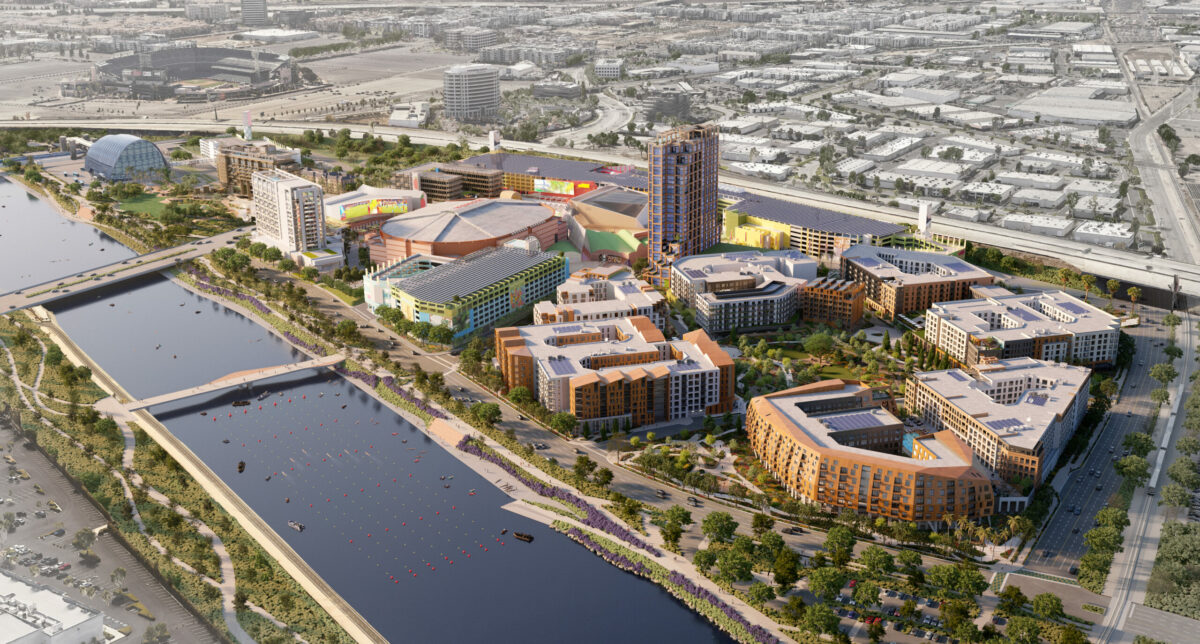
Two of our Future of Real Estate panelists are engaged in cutting-edge development models that integrate home, work, retail and amenities, all with an eye toward affordability and quality of life. Their insights into the future of real estate development will be lessons in how property developers can engage the future of the community.
Radical Change for Home-Buying
The home-buying process is also undergoing radical rethinking. The usual environment of buyers and sellers seeking out agents and brokers to assist in the search process and then seeking financing through a search for an appropriate lender is changing.
Recent court rulings have undermined the traditional model in which sellers absorb both seller and buyer agency costs, and agents and brokers have had to adjust accordingly. More profoundly, platforms such as Zillow and Redfin have lowered search costs for buyers by advertising property availability.
The more recent introduction of so-called i-Buyers—enterprises which make (semi-) automated offers on any home using Automated Valuation Models (AVMs) has lowered the cost of selling a home for many households.
While the long-term viability of i-Buyer entities is uncertain—it has certainly faced a number of challenges over the past half-decade—the use of more powerful computational algorithms for valuation could revive their use and, at the same time, challenge the appraisal profession.
The evolution of real estate agencies and brokerage firms in such an environment will be challenging. Another of our panelists at the Future of Work is a prominent leader in real estate brokerage and will speak to both the homebuying process and the tests facing agents.
But there is more. Real estate has traditionally been a laggard in adopting new technology across its lines of business. Real estate is real—so the argument goes—and not digital and there is some truth to that.
Hands-on, in-person experience with real estate assets is important, and digital technology may never fully replace that rather tactile engagement. This is one of the lessons from the rocky road of i-Buying technology. But the industry overall can surely do with a dose of modernity. One of our panelists has created a real estate experience that seamlessly integrates the entire real estate experience, from search to transaction to financing, into a single platform using computing technology to its fullest potential.
The Future of Real Estate is here. Join Ian Williamson, dean of the Paul Merage School, Ed Coulson, director of the school’s Center for Real Estate, Bill Foltz, CEO of OCVibe, Landon Taylor, CEO of MacFarlane Partners, Gary Acosta, CEO of the National Association of Hispanic Real Estate Professionals, and Bill Qin, CEO of Linkhome, as these and other cutting-edge topics are explored.
They are leaders and their vision for what is to come will be of interest to anyone with an interest in our built environment, and that is everybody.
For more information contact sharon.nakamura@uci.edu.
