

Edwards Lifesciences Corp. was once the poorest performing business unit of Illinois-based Baxter International.
In 2000, Baxter decided to spin out the unit as an independent public company, which had $550 million in debt and a net value of $230 million at the time, according to reports.
It has become one of Orange County’s biggest-ever business success stories.
Edwards’ stock began trading at a split-adjusted $1.15 in 2000. It is now around $90, with a $52 billion market cap, making it the most valuable publicly traded company with headquarters in Orange County.
Under the leadership of Mike Mussallem, Edwards’ first chief executive after the spinoff, the company grew annual revenue from under $1 billion to more than $5 billion by the time he stepped down in 2023.
Its claim to fame was a pioneering breakthrough allowing physicians to replace a diseased heart valve without open-heart surgery. More than 1 million patients have been treated with Edwards’ transcatheter therapies.
“Edwards was not an overnight success by any stretch, but a journey of continuous improvement, and that’s still alive today,” Mussallem told the Business Journal.
The OC Footprint
As Edwards’ therapies gained traction around the world, so did its footprint in Orange County where it is the largest medtech company by employee count. About 5,100 of Edwards’ nearly 16,000 employees work at its expansive Irvine campus.
Edwards has now entered its next chapter under Bernard Zovighian, who took over as CEO in 2023. He is steering the company toward a greater focus on structural heart problems.
He’s made major changes, such as selling Edwards’ slowest-growing Critical Care business to Becton, Dickinson and Co. for $4.2 billion in 2024.
“Edwards has evolved from a bold vision in 1965 to build the first artificial heart valve into today’s global leader in structural heart innovation,” Zovighian told the Business Journal.
“What has remained constant is our purpose to improve patients’ lives. What has changed is the scale of our impact, the depth of our science and the breadth of therapies we bring to patients around the world.”
Edwards most recently reported first-quarter results in April that exceeded analysts’ expectations. The company posted revenues of $1.65 billion and earnings per share of 78 cents. Officials are now eyeing a 9% to 11% increase in full-year sales, up from 8% to 10%.
The Bet That Changed Edwards
When Baxter decided to exit the cardiovascular business, Mussallem raised his hand to become CEO.
Mussallem had joined Baxter in 1979 as an engineer, eventually getting transferred to Orange County in 1988.
The cardiovascular unit was underperforming prior to the spinoff because innovation “had diminished,” according to Mussallem.
“The portfolio was dated, and there was a real lack of growth,” he said. “We needed to reignite the innovation, the portfolio needed to be updated and the culture was not well-defined.”
At the time of the spinout, Mussallem said that there was “just a handful” of successful healthcare companies in Orange County such as Allergan and Beckman Coulter (see page 1).
Fast forward to today, “the whole Orange County ecosystem has grown and matured and is perceived as one of the premier regions for medtech globally,” Mussallem said.
A pivotal moment for the company came in 2004 when Edwards paid $155 million to acquire PVT, a company experimenting with a catheter to replace aortic heart valves.
Instead of performing open heart surgeries, a catheter could be introduced in a small hole in the upper thigh and make its way to a diseased heart valve.
The replacement valve would then inflate like a balloon, pushing aside the diseased valve. The minimally invasive procedure came to be known as transcatheter aortic valve replacement (TAVR).
“The innovation of replacing a heart valve without open heart surgery was transformational for patients, providing them with a far less invasive option and a speedier recovery,” Mussallem said.
Back then, the procedure had its skeptics.
“We’d been advised that it was a fool’s errand, would never work,” Mussallem previously said.
The company had to stop the first trial because early patients didn’t live, and the company had to revamp the procedure.
In 2007, the European Union approved the procedure, followed by the U.S. in 2011.
Company Named in Honor of Inventor
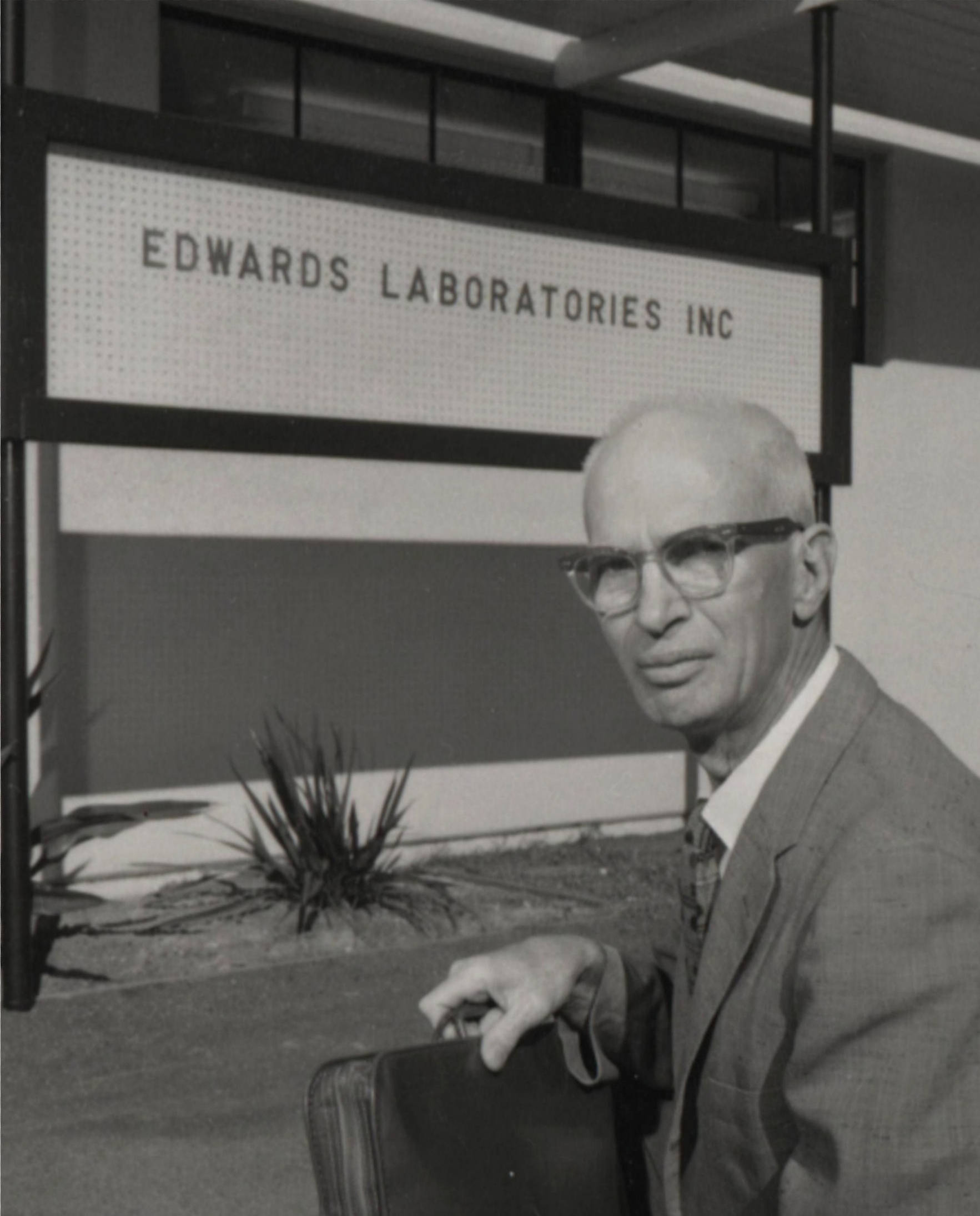
Edwards Lifesciences’ name can be traced back to founder Miles “Lowell” Edwards, who is credited with co-inventing the first commercially available artificial heart valve.
He was an electrical engineer and inventor who suffered from rheumatic fever as a young boy, sparking an interest in solving the heart’s problems.
Edwards owned 63 patents and designed industrial pumps used by Weyerhaeuser Timber Co. and Boeing before retiring.
In the summer of 1955, Edwards and his family purchased a summer home and built a yellow workshop cabin just outside Portland, Oregon. Even in retirement, Edwards remained captivated by pumps—an interest that led him to see the human heart through the same mechanical lens.
In 1958, Edwards brought this concept to Dr. Albert Starr, a young heart surgeon at the Oregon Health & Science University (OHSU), who encouraged Edwards to focus on an artificial heart valve instead of the whole heart.
Over the next two years, they developed the Starr-Edwards mitral valve, featuring a caged-ball design similar to other valves of the time. The valve was implanted in a human patient for the first time in 1960 with newspapers proclaiming a “miracle heart surgery success.”
A year after the surgery, Edwards founded a medical device company in Santa Ana called Edwards Laboratories. American Hospital Supply bought Edwards in 1966 and then American Hospital was acquired by Baxter in 1985, which renamed the unit Edwards Lifesciences.
Edwards launched several firsts in the medtech industry, including the first hemodynamic monitoring system in collaboration with cardiologists Jeremy Swan and William Ganz.
The company pays tribute to its founding history with a life-size replica of Edwards’ workshop that sits at the center of its campus. The replicated workshop includes original artifacts including machinery, tools and equipment from the Edwards family and the OHSU Historical Collective & Archives.
Edwards Lifesciences Corp.
FOUNDED: 1958
LEGACY LEADERSHIP: Mike Mussallem
HQ: Irvine
OC SIGNIFICANCE: Anchors Orange County’s thriving medical device sector as the second-largest public company in the region.
DEFINING MOMENT: Was acquired by Baxter International Inc. in 1985, then spun out in 2000.
BY THE NUMBERS: Market cap was around $1B when company went public; now worth about $51B. Largest medtech employer with about 5K locally in Irvine and nearly 16K worldwide.
QUOTABLE: “When Edwards became a publicly traded company, headquartered in Orange County, it felt like the whole community really welcomed us in a new way, compared to when we were the division of an Illinois-based corporation.” – Mike Mussallem
FUN FACT: Company was named in honor of Miles “Lowell” Edwards, who built the world’s first mitral valve successfully placed in a patient.
