

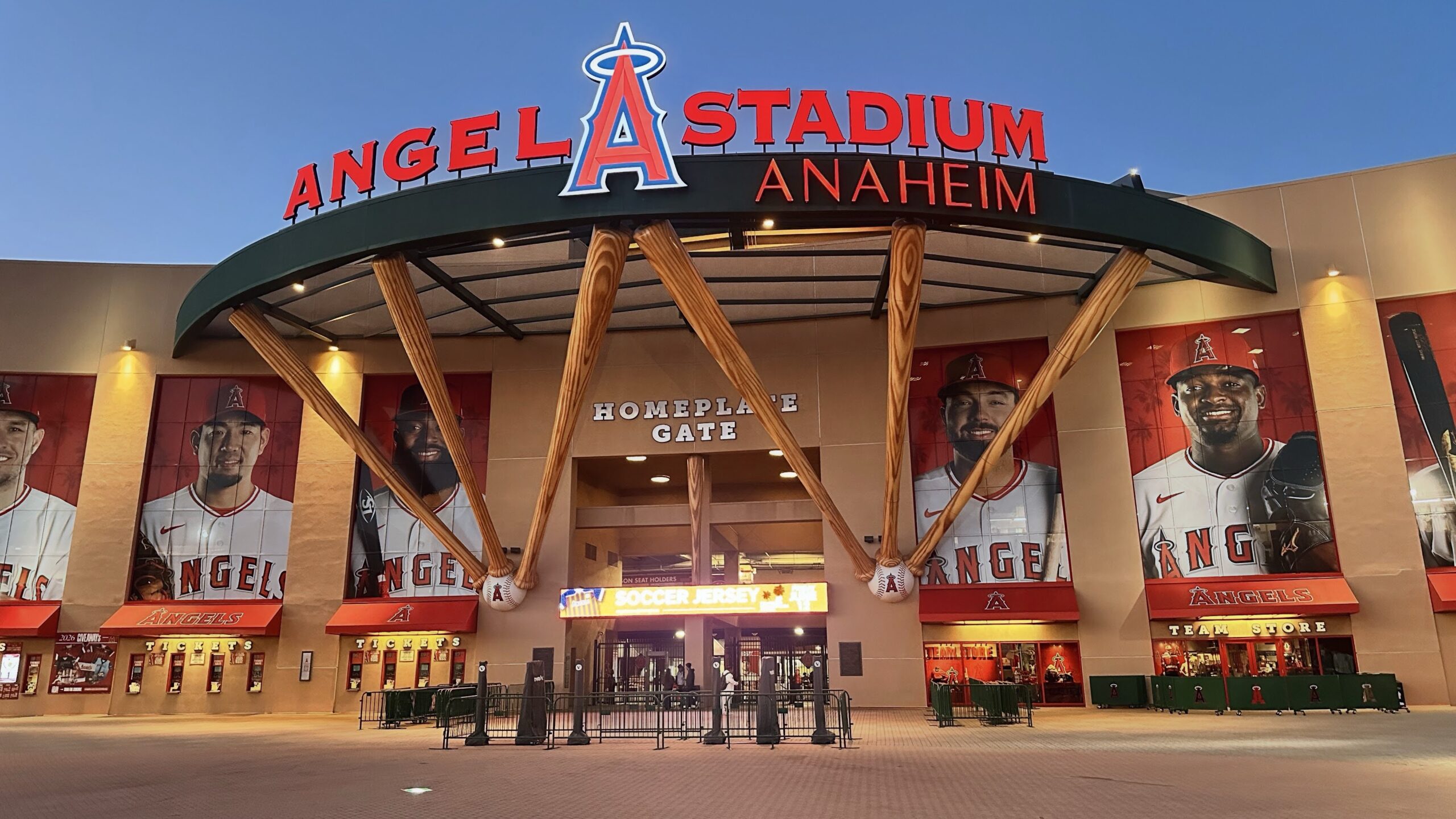
ANAHEIM — When Arte Moreno promoted Molly Jolly to president of the Los Angeles Angels in April, he entrusted the club’s longtime finance executive with overseeing the organization’s business operations and one of the biggest media decisions in franchise history.
“He didn’t ask anything of me,” Jolly said during an interview with the Business Journal inside the Lexus Diamond Club Restaurant on June 8. “He offered me an opportunity … his perspective was that this is an organization for me to lead. That has been really empowering.”
It was a milestone move for the ball club. Taking over from former president John Carpino, the promotion made Jolly the first woman to serve as president of the Angels and one of only three women to serve as presidents in Major League Baseball.
She is also facing a slew of problems. The club hasn’t been to the playoffs since 2014, has lost stars like Shohei Ohtani, and has seen attendance dip by half a million since 2019.
To top it off, when the Angels’ broadcast partner fell apart earlier this year, Jolly had to start a new broadcast network for the team—Angels Broadcast Television, or ABTV.
Starting a 24-hour regional sports network days into her new role has been a “feet to the fire” moment for Jolly, who said she has no prior broadcast experience.
“To be honest, I’m still figuring it out,” she said.
Despite the problems, the Angels are still a winning business as valuations of major league baseball teams have soared. Since Moreno bought the team for $184 million in 2003, its value is now estimated at $2.8 billion, according to Forbes.
In 2025, the team generated $377 million in revenue and an operating loss of $14 million, Forbes estimated.
Launching ABTV
The Angels had previously relied on FanDuel Sports Network West for its live games. However, the network’s parent company, Main Street Sports Group, said earlier this year that it’s winding down operations due to ongoing financial difficulties, particularly as viewers cut cable in favor of online subscription services.
Rather than go with Major League Baseball’s network, the Angels launched their own on March 6.
Jolly framed the decision as a branding and fan-engagement decision rather than one driven primarily by economics.
“It really wasn’t a financial decision,” Jolly said. “It was a strategic organizational decision about who we are and how we present ourselves to the people that care the most about us, which are the fans and the community.”
In other words, ABTV allows the Angels to control their own narrative, be nimble and “make choices” about who the organization partners with, she added.
“Our long-term vision is to have an operating platform for the Angels where we really can connect across TV, radio, marketing and digital,” Jolly said. “Have it all be integrated and create a fandom where you’re connected on a variety of platforms.”
In March, the Angels purchased the 50% stake in FanDuel Sports Network West held by Main Street’s Sports Group, allowing the Angels to own the channel outright, according to Sports Business Journal. This purchase allowed the games to continue on the same cable and satellite channels without disrupting subscribers.
The team got off to a good start by convincing the Los Angeles Kings, which was previously on FanDuel’s network, to stay on the Angels’ new network. The Angels declined to disclose the details of its partnership with the Kings.
A 24/7 Network Startup
The network currently operates 24 hours a day, seven days a week. Besides extensive airings of Angels and Kings games, the network’s programming also includes “Angels Weekly,” the “Under the Halo Podcast” as well as “Swing Clinic with Jimmy Hanlin,” “Diggin’ Deep,” among other sports adjacent shows.
Future programming could expand beyond live games to include hour-long features on players, community stories and original content.
Nick Garvin, CEO of the Angels’ production partner Mobile TV Group, told the Business Journal that ABTV allows the team to move more quickly than larger media organizations when testing new technology and presentation formats, such as enhanced graphics and super-slow-motion cameras.
“I think that’s an additional pro of working so closely with Molly and the Angels,” Garvin said. “We can react and innovate much faster.”
The team said early results from ABTV have been encouraging.
According to the Angels, viewership during the first month of the season increased 26% compared with the same period a year earlier. The club declined to give details on the actual number of viewers per game.
The organization also chose not to market the transition from FanDuel to ABTV, a decision Jolly said was intended to avoid confusing viewers.
For now, Jolly’s focus is on giving Angels fans a great experience.
“The priority right now is delivering the quality live game experience our fans expect and deserve,” she said.
Observing Controlled Chaos
Back inside the production truck before first pitch against the Houston Astros, Jolly stood in the dark, cramped space parked outside Angel Stadium, closely observing the new business that she now oversees. Producers called out instructions as staff monitored the dozens of moving parts behind the night’s broadcast.
The veteran Angels executive knows she has a daunting task ahead—building a competitive team and a broadcast network that supports it.
She wants people to know who the Angels really are.
“My first day [as president] was April 6, the Monday after opening day,” she told the Business Journal. “I’ve been focused on listening, learning … part of my focus is really talking about who we are and who we are in the community, especially from an organization and a brand perspective.”
Surrounded by producers monitoring rows of screens and camera crews preparing throughout the ballpark, Jolly moved through the trailer asking questions and occasionally pointing to a monitor as staff explained the complex operation unfolding around her.
Up to 40 production workers monitor dozens of moving parts behind a live game broadcast — from graphics and instant replays to audio feeds and camera shots. One employee managed the night’s “one sheet,” coordinating sponsor messages, promotions and commercial breaks around the rhythm of the game.
Outside in the ballpark, about a dozen camera operators, along with a robotic camera named “Tim,” were positioned to capture all aspects of the game from the action on the field to crowd shots.
One producer described the operation as “controlled chaos.”
“We’re like the duck’s legs paddling underneath the water, moving as fast as possible,” said Max Leinwand, one of the network’s producers said as he gave the Business Journal a tour of the trailer. “But everything you see on top of the water needs to look stable and calm.”
The goal, he added, is simple.
“A good game broadcast tells the audience what happened, why it happened and gives them pretty pictures,” he said.
Behind the Scenes
The Los Angeles Angels are not building a network alone.
The organization partnered with Mobile TV Group, a Denver-based media technology company that has worked on Angels broadcasts through previous network iterations, including Fox Sports West, Bally Sports and FanDuel Sports Network West.
Mobile TV Group supplies a production truck that costs $10 million and is parked outside Angel Stadium.
The truck’s equipment is basically the live game’s brain by helping coordinate the cameras, replay systems and technical infrastructure used to create and distribute the live broadcasts, Nick Garvin, Mobile TV’s CEO, told the Business Journal.
“We’re a company that pretty much everyone has seen our work, but very few know who we are,” Garvin said.
As the game is being produced, a live feed is sent to Mobile TV Group’s media center in Denver, where advertising, closed captioning, and quality control are added before the signal is distributed to television providers and streaming platforms.
Garvin said the Angels’ launch of a regional sports network in such a short period of time was no small task.
“Being 24/7 is a beast,” he said. “It’s relentless.”
The Angels officially assumed control of the regional sports network operation on March 6, giving the organization only weeks to prepare for the start of the baseball season.
Garvin credited Jolly and her team for assembling the pieces necessary to launch the network so quickly.
“The Angels deserve a ton of credit for what they’ve done in such a short period of time,” he said.
—Joseph Pimentel
Angels Baseball Foundation Awards Scholarships to 8th Grade AVID Students
ANAHEIM — The Los Angeles Angels are extending their reach beyond the field and into education.
The team’s Angels Baseball Foundation is helping Orange County students get a head start on saving for college through a scholarship program for 8th graders in AVID (Advancement Via Individual Determination), a nonprofit organization dedicated to “closing the
opportunity gap by preparing all students for college and career readiness and success in a global society.”
This month, the foundation recognized eight students who were selected to receive $10,000 in scholarships that will be held in a trust until they graduate from high school and enroll in a four-year university.
“Education is one of the pillars underneath the Angel’s Baseball Foundation,” Angels Scholarship Programs Manager Lilea Acasio told the Business Journal. “We really believe in making a difference in families and also making general change because some of these students are first-generation college students.”
The eight finalists were chosen from 68 local middle schools offering the AVID program. Acasio said that nominees were recommended by teachers for displaying academic drive, leadership skills and community involvement.
One of this year’s recipients was Juxi “Bella” Liu, who just graduated from Vista Verde Middle School and will be attending University High School in Irvine next fall.
In 2020, Liu founded the nonprofit U.S. Leader Group with her family, helping raise $100,000—alongside several other nonprofits—to donate a van to the Irvine Police Department’s Explorer Program.
Liu said that she’d like to attend Stanford University or UCLA to study to become an orthopedic surgeon, biomedical engineer or financial advisor in the future.
Receiving the Angels scholarship reduces the burden on Liu’s family and now allows her to “go full speed ahead,” she said.
The scholarship program was founded in 2006 by the Angels Baseball Foundation in partnership with the Orange County Department of Education and AVID.
Over the years, the scholarship amount has grown from $4,000 to the current $10,000, according to Acasio.
Since inception, the foundation has awarded more than $1.1 million in scholarships to 145 students to date.
2026 Scholarship Recipients:
• Peton Acosta of Alamitos Intermediate School in Garden Grove Unified School District
• Emilia Ayala of Yorba Middle School in Orange Unified School District
• Eldon Bailey of McFadden Institute of Technology in Santa Ana Unified School District
• Anna Hughes of Hewes Middle School in Tustin Unified School District
• Laurie “Lam” Le of Johnson Middle School in Westminster School District
• Juxi “Bella” Liu of Vista Verde School in Irvine Unified School District
• Guadalupe Montillo of TeWinkle Middle School in Newport-Mesa Unified School District
• Katie Rojas of Warner Middle School in Westminster School District
—Yuika Yoshida
A Homegrown Executive
Long before she oversaw a brand-new television network, Molly Jolly helped manage the business operations of two Anaheim sports franchises.
Her love of sports is rooted in her early academic years. A Naples, Florida, native, Jolly swam and cheered at the College of the Holy Cross, a private Jesuit liberal arts college in Worcester, Massachusetts. She later built her career in finance, eventually becoming director of finance for the Walt Disney Company’s Anaheim Sports Inc., which at the time operated both the Angels and the Anaheim Ducks.
She joined the Angels nearly 26 years ago, initially serving as a finance executive before moving through a series of leadership roles across the organization.
She most recently served as the Angels’ senior vice president of finance and administration.
Jolly managed all financial operations and office administration, including legal, risk management, human resources and information services. She also oversaw financial operations at Angel Stadium for major non-baseball events, including Supercross and Monster Jam.
—Joseph Pimentel
ABTV Launches Amid Industry Upheaval
Helping build a contending team and launching a broadcast network that Los Angeles Angels fans want to watch are among Molly Jolly’s goals.
Winning teams typically attract larger television audiences, making it easier to attract advertisers, build viewer loyalty and expand the fan base.
“It’s really what every sports team is trying to figure out,” said Jolly, who became president in early April. “How do you bring those fans into the network in a way that hasn’t been defined yet?”
Jolly faces those questions at a time when the traditional sports broadcasting business is under pressure. Millions of Americans have abandoned cable subscriptions in favor of streaming services, shrinking the audience base regional sports networks once relied upon. Younger viewers increasingly consume highlights and short-form clips on mobile devices rather than sitting through a three-hour live game broadcast.
Sports teams are also competing for attention against an ever-expanding menu of entertainment options across streaming and social media platforms.
For the Angels, the challenge extends beyond the changing media landscape. The franchise is trying to reconnect with fans after more than a decade without a playoff appearance, 10 consecutive losing seasons and the departure of former MVP Shohei Ohtani to the rival Los Angeles Dodgers.
The team currently sits at the bottom of its division.
—Joseph Pimentel
