

If you’ve visited Knott’s Berry Farm, The Outlets at Orange or Fashion Island’s food court, chances are you’ve seen the water features and rockwork created by Outside the Lines.
The 18-year-old Anaheim-based specialty construction company designs and builds water features, rockwork and themed environments for public spaces, resorts and theme parks around the world—from a tranquil memorial at the Sandy Hook Elementary School site to rock installations at the Detroit Zoo.
For Chief Executive J. Wickham Zimmerman, the construction work is just as much about artistry as it is engineering.
“I became enamored with the business because it was very different,” Zimmerman told the Business Journal. “No two jobs were similar. Really, the only time in construction where I’ve seen the left and right sides of the brain kind of be forced to merge.”
Launching During the Great Recession
Zimmerman and his partner, the late Hugh Hughes, launched Outside the Lines (OTL) in Orange during the Great Recession in 2007. He noted it “wasn’t the perfect time to start” a business.
Early projects by the company, now based in Anaheim, included the reflective black granite fountain at The Outlets at Orange, a water fountain at the Fashion Island food court, the Jaguar Lagoon at Knott’s and three fountains at Lakeshore Towers in Irvine.
Coming up next—water features at Hoag Hospital’s Irvine campus expansion.
“The project includes two water features—a water wall and a cascading-style fountain—both designed to complement the calm and healing environment of the campus,” Zimmerman said.
The company routinely works with local firms such as LPA Design, AO and Lifescapes International.
The Rise of AI-Driven Water Features
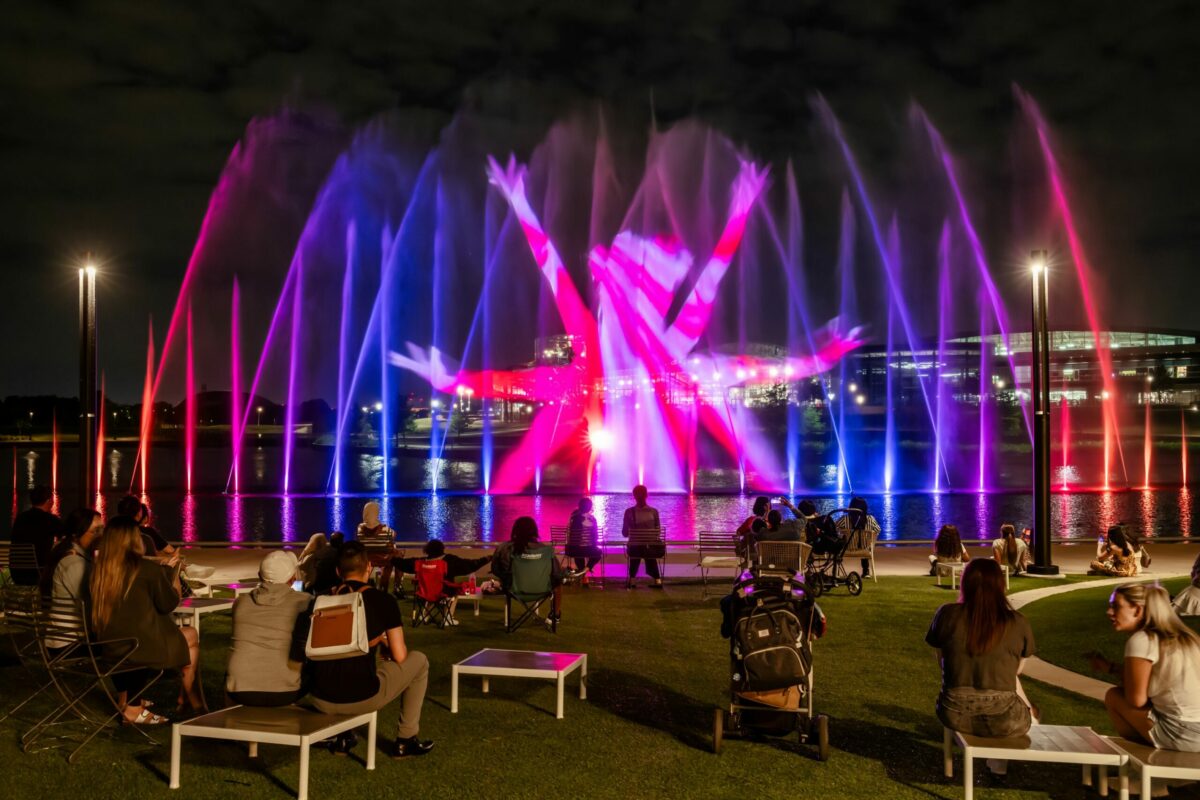
OTL is currently evolving its show fountains to be immersive, choreographed water experiences with light, sound, and motion using artificial intelligence through its proprietary system, Aquarius Interactive.
The AI-driven water feature system is designed to engage directly with people.
Think of it as a more immersive experience than the famed Fountains of Bellagio in Las Vegas.
“Everybody talks about the Bellagio, which is a very cool fountain for sure,” Zimmerman said. “But you can’t stop there.”
OTL uses LED lights capable of displaying a million colors—more than the human eye can see—and is choreographing those lights to music and adding fog and fire.
“It’s truly interactive,” Zimmerman said.
The company uses AI in a couple of different ways.
“One is object detection. So, we now have multiple cameras that detect objects, size, location, motion, and so forth, and then translate that motion into signals that a DMX controller understands,” Zimmerman said.
DMX, he explained, is the same programming language used for concert lighting and show fountains.
The result: “You walk up and raise your arms like this, and the water will go up,” Zimmerman said, demonstrating with his arms. “You walk by, and the water starts to follow you. You stop, and the water stops. You walk back the other way; the water goes the other way.”
Aquarius Interactive technology was recently added to fountains at the Mountain View Village retail center in Riverton, Utah, and Illuvia at EpicCentral, an entertainment district in the greater Dallas metro area. The interactive fountain in Texas draws about 30,000 weekly visitors for its free nightly shows, where water, lights and video projection are all choreographed to music.
Zimmerman said OTL is working with a client in Tennessee on a potential installation and is also in discussions with a major fountain equipment manufacturer about integrating Aquarius Interactive into splash pads and pop jet systems.
No AI-driven projects are in the works in OC.
Zimmerman said the company’s show fountains typically start at several million dollars, with the largest reaching about $10 million. He noted that water features represent the company’s core revenue stream, with the AI component being part of its future growth.
“I believe Aquarius Interactive represents the future of entertainment-driven water features,” he said. “As public spaces continue to evolve, people want experiences that respond to them, not just perform for them. That is exactly what this technology delivers.”
