

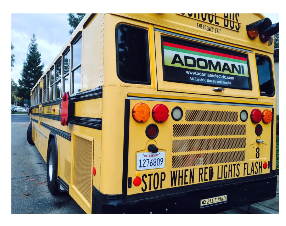
ADOMANI Inc., the first equity crowdfunded company to list on the Nasdaq, has moved its headquarters from Newport Beach to Corona in Riverside County and landed its first contract to build an electric school bus.
The move from Newport Circle to 4740 Green River Road just over the Orange County line, comes about four months after the manufacturer went public, raising $9.2 million in a Regulation A common stock offering.
The new 4,800-square-foot office houses about half of the company’s dozen employees. Others are based in Milpitas, Ariz. and a production facility in Orange, where it handles research and development, battery testing and prototypes.
“It’s just central office base,” convenient for employees who live in north OC and the Inland Empire, Chief Executive Jim Reynolds told the Business Journal.
Meanwhile, newly formed subsidiary, School Bus Sales of California Inc., is working on its first purchase order. The distribution unit partnered with Canadian school bus maker GreenPower Motor Company Inc., which will build Los Angeles Unified School District’s first zero-emission, electric school bus in the 1,300-vehicle fleet. The hope is that the district will order more if it’s happy with the performance, cost and maintenance of the vehicle.
The order for the 72-seat vehicle came in at just under $400,000, a positive development, considering ADOMANI hadn’t generated “any material revenues” before its public offering in June and had posted net losses since its 2012 inception, according to its prospectus.
“Since then, we have received orders for additional school buses,” said Reynolds, adding he couldn’t discuss orders that haven’t been publicly disclosed.
The cost of a new school bus varies widely, depending on options, financing and planned years of service, but those that run on diesel typically cost around $125,000, propane $135,000, and compressed natural gas $165,000 or more.
The subsidiary was established as the California distributor of school buses, while the parent supplies electric drivetrains.
Bluebird Deal
The unit has another manufacturing partnership with the country’s largest school bus maker, Bluebird Corp., which produces over 11,000 units a year. The Fort Valley, Ga.-based company trades under Nasdaq ticker BLBD and posts about $932 million in annual sales.
Bluebird exhibited a school bus powered by an ADOMANI drivetrain at a Reno trade show in July, and plans to showcase another vehicle at the National Association of Pupil Transportation conference in Ohio next month in an effort boost awareness and business.
The L.A. school district accessed funding from the South Coast Air Quality Management District and California Air Resources Board for the purchase, which requires a few custom designs, including roof lights so that helicopters can track the vehicle, if needed for occupants’ safety.
The bus will feature two battery packs inside the frame rails that will produce 150 kilowatt hours of power, generating about a 100-mile range before charging is needed, according to Reynolds.
The order highlights one of three hopeful business lines for the startup.
ADOMANI developed a drive train that converts an internal combustion engine into an electric motor assembly. Its retrofit business targets fleet vehicles produced before 2010, when a new set of state emission standards and new-vehicle requirements took effect.
The company is also building drivetrains for original equipment makers.
First Coverage
SeeThruEquity, an independent research firm in New York focused on small-cap and micro-cap public companies, views ADOMANI as an intriguing play in the emerging high-growth market for electric vehicles.
“The company offers a speculative, high risk/high potential reward conduit for gaining exposure to the large opportunity for electric school buses and commercial fleet vehicles in the U.S. and potentially China,” it wrote in a recent investor note.
SeeThruEquity initiated coverage last week with a $10.20 price target, and cited a potential pipeline of $270 million in sales over the next year in North America alone, based on an ADOMANI regulatory filing in March.
Reynolds and Vice President Kevin Kanning recently hosted an economic development delegation from China in San Francisco, engaging in early discussions to establish a drivetrain development and manufacturing facility in Nantong.
The talks will next move to China, where the most populous country is implementing major changes in its transportation grid and environmental policies, including a push to ban nonelectric delivery vehicles in urban areas over the next few years, with an ultimate goal of prohibiting all fossil-fuel vehicles. Industrial and other pollution have caused widespread health and environmental problems in China.
“We have another trip scheduled in 60 days,” Reynolds said.
Post-IPO
ADOMANI, which has the Nasdaq ticker ADOM, was trading around $6.80 as of presstime last week.
Its shares are down about 15% since its June 15 initial public offering, peaking at $18.31 in mid-July with a market value over $1 billion.
Its market cap has since settled to about $466 million.
ADOMANI became the first equity crowdfunded company to list on the tech-heavy exchange after selling more than 2.5 million shares at $5 per share through flashfunders.com. The underwriter was Irvine-based Boustead Securities LLC, a former sister company of FlashFunders Inc. in Santa Monica.
Boustead acquired FlashFunders and its subsidiaries in August on undisclosed financial terms.
The company raised the IPO through a provision in the Jumpstart Our Business Startups Act, which was signed into law in 2012 by former President Barack Obama to allow crowdfunded companies to issue securities.
A central goal of the JOBS Act was expanding access to capital for entrepreneurs and emerging companies. Under it Regulation A+ of Title IV—adopted by the Securities and Exchange Commission in 2015—private, growth-stage companies can raise up to $50 million from nonaccredited investors, essentially the general public.
