

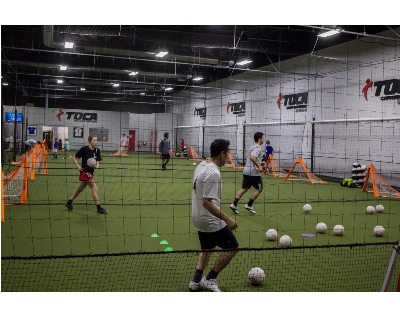
The green turf fields are full on a Tuesday afternoon at the Toca Football complex in Costa Mesa.
The four training zones are outfitted with Toca Touch Trainer machines, spitting out smaller-than-standard sized soccer balls to players, a mix of beginners, professionals and aspiring college and pro players, waiting to spring into action and sweep the ball into the goal.
It’s all about practicing a player’s first touch with the ball, in an environment where players have time to slow down and focus on their own weaknesses, according to Eddie Lewis, a 15-year professional player in England and the U.S., and executive founder and president of Toca Football.
Lewis’ patented machine—similar in design to a tennis ball machine—combined with the company’s “small ball philosophy,” gives soccer players a chance to hone their skills in a condensed amount of time, and work with a coach in a family-friendly environment.
Members with a $29 monthly membership pay $59 per hour-long session at Toca, while non-members pay $90 per session.
Pricing goes down for two and three player sessions.
A player honing their skills with smaller-sized balls and other objects is not a novel approach; the “things I could do with a football, he could do with an orange,” famously said French star Michel Platini, when once speaking of the skills of Diego Maradona, arguably the greatest soccer player ever.
Adding the coaching element to the mix for America’s huge youth soccer community, along with heavy amounts of entertainment-focused elements for the business, though, makes Costa Mesa-based Toca a company to watch in the sports industry.
The 5-year-old company late last month said it closed a $25 million Series D round of funding. News reports now put the company’s valuation in the $200 million range.
To prepare for a planned growth push, the firm recently enlisted entertainment experience veteran Yoshi Maruyama to lead the line as its new chief executive.
Team Leader
Maruyama, who spent a combined two decades at Universal Parks & Resorts and DreamWorks Animation, and who has served as chairman for publicly traded SeaWorld Entertainment Inc. (NYSE: SEAS), said he was brought on to help the company “deliver a world-class entertainment experience.”
He added that moving forward, Toca’s business model will hinge on owning and operating training facilities, so the company is able to control the experience for individual players and groups.
Toca currently owns 12 indoor training centers in California, Georgia and Washington, and has licensing agreements with 18 affiliate facilities. Along with its roughly 10,000-square-foot training facility and headquarters along Bristol Street, it also has regional locations in Torrance and Chino Hills.
New indoor facilities are expected to include about 12 training fields, which can be transformed into a full-size soccer field that will allow the company to conduct league business during evening hours, according to Maruyama.
The company also hosts the Toca Academy at various schools to test demand in various locations. In Costa Mesa, the Pateadores Soccer Club regularly uses the facility for training sessions and practice scrimmages, added Lewis.
While the company’s immediate focus is ramping up its base of training centers, in addition to greenfield locations where there is demand, it is also looking into more entertainment-focused offerings for fans of the sport.
Toca Social, a large venue where consumers can play soccer, as well as eat, drink and relax with friends, is currently in the research and development stage.
The company hopes to take the wraps off the concept in London next year.
Key Players
The focus on a fan-friendly experience, rather than a player-centric one, represents a shift toward the method that brought Dallas-based Topgolf Entertainment Group—whose collection of 60-plus facilities include a mix of golf training areas, party venues, sports bars and restaurants—success.
“They’ve taken the sport of golf and put it in an ‘anyone-can-play environment’ that is still authentic to the sport,” said Maruyama. “We have the chance to do that with a much more popular sport.”
Maruyama added that the company is also looking into community engagement to bring together the 2 billion soccer lovers worldwide in a gamified, yet authentic environment.
Toca and Topgolf count other similarities.
Toca is backed by TopGolf’s lead investor WestRiver Group of Seattle, along with Laguna Beach-based RNS Capital Partners and affiliated family office investors. WRG founder and Chief Executive Erik Anderson and RNS Principal Tom Denison serve as co-executive chairs of the board.
The company raised a $6.3 million Series A round of funding in 2016, followed by a $5.3 million Series C round in 2018, Crunchbase records indicate.
The seven-person board includes Celeste Burgoyne, executive vice president of the Americas and global guest innovation at Lululemon Athletica Inc. and Scott Maw, former chief financial officer at Starbucks Corp.
Soft Start
Lewis, a Cerritos native, fell in love with soccer at a young age, but he liked a lot of other sports, too. So training during his youth was limited.
Between the ages of 8 and 12 years old, it is critical to learn the proper techniques and skills—in particular, a deft first touch of the ball—required to play soccer at a high level.
But the nature of the fast-paced sport, and the typical training methods in the U.S., doesn’t give kids enough time to drill their own skills, he said.
“I couldn’t just keep losing the ball at my own expense, so that I could practice some more,” Lewis explained of his experience as a youth player.
Lewis himself fell behind the curve, and by the time he got to the University of California-Los Angeles, he was “a long-shot recruit.”
And then one evening he stumbled across the UCLA Bruins basketball team, practicing their three-point shots with a smaller-than-regulation sized hoop.
“The idea made sense to me, so I got a tennis ball and started [kicking] it around,” explained Lewis.
Shortly after his discovery, Lewis purchased a portable tennis machine to practice his shots, and spent his free time shooting the balls in empty industrial parks and garages in West L.A.
“I was getting six months of practice in a week,” he said. “I started blowing past my teammates.”
“When I graduated, I was drafted into Major League Soccer, and I went on to have a successful career.”
That’s an understatement for a player that former club and national team coach Bruce Arena once called “arguably the finest left-sided midfielder in the history of U.S. Soccer.”
He played overseas for 10 years, with stints including English clubs such as Leeds United, Preston North End and Fulham, and in the U.S. played for the L.A. Galaxy, among other teams.
In the 2002 World Cup, Lewis’ inch-perfect cross to Landon Donovan led to the second goal in the U.S.’s famed “dos a cero” win over Mexico; the round-of-16 victory is the only knockout round win for the men’s team in the World Cup in over 50 years.
Lewis is the first to say that he is “living proof” of his own invention, though it was his wife, Marisol Lewis, who encouraged him to introduce it to the world.
“She told me that it was going to help millions of soccer players around the world.”
