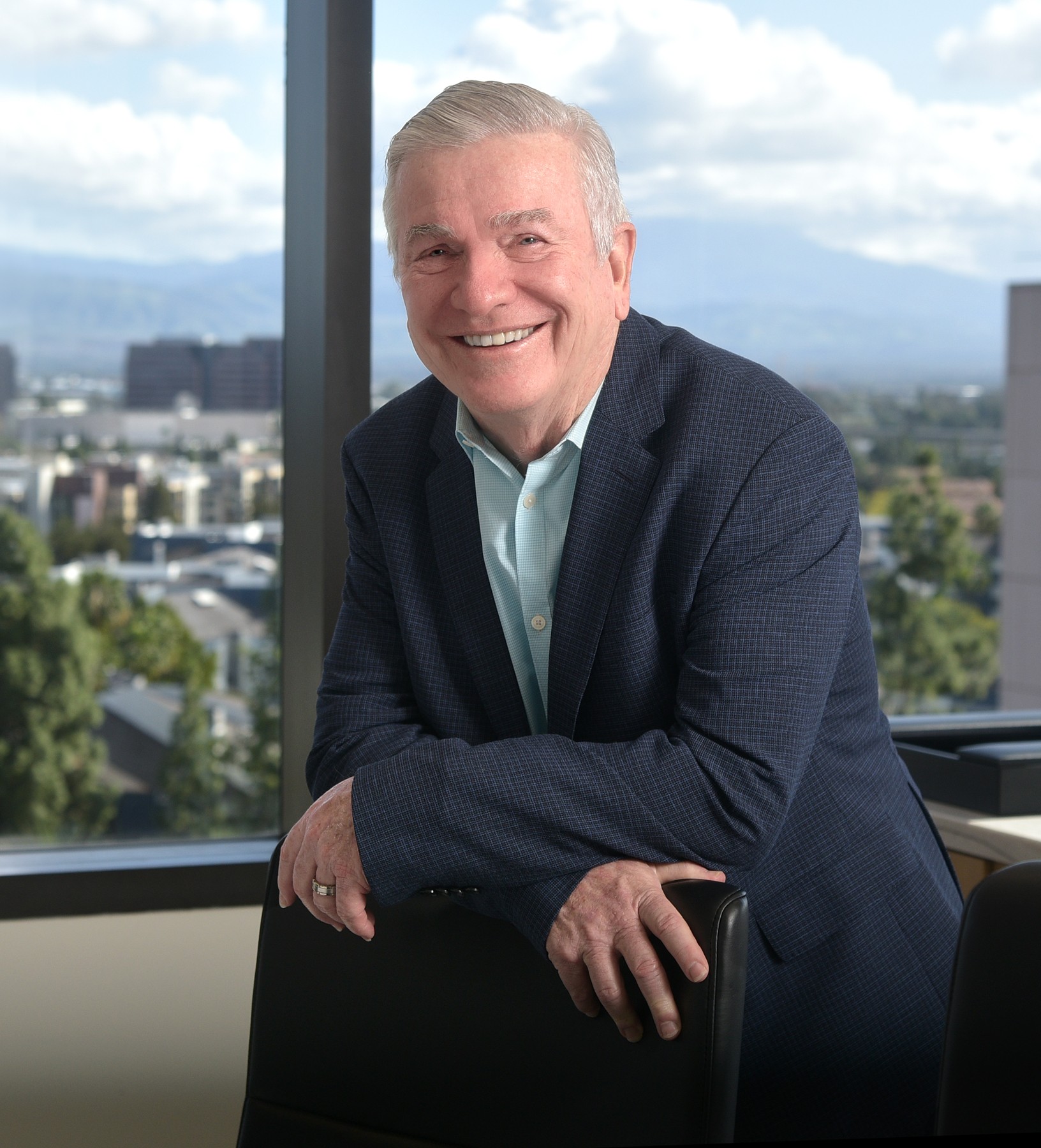

It’s not often a father and son can together build a company to a $2.6 billion valuation.
It’s even rarer to find one that spins off another firm that by itself becomes worth another $2.1 billion.
Such is the case of Roy E. Christensen and son Christopher Christensen who in 1999 began the Ensign Group, (Nasdaq: ENSG) a provider of healthcare-related services at nursing homes and other facilities and one of the most valuable publicly traded companies in Orange County (see list, page 21).
In 2014, Ensign spun off its real estate assets into San Clemente-based CareTrust Reit Inc., which has a $2.1 billion market cap.
“It’s a terrific story,” said Greg Stapley, chief executive and chairman of CareTrust. “Roy is the visionary while Christopher makes things work. It’s been a great team effort.”
Wall Street has noticed. Ensign Group’s shares have doubled in the past year. 2018 sales rose 10% to $2.04 billion while net income more than doubled to $92.4 million, or $1.78 a share (see box, this page)
The company forecasts 2019 sales rising to between $2.29 billion and $2.35 billion, a 14% increase at the midpoint. Profit may rise at an even faster pace: $2.17 to $2.26 per share.
“We’re very excited about the coming year and our guidance demonstrates our optimism,” Christopher Christensen told analysts on a February conference call.
The 20-year run of father and son is about to change.
Roy Christensen will step down as chairman May 30, and remain on the board. Christopher, chief executive, will become executive chairman, working full-time on strategic growth initiatives and new business ventures. Barry Port, who has been chief operating officer for five years, will become CEO.
“They have a rather deep bench on the management level,” said Dana Hambly, a research analyst at Stephens Inc. “I don’t see a change in strategy.”
Father and son together own about 2.5 million shares, or about 3.9% of Ensign Group, according to its latest proxy. That stake was worth about $123 million at press time.
Old Industry
Ensign Group is in an industry where aging is a good thing.
About 78 million Americans will be older than 65 by 2030, up from 41.5 million in 2012, according to the U.S. Census Bureau. Nursing home expenditures will grow from $156 billion in 2014 to $274 billion in 2024 for an annual compounded 5.3% growth rate, according to the Centers for Medicare & Medicaid Services.
It’s also a highly regulated industry where class action lawsuits over practices and government probes into billings are common. Ensign in 2013 reached an agreement with the Department of Justice to remit $48 million in disputed billings and accepted a five-year monitoring program; the company denied any wrongdoing.
The Service Employees International Union has criticized the company and other for-profit skilled nursing operators for questionable practices, Ensign’s annual report said.
Skilled nursing is a relatively low margin business where competitors often include nonprofits.
“We call them the best house in a bad neighborhood—skilled nursing is not a great industry,” Hambly said.
It’s also fragmented, with 15,000 nursing homes nationwide. Companies can buy too many assets and rack up debt.
“That’s where their competitors have gotten into trouble,” he said. Ensign has “maintained a disciplined balance sheet.”
Buy Underperformers
The company’s general policy is not to speak with the press, according to an executive when the Business Journal asked for an interview. The website doesn’t have photos of directors or executives.
“They’ve always been pretty low key,” said Stifel analyst Chad Vanacore. “They don’t even talk to many analysts.”
Roy Christensen has almost 50 years in the long-term care industry, dating back to when he was also a member of President Richard Nixon’s Healthcare Advisory Task Force on Medicare and Medicaid.
He founded long-term companies such as in 1994 Covenant Care Inc., an Aliso Viejo-based based provider of healthcare centers with 4,000 residents and patients.
In 1999, the father and son along with four others co-founded Ensign with the goal of establishing “a new level of quality care” within nursing homes.
Roy began as chief executive, while Christopher started as president and became CEO in 2006. Another son, Clayton Christensen, is director of learning and development, overseeing training and professional growth programs.
The company started with 665 beds in 1999 and climbed to 19,615 beds by the end of 2018.
The pair’s modus operandi has been to acquire struggling facilities and transform them into successful stand-alone entities by giving local management the authority to make their facilities the best in their communities.
As of Dec. 31, Ensign had 244 businesses operating independently with 23,463 employees. Besides nursing homes, it provides rehabilitative care services, hospices and home healthcare. It generates revenue from a combination of private pay sources, Medicaid or other state-specific programs.
Last week it bought facilities near Dallas and Phoenix; it said the 52-unit memory care community near Lewisville, Texas was underperforming, at 40% occupancy.
“What Ensign has done very well is take underperforming skilled nursing facilities and turn them around, improving the quality of care and the profitability,” Vanacore said. “That is a monumental task that is difficult to achieve.”
2007 IPO
The company went public in 2007, opening at a split-adjusted $3.32 a share. At press time, shares traded near $50.
In 2014, it spun off its real estate holdings into CareTrust. Stapley, who co-founded Ensign and was its general counsel for a decade, became CareTrust CEO.
“Ensign spun out all of its real estate and did it in a smart way,” Hambly said. “They are sort of a different animal in the arena that they are playing.”
After the spinoff, Christopher Christensen became a director of CareTrust and owned 1.1 million shares, or 4.8% of the company. He is no longer a director and it’s unclear how much stock he now owns.
Since the spinoff, CareTrust shares have climbed 34%. If Christensen held onto those shares, they’d be worth about $25 million.
The two companies still have close connections. About 92 of CareTrust’s 194 facilities are leased to Ensign Group.
Ensign itself has gradually moved back into real estate. It owns 72 of the 244 facilities it runs, according to a regulatory filing.
“When you can buy a distressed asset for cents on the dollar and turn it around, you create a ton of value,” Stapley said. “It’s a powerful business model that we created.”
The two firms rarely compete against each other because CareTrust tends to buy premium properties already in good shape while Ensign Group pursues underperformers, Stapley said.
“What those guys do is not easy and they do it very well,” Stapley said. “They’re fantastic operators and wonderful business people.”