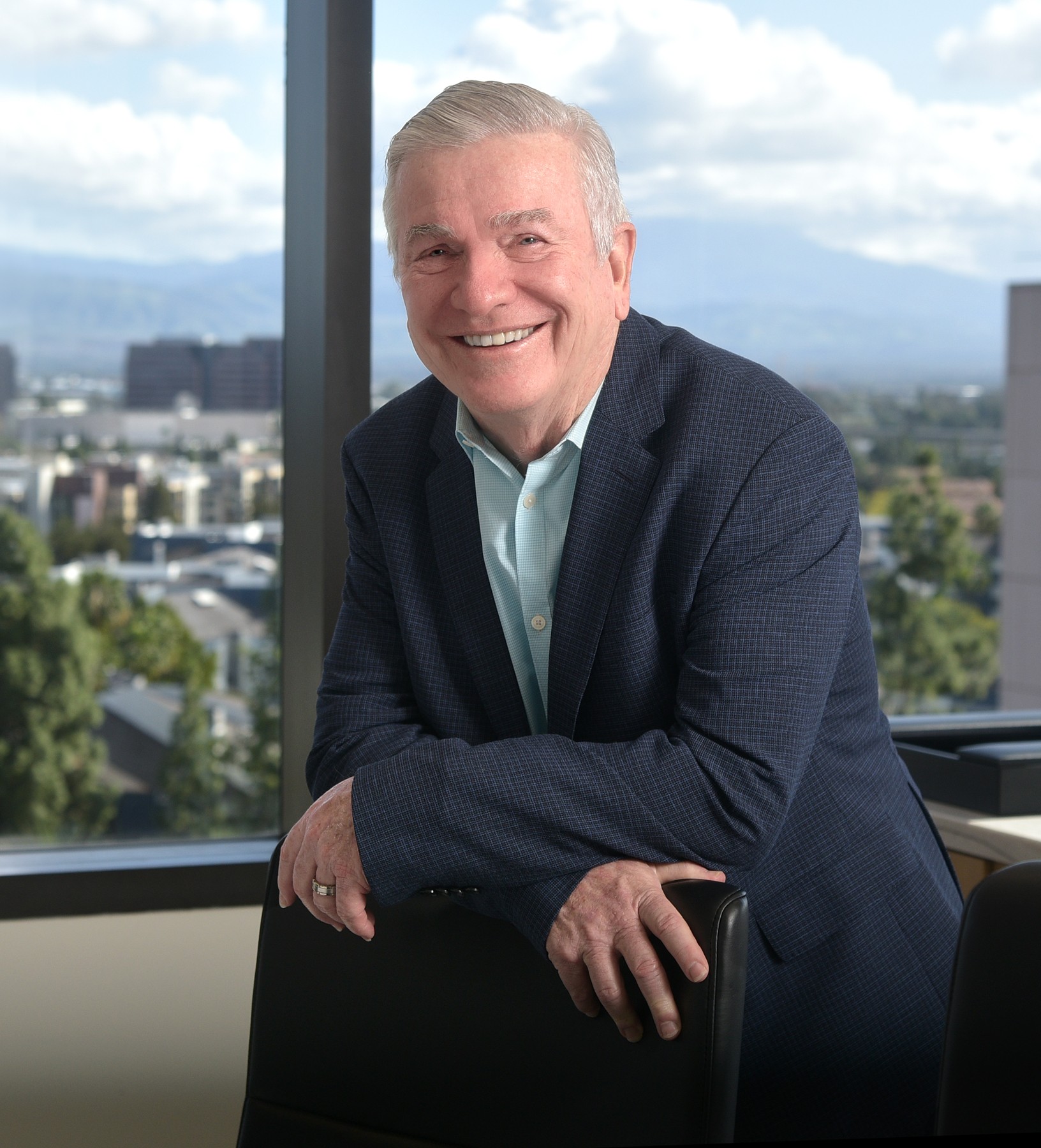
Next year Pacific Life Insurance Co. will celebrate its 150th anniversary since being founded by Leland Stanford. Jim Morris is its 14th CEO and celebrating his 35-year anniversary this month at Orange County’s largest private company.
I recently met with Morris for an hour-long, rare interview in his Fashion Island office overlooking Newport Beach harbor. Last week the 57-year old executive discussed how he steered PacLife through the 2008 financial crisis and helped reshape an old company in an “old industry.” Here’s part two of our discussion, including PacLife’s future in Orange County.
Q: Your annuities are often ranked among the best in the industry by media like the Wall Street Journal. On the other hand, financial adviser Ken Fisher advertises how much he hates them. What are your thoughts on the direction of annuities?
A: I’m bullish on the future of annuities. It’s the only place you can go to get guaranteed lifetime income. Today, only one in 11 workers have pensions. If you want a guaranteed income, the only place to get that is an annuity.
The products have fees, which the Ken Fishers object to. But if you talk about delivering certainty to consumers who need it, it’s a good product.
Q: I’ve heard of commissions of 5% to 10% on annuities. Do you see that coming down?
A: We’ve never had 10% commissions. Generally, they’re trending down.
Q: Are hybrid annuities exciting?
A: Hybrids are annuities tied to indexed products or long-term care benefits. We do both. We got into this area a few years ago. It’s the fastest growing subset of the annuity world today, and it’s fast growing for us. That’s an attractive product for someone who wants certainty but wants to participate in the upside of the market. The hybrid has had a pause this year because of the Department of Labor fiduciary rule.
Q: Are your insurance salespeople obligated to follow that rule?
A: The insurance advisers follow a best interest standard. The part of the rule that we want to fix is not having these issues administered by the court system. We’re all for consumers coming first. We want to see it administered through agencies that we deal with rather than through the courts.
Q: How is your aviation business doing?
A: Terrific. It’s a growth business and a financial services business. It fits our skill set where you match an asset, a plane, with a liability where money is borrowed. Airlines don’t want to own their planes anymore. They’d rather lease them. In the 1980s, they owned 100% of their airplanes. Today, they own about half and lease the other half.
Most of our customers are non-U.S. It grows based on world air travel, which is something to be bullish about.
The metric I’ve heard our aircraft leasing unit talk about is that in the U.S., there are about 10 planes for every million people. In China, there is 0.1 plane for every million people. There are great growth prospects as airlines grow.
Q: Why would you want to own the planes if the companies in the business don’t want to own them?
A: It’s like a lot of specializations. We’re a reputable organization with good ratings, so we can go out and lease those planes.
Q: Is it like the airline company outsourcing the owning of a plane?
A: That’s a good way to put it. There’s a lot to running the rest of the business. Running that business is enough without having to source the capital to buy those planes.
Q: How will the Federal Reserve’s interest rate increases affect your profitability?
A: For us, having higher yields would be helpful. Earnings for our industry have been impacted by falling rates over the last decade. The rise in rates has helped slow down the reduction in yields. We’re still seeing yields on new bonds that we’re investing in still quite a bit below long-term historical averages.
Q: It’s much tougher to make a profit?
A: Margins are squeezed. It gets back to our assets growing 14 times, but our employees have to be more efficient.
We’re doing more with mortgages, where you get more yields but it’s less liquid than bonds.
Q: Ten years ago, everyone was nervous about the mortgage industry before it imploded. Do you consider it similar to 10 years ago?
A: It’s totally different. There were poor underwriting standards. The risk is lower today than a decade ago. There seems to be a disconnect between the bullishness of the equity markets and the bond markets that are still pretty tepid in terms of rate expectations. The system today is better. Businesses and individuals have liquidity.
Q: Any big changes in your allocation of investments?
A: Nothing stands out. We lean a little bit more on mortgages. We’re a little heavier on utilities, a little lighter on financial services. We just have small adjustments.
Q: Any more acquisitions?
A: We first and foremost grow organically. We have enough dry powder if the opportunity comes along. There’s no deal that is close. Last year we purchased an asset manager. It’s an area we’d like to be bigger in. The reinsurance business is growing. Growth could come organically or through acquisitions. That is a business we got into a decade ago, and now it will make over $100 million for us.
Q: Do you still like the humpback whale for marketing?
A: Yes. It’s the heart of our campaign. It’s an icon that people seem to like and remember.
Q: Social media—are you going heavily into those areas?
A: That presence is building. The most significant is take some of those dollars from television and do some more internet advertising to reach different demographics. LinkedIn is a way to connect with advisers.
Q: Are you happy with your business headquarters in Orange County?
A: We have no plans to move. We are very happy in Orange County. Newport Beach is an iconic place. The place works great for us in our ability to attract and retain employees. We had a downsizing in the past year. That was driven by different dynamics, but it wasn’t a precursor to moving.
Q: What about employee growth this year?
A: We’re beginning to add again. I don’t know exactly what the employee growth will be for Orange County, but it will be modest as we try to keep expenses down. It’s harder to manage this business in a low-yield environment. We’re trying to control costs.
Q: In June, you were scheduled to meet Republican politicians in Washington D.C., on the same day they were shot. What was that like?
A: My first thought was it was a disaster and if everyone was going to be OK. It was reassuring to see a common concern, regardless of which side of the aisle you were on.
Q: Do you see regulatory or tax reform occurring this year?
A: It doesn’t seem likely that they can bring this all together. Still, I wouldn’t be going back there as often as I am if I didn’t feel like it’s possible. I want to make sure they understand what is meaningful to our company. I’m just trying to make sure it doesn’t hurt our business.
Q: You’ve been on the job 10 years. Any plans to retire?
A: No.
Q: Thanks Jim.