
Why in the world would anyone want customers who won’t even pay the Internal Revenue Service?
And confront the IRS on a daily basis? Not to mention, why enter an industry considered sleazy and where some of the biggest players have been accused of wrongdoing and ended up bankrupt?
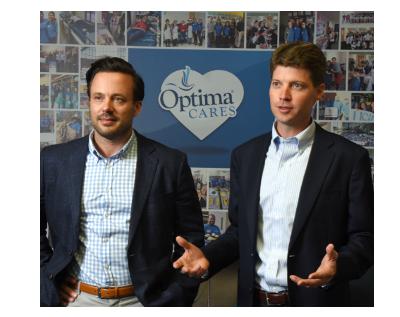
Jesse Stockwell, 40, and Harry Langenberg, 41, knew all this when they founded OptimaTax Relief LLC of Santa Ana in 2011.
“There’s an incredible opportunity when smart, polished, honorable people go into industries that need cleaning up,” Langenberg said. “There are much more opportunities than entering industries that don’t have problems.”
They have found a thriving niche, especially with the booming gig economy, and now have about 25,000 clients, $100 million in annual sales and no debt.
They say they plan to almost double their workforce to 1,000 within five years and expand to new areas, including loans and tax preparation.
They’re on the hunt to move from their 100,000 square feet of office space that’s in between two buildings to a 125,000-square-foot building to house employees under one roof.
The company spends $25 million to $35 million a year on marketing, including Alphabet Inc.’s Google and Facebook Inc. Its catchy radio spots are often heard on popular shows, such as those of Rush Limbaugh and Mark Levin.
“Optima would not have continued as a sponsor of my show for more than five years if they were not providing an excellent service to my audience,” Levin said in an email to the Business Journal.
“The IRS is a very powerful federal agency, and people need professional representation if circumstances lead them to fall behind on taxes,” said the host of the country’s fourth-most popular talk radio show with more than 7 million listeners a week.
“Harry Langenberg has a top-notch financial education and financial services experience.”
Subway Diet
The partners met at the famed Wharton School for business at the University of Pennsylvania. One classmate was Donald Trump Jr., a son of the president.
After graduating, they worked in San Francisco as investment bankers, Stockwell at Prudential Securities and Langenberg at Merrill Lynch & Co. Following the 2000 dot.com-bubble burst, they formed a mortgage company in Southern California, eventually settling on Santa Ana because they said it was business-friendly and inexpensive.
They lived a few blocks from what they jokingly refer to as a “garbage office.”
“We were eating Subway sandwiches, six inches for lunch and six inches for dinner,” Langenberg said.
By 2006, they knew something was awry in the mortgage market as they saw gardeners get 100% financing with no money down. They switched from mortgage lending to debt counseling, forming Debtmerica LLC. In retrospect, they say they’re proud they saved the jobs of up to 70 people then working for them.
Debtmerica ranked No. 3 on the Business Journal’s 2009 list of the fastest-growing private companies, when its revenue climbed 1,462% to $17.4 million in two years.
“When everyone was tanking, we were growing like crazy,” Stockwell said.
Patriotic Service
Around 2011, they observed major industry players in the tax-resolution industry facing accusations of wrongdoing and filing for bankruptcy, such as TaxMasters Inc., JK Harris & Co. and “tax lady” Roni Deutsch.
“Three major companies in the state were leaving, and we were getting more calls from our customers demanding help,” Langenberg recalled.
They hired Chief Executive David King, who’d worked in the mortgage industry, including managing a $20 million distressed real estate portfolio for Orange-based Kondaur Capital Corp.
Today, OptimaTax prepares about 3,000 returns a month, and its average client is three to four years behind in payments.
They accept clients who owe at least $10,000 to the IRS, charging $495 for an initial assessment and a typical $4,000 to $5,000 fee for more extensive work. As many as a dozen employees, including tax attorneys and tax preparers licensed by the IRS, can work on one person’s file.
“Nothing is outsourced,” Stockwell said. “We’re dealing with people who are scared and upset.”
Langenberg said. “We’re essentially running a financial emergency room.”
Tax accounting firms typically aren’t set up to handle tax resolutions, which are seen “as a major headache,” he said.
Langenberg acknowledged that “the IRS is the most aggressive collector on the planet,” but the partners said they’re not scared of the powerful agency and that they actually have a good relationship with it.
“This is a very patriotic company, because we’re fulfilling a service to collect revenue for our country.”
1099 Bonanza
They project business will continue to grow as “gig workers,” such as Uber drivers, independent contractors, start filing their taxes via IRS form 1099.
Those are “the AirBnb people who are renting out the spare bedrooms,” Langenberg said. “These people don’t realize the tax implications on 1099s.”
They’re also making plans for their other businesses to gear up. Debt management “will come roaring back” because online lending has made getting loans so much easier that credit card debt now tops $1 trillion. They invested about $1 million in SuperMoney LLC, an online lending platform that’s generated more than $500 million in loan requests since its 2013 launch. One of their companies, LoanNow, a 2013 startup that originated loans through a verification system on social media, didn’t pan out. It remains online as a lead generator.
“In a nutshell, it was a business failure,” Langenberg said. “Everyone that has had successes has had failures. You don’t want to sit there and get depressed about how things went in the past.”
OC Workforce
They’re in the process of expanding to Arizona but plan to keep headquarters in Orange County, where “the employment base is incredible,” Langenberg said.
“It’s expensive, but people pound for pound, these are the most efficient, smartest and talented managers in the country.”
Stockwell added that Orange County has the best sales talent “in the world.”
They don’t have an exit strategy, such as an initial public offering, and are uninterested in selling the firm.
“As long as the government needs to fund itself, there will be a need for tax resolution,” Stockwell said.
“We’ve made a reputation for ourselves operating in industries with poor reputations by bringing trust and investments in human capital,” Langenberg said.