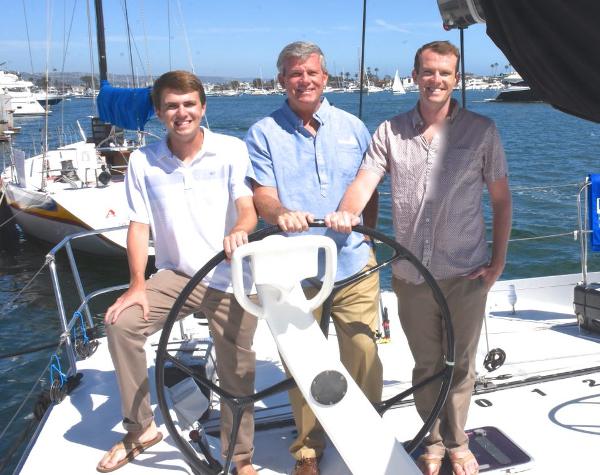
On July 17th, I began my first Transpac Race, one of the world’s oldest and longest boating races that travels 2,225 nautical miles from Long Beach to Honolulu.
The start was thrilling, with the year-long preparation behind us as we set out on the 51st version of this event that dates to 1906. Our 14-member crew was full of hope for our sleek, 77-foot Compadres. The other owners besides me included: John Clement, president of VenturePoint; Don Yahn, executive director at Cushman & Wakefield; Bart Scott, president of J Hofert & Company, and his daughter Brett; Anton Visser, CEO of Cubex; and Travis Winsor, CEO of the Raymond Group. There was no one officially in charge as the owners, each of whom was onboard, decided to share the captain responsibility and list the official captain as El Hefe.
A few days later in the middle of the race, when things started going wrong, I had the realization that we were closer to the Space Station than to the safety of land. Our small boat, provisions and teammates were the most important things in our lives. While no one has died in a Transpac, it can be dangerous as in the previous race in 2019 when the Santa Cruz 70 OEX sank, with all nine crew members safely rescued by a nearby competitor that was skippered by Roy Disney.
I participated in this race both as a nod to my family and my company, Whittier Trust Co., which was the Heritage Sponsor. Numerous Whittier Family members and employees have regularly participated in the Transpac since 1923 when Max Whittier, our founder, purchased the 107-foot Poinsettia and entered her in the race with his sons.
Our family also has a long tradition of sailing, beginning with my grandmother sailing in Paw Paw Lake, Michigan, migrating to my mom and dad sailing at Lake Arrowhead with me and then I would sail with my children in Newport Beach.
My two sons participated in this race: Michael as a helmsman, and Sean as the navigator. I could not have been prouder of these accomplished sailors who were sailing with me on a highly competitive long-term race that was an adventure. It was uniting a family tradition of sailing. (I also have two daughters, Emmy and Clare, who sail for their respective college teams, but weren’t on this trip.)
The Boom Vang Broke
Halfway through, we were succeeding in our mission. Our strategy was to travel fast to Catalina and then as far north as we could before we would tack to reach the Rhumb line, the shortest nautical line to Hawaii.
I didn’t have time to check the stock market or the news. As this was not a cruising boat, each person was always working; there wasn’t time nor was it safe to worry about things at home
In the first half of the journey, we covered 1,113 miles in three days, all of which were nearly flawless. Strong winds topped 29 knots and swells averaged four to six feet. The team was in high spirits.
Then on the fourth night around 9 p.m., the boom vang broke. The vang, which holds the boom, is critical to the function of any sailboat—and especially a racing sailboat.
Then the mainsail ripped.
It wasn’t because of high wind or waves. There was no reason—It was just luck of the draw. These things happen on sailboats.
Many other competitors would have motored to Honolulu.
As a team, we deliberated the strengths and weaknesses of each option, seeing opportunities and threats in every decision.
Each teammate brought an enlightening perspective on the risk and reward of different strategy options. The collective input was invaluable. When it appeared that a definite decision was forthcoming, a new voice brought a dimension that had not been considered.
We recognized that without the vang, only the weakened sail would hold up the boom. If the sail were to fail again, the boom would fall and could destroy the helm and seriously injure crew members.
Race to Diamond Head
In such a situation, you look around and take stock of what you have, not only in terms of tools and spare parts, but also in your teammates. Something I have learned in my 35 years of business is that each person has talents and skills and to seek out their competitive advantages and then cross train them. You align your strategy with those individuals’ competitive advantages. This was no different.
Our crew, which had practiced for a year for this race, wanted to achieve our mission—complete the race safely by sailing.
We decided we could finish if we sailed conservatively and safely.
When you have limited tools and spare parts in the middle of the Pacific Ocean, and nowhere to turn, you turn inward. Our crew – including helmsmen, trimmers and bowmen—leaned on their multiple talents and cross training. They spent hours making repairs. We improvised and made changes to the sails, our sailing tactics and strategy.
We raced flying the spinnaker during the day and the storm trysail at night. When flying the spinnaker, we still traveled fast, about 15-18 knots an hour. However, at night and without the spinnaker we slowed. We notified, via email, our land crew and race committee, that we had equipment failures but were safe. We had to notify one boat to cross our stern to avoid an accident.
Despite everyone being trained to drive the boat and trim the sail, a weakened sail requires your most talented trimmers and helmsmen. We reorganized the rotation and rest schedules—three hours on watch—three hours rest at night instead of the typical four hours on and off.
The Finish
At 9 a.m. on a Sunday, eight days after we began and a day behind our original schedule, Team Compadres’ owners all put their hand on the wheel and crossed the Diamond Head finish line together, placing fourth in our division. It was the thrill of a lifetime.
Then we were greeted by our wives on the dock holding the ceremonial Mia Tai in a hollowed-out pineapple.
Ultimately, the lessons learned are that you must have a quality team, each team member must know his or her role and there will never be enough training. Mental attitude, focus and commitment are essential components to success. You can be talented, but if you don’t have the willingness and ability to persevere and lead in difficult times, talent alone will not win.
The Transpac race is an experience that transcends generations. Will I do it again? I’m still working through the emotions but most likely yes.
Editor’s Note: David Dahl, who is based in Newport Beach, is CEO of Whittier Trust Company, the oldest and largest multifamily investment office located on the West Coast. It has $19 billion in assets under advisement.