
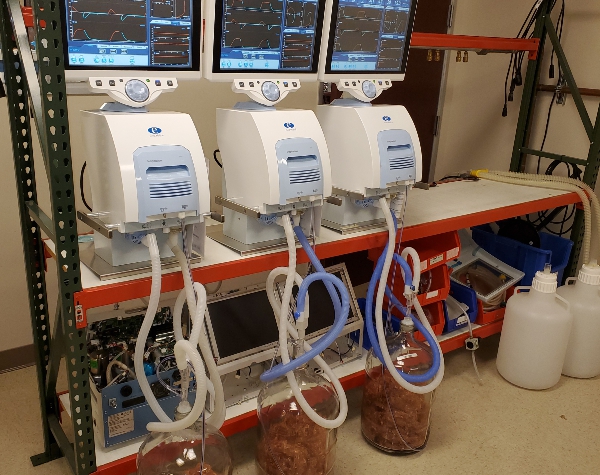
A 40-person company in the foothills of Lake Forest is making one of the world’s most sought-after products—ventilators for intensive care units, to help those hospitalized from severe effects of the coronavirus.
“If we had 5,000 ventilators in inventory, I could sell every one of them right now,” said Tony van den Berg, vice president of operations at eVent Medical.
“I have none in inventory ‘cause every day we build, we’re shipping immediately.”
As it is, the company last year made about 1,000 ventilators, or fewer than 100 a month.
Demand has caused production to rise to 125 to 150 a month. The company is aiming to boost production to 500 a month, although a lot of that will depend on suppliers.
“We get phone calls from all parts of the world, not asking, ‘What’s the price?’ but ‘How quickly can you get them to us?’” van den Berg said.
The price for the company’s product: about $15,000.
eVent’s issues are not alone. It was reported last week that device giant Medtronic PLC, one of the largest manufacturers of ventilators in the world, can only make about 225 of its machines each week. Medtronic makes about 100 a week normally. Its U.S. headquarters are in Minneapolis and it has a large base of operations in Irvine.
Ancestry
eVent Medical, which was founded in 2000 by respiratory therapists and engineers, was sold in 2006 to Kobayashi Pharmaceutical Co. The Japanese company brought in Kirk Inoue, a native of Japan, to run the operations.
Inoue in 1981 started and was CEO of Newport Medical Instruments Inc., a ventilator company, until 2000. Newport Medical was sold in 2012 to Covidien PLC for about $108 million.
In 2011, Kobayashi spun off its non-essential businesses and Inoue decided to buy eVent Medical himself. He shifted production from Ireland to California. He also decided to cut the U.S. sales force because of stiff competition, and instead concentrated on sales in Southeast Asian nations like Thailand, Vietnam and Pakistan.
Since he’s made those moves, he said the company has been profitable since 2012.
“We are one of the few companies that can make ICU ventilators in the U.S.,” Inoue said.
His competitive advantage is that his machines are “more state of the art” compared to competitors and he prices it about half that of the competition.
Another advantage is that he makes the machines user friendly so someone using it can adjust it as needed without the help of an aide.
“Many caretakers where we sell are not educated like in the U.S.,” Inoue said. “We make it intuitive for users.
“The user can just turn it on and run. A less educated user can use our highly sophisticated product.”
Van den Berg last week gave the Business Journal a tour of the company’s 28,000-square-foot facility where among other things, it designs its own customized circuit boards and tests the products extensively before they are shipped.
“If you’re on this machine and it fails, how long do you have until you die?” van den Berg said. “It’s as long as you can hold your breath. This machine has to be reliable.”
The company also writes its own software code.
“There are only a few people who know how to write software and know how your lungs work. That’s a specialty,” said van den Berg, an engineer for more than 40 years.
Demand Explodes
Since the coronavirus began, the company has seen demand from China explode to about 300 to 400 in the first 10 weeks this year alone.
“We’ve been working on weekends,” Inoue said. “We have to crank up until we use up all the parts.”
Supplies are a constant worry. While their business is considered essential, those of its suppliers may not fit the list as determined by the state government.
A Santa Ana-based machine shop told van den Berg it was shutting down.
“I called them and told they cannot shut down. They’re essential to us,” van den Berg said. “We’ve supplied local suppliers with letters that they can show they are supplying to us and they are essential to us.”
European Bias
The industry is dominated by suppliers based in Europe where its governments are asking them to limit exports of critical components until that continent’s domestic demand is met, van den Berg said, mentioning how a Swiss-based maker of a key component isn’t answering emails.
“Ramping up to as many as 500 a month is not that easy unless the suppliers cooperate with us,” van den Berg said.
“You cannot tell a supplier who is building 20 parts for you a month and tell him you need 1,000 a month. He needs time to ramp up.”
If it’s able to get supplies, the company can increase production by working three shifts a day and wouldn’t need to rent additional space, company officials said.
Along with more suppliers, it’s also crucial for there to be more technicians to test the company’s products, officials said.
The Ramp
An existing maker of ventilators that can ramp up production would solve the shortage problem far faster than having another company build a ventilator that would need two to five years to become certified.
A company that can start from scratch on a ventilator and get it made in a year would be “phenomenal,” van den Berg said.
Instead, van den Berg and Inoue estimate they can get to 500 a month within a few months—if government officials would become aware of their problems and help resolve the supply issues.
“With all the talk on the news about how critical ventilators are, you’d think that someone would have said, ‘Let’s talk to the ventilator companies,’” said van den Berg, who said no one in the federal or state governments has contacted them.
“If you really want to increase production, don’t reinvent the wheel. Take what’s there and figure out how to ramp that up.”
The company said it must fulfill current orders from outside the U.S., but it intends to shift to domestic sales.
Inoue, who emigrated from the Japan to the U.S. about 40 years ago, said he wants to help his adopted country.
His career in the U.S. “is not a big success, but a good success. It’s been reasonable. I’d like to help if I can.”
The Truth About Ventilators
Kirk Inoue is disheartened to see the misinformation regarding ventilators and their use during the COVID-19 crisis, whether it’s a high-ranking politician promoting a home-care ventilator for an intensive care unit or an executive like Elon Musk saying a ventilator can be used on more than one patient at the same time.
“It’s frustrating for us to watch the news,” said Inoue, chairman and CEO of eVent Medical, a maker of FDA-approved ventilators for intensive care units.
Currently, about 60,000 ventilators for intensive care units are available for about 45,000 hospital beds at about 5,500 hospitals, he said. By contrast, New York Governor Mario Cuomo said he needed about 30,000 ventilators to resolve that state’s crisis.
As of March 27, 86,012 Americans have the coronavirus, according to the John Hopkins Coronavirus Research Center, with more than 1,300 deaths.
There were more than 250 cases in Orange County with one death, according to the Orange County Health Care Agency. Experts fear a surge in patients needing ventilators—1 million people is a figure cited often in reports—from the respiratory-affecting symptoms of the coronavirus could quickly overwhelm hospitals and cause the death count to mount drastically.
UCI Visitor
Treatment of COVID-19 via home-care ventilators doesn’t work well for a variety of reasons, the company said. For example, eVent Medical builds HEPA filters into its system to purify the air, something that home-care ventilators don’t include.
“If I got patients with different diseases going in and out of ICU, where is that home ventilator getting that air from? The room,” said Tony van den Berg, eVent Medical’s vice president of operations. “So, if I got a contaminated patient, it’s sucking the air out of the room and pumping it into the next patient.”
Reserves of ventilators such as those held by the Department of Defense are usually designed for young people in trauma situations, not for elderly with respiratory ailments.
“It’s like you say you need a truck and the military says I have 2,000 cars I will drop by. It’s the wrong kind of product.”
Home ventilators “are helpful to keep you alive for some time, but if you get pneumonia, it won’t save the patient.”
The company would like to see the government step up to help suppliers. The only regional hospital that has contacted eVent Medical has been UCI Medical Center, the largest in Orange County.
“We are concerned that the government is distributing home care and transport ventilators that are not qualified for use in ICU under FDA regulation,” Inoue said in a letter that he gave to the Business Journal.
“We wish to increase public awareness of the need of ICU ventilators to treat COVID-19 pneumonia patients.”
—Peter J. Brennan