

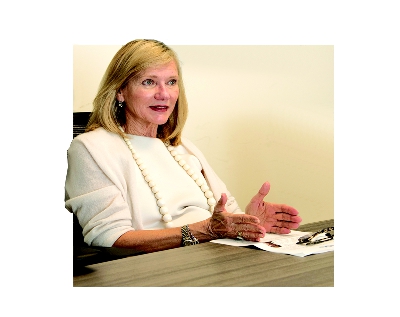
In a meeting last month at Broadcom Ltd.’s San Jose headquarters, Hock Tan asked Julie Hill why she wanted to join a board takeover of rival Qualcomm Inc.
The business leader told the Broadcom chief executive, “It gives me street cred with my son.”
Her son, Matthew Newcomb, 31, is vice president of strategy and finance at San Francisco-based mobile banking startup Chime.
Tan, whom the Wall Street Journal recently crowned the chip industry’s most visible dealmaker, laughed and said that was the best answer he’d heard yet.
Then he told Hill why.
Tan was visiting the White House in early November, on the day President Donald Trump touted the new tax plan, and joined him at a press conference at the Oval Office minutes later to announce Broadcom was seeking to repatriate its headquarters from Singapore to the U.S.
Tan, who’s gained plaudits on Wall Street for his roll-up strategy and cost-cutting measures, told Hill the Nov. 2 White House visit was the first time his children thought he was cool.
Four days after the Trump meeting, Broadcom announced a $103 billion unsolicited bid for Qualcomm at $70 per share. Qualcomm’s board unanimously rejected the offer a week later, saying it “dramatically undervalues” the company and faces regulatory hurdles that may prevent a deal.
Hill, who chairs the University of California-Irvine Foundation and runs Newport Beach-based consulting and investment firm The Hill Co., is one of 11 candidates recommended by Broadcom and private-equity firm Silver Lake Partners to replace Qualcomm’s directors.
The Vote
Qualcomm’s board unanimously rejected the slate on Dec. 22, setting up a dramatic March 6 vote in Irwin M. Jacobs Qualcomm Hall at the chipmaker’s San Diego headquarters at 5775 Morehouse Drive, where in one afternoon shareholders could alter the future of two of Southern California’s most prized technology companies, and a global industry.
A blue ballot is a vote for the Broadcom slate. A white ballot is a vote for Qualcomm’s 11 incumbent directors.
“So we’ll see,” Hill said during a wide-ranging, hour-long interview with the Business Journal in a second-floor conference room at University Research Park, in the shadows of Broadcom’s downsized Irvine operation.
Hill, who’s been involved with various UCI boards, schools and philanthropic initiatives for about 25 years, was handpicked for the Qualcomm slate by Broadcom co-founder and Chief Technical Officer Henry Samueli.
“I think Henry just decided it would be a good idea, so he threw me in the mix,” she said, an indication that the longtime Broadcom visionary is deeply involved in the hostile takeover attempt and ongoing negotiations.
Hill has served for years on the board of UCI’s Susan Samueli Center for Integrated Medicine and previously served on boards at its business, social ecology and humanities schools.
She’s a recipient of the Elizabeth Dole Glass Ceiling Award of the American Red Cross and the Amelia Earhart Award for leadership from UCI’s Women’s Opportunities Center.
In September the Samuelis donated $200 million to UCI, one of the largest donations ever made to a public university. The money will build a home for the Susan and Henry Samueli College of Health Sciences at the corner of Bison and California avenues and fund a permanent endowment for faculty recruitment and student scholarships.
Henry Samueli, Broadcom’s largest inside shareholder, with about 195,000 shares worth roughly $483.8 million, has kept a low corporate profile since Broadcom Corp. was acquired by Tan’s Avago Technologies Inc. in February 2016 for $37 billion and renamed Broadcom Ltd., its U.S. headquarters in Silicon Valley.
Samueli declined to comment for this story, and requests for comment from Broadcom weren’t answered.
Board Seats
Hill, an inquisitive type and relentless learner, welcomed the challenge of understanding a complex industry, key players, the mechanics of the deal, Tan’s roll-up strategy, which has funded $50 billion in acquisitions over the past few years—most recently Brocade Communications Systems Inc. for $5.5 billion—and the chip sets that made both companies industry leaders.
Qualcomm dominates the world market in high-margin baseband chips—the technical brains of smartphones—and its Snapdragon processors are among the most used for gaming graphics.
The company announced a $2 billion memorandum of understanding last week to supply chips for the next three years to China’s largest wireless-equipment manufacturers: Lenovo, Oppo, Vivo, ZTE, Wingtech and Xiaomi. It also publicized a licensing deal with Samsung on 5G development that could ease an ongoing antitrust battle with the Korea Fair Trade Commission as Broadcom fights a $1 billion lawsuit filed by Apple alleging unfair business practices, specifically boosting royalties and requiring the Cupertino-based company to pay a percentage of iPhone sales in exchange for patents.
Broadcom specializes in communications chips that power Wi-Fi, Bluetooth, GPS and other applications in mobile devices, as well those used in data centers and set-top boxes.
The chipmakers serve the largest consumer electronic makers in the world.
“I think I have good working knowledge,” said Hill, who might join a road show this month to talk up the deal to investors and utilize her deep Rolodex of contacts.
Hill sits on the board of trustees of the Lord Abbett Family of Funds, which manages $157 billion as part of Jersey City, N.J.-based Lord Abbett & Co. LLC, and is a director of Indianapolis-based health insurer Anthem Inc., which posted net income of $3.8 billion last year on $90 billion in revenue.
She’s the first female trustee at Lord Abbett, which was established in 1929, and the first woman and longest-serving director at Anthem.
Other Abbett board members include Franklin Hobbs, chairman of Detroit-based Ally Financial Inc., which generates nearly $10 billion in annual revenue; and Evelyn Guernsey, former chief executive of Americas at J.P. Morgan Management.
Anthem directors include R. Kerry Clark, former chairman and chief executive of Ohio-based Cardinal Health Inc., which posts about $130 billion in annual revenue, and Antonio Neri, president of Hewlett Packard Enterprise Co.
Hill was the only female board member of Australia-based Lendlease Corp., a multinational property and infrastructure company. During her six-year tenure there, she traveled to 40 countries to meet with company executives about best practices for gender equality in the workplace, an issue she champions today as a board adviser of the B Team, a venture created by billionaire philanthropist and entrepreneur Richard Branson and former Puma SE Chief Executive Jochen Zeitz, with a mission to “catalyse a better way of doing business, for the wellbeing of people and the planet.”
In the mid-1990s Hill chaired UCI’s Chief Executive Roundtable, which is made up of dozens of Orange County’s most influential business leaders, including Business Journal Publisher Richard Reisman.
“It was a natural progression to move to the foundation,” she said.
Hill, who said she leads with a light touch and a drive to inspire, became chairwoman in June, with a goal to boost cooperation between academics, the administration and trustees.
“I don’t think we know the students as well as we should,” said Hill.
A rule she implemented requires all of the foundation’s trustees to take an active role in a UCI school or center of their choosing, or join a dean’s council. She said she wants them to visit classrooms and mingle with students.
Last year she invited Chancellor Howard Gillman, senior administration officials, all 16 deans and the leaders of UCI’s educational centers to a retreat at Pelican Hill Resort, where they talked up their schools, individual accomplishments and areas of expertise and need.
“The deans had never sat next to each other all at one time,” Hill said.
Hill is an advocate of board and executive diversity and enters a tech industry that’s been knocked for lacking both.
“I’ve sat on a lot of boards with guys. And almost every place I’ve gone, I wound up being the first woman,” she said. “It needs to change.”
In one of her first acts as foundation chairwoman, she brought in 10 trustees—eight of them women, including Susan Samueli; UCI alumna Carol J. Choi, founder of United Exchange Corp.; and Kate Duchene, chief executive of Irvine-based Resources Global Professionals.
“That was not an accident,” said Hill, who’s gaining more street cred by the day.
When her son heard the news of the Broadcom bid, he quickly called and asked if she was on the Qualcomm slate in what would be the largest tech deal in history.
“Yeah, that’s me,” she told him.
“That was the primary motivation.”
