

Jeff Duggan could use a drink.
Fortunately, he can make them.
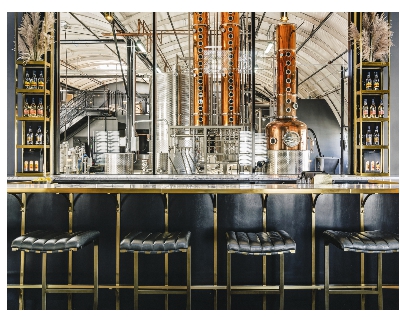
Duggan, who co-founded Costa Mesa’s Portola Coffee Lab, is turning his attention to evening libations with Stone Groove Stillhouse, a distillery that is set to open in Anaheim by the end of the year at Make, Shaheen Sadeghi’s craft food and drink hall that sits across the street from his Anaheim Packing House food marketplace.
“I’m a lover of all things that taste great—beer, coffee, wine,” says Duggan, who’s made all three as a hobby for years. “I got fascinated with making alcoholic beverages at home and started getting good at it, but it’s illegal to home distill.”
Two relatively new laws in California have partly deregulated the liquor industry, resulting in a renaissance in the making of high spirits in Orange County. While the number of distilleries in Orange County is only a handful, it’s clear that investors are pouring money into what they see as a hot new trend—the next big thing locally following the profusion of beer-focused tasting rooms in recent years.
Local distilleries have emerged in a variety of OC cities such as Santa Ana’s Blinking Owl Distillery, Huntington Beach’s Surf City Still Works, Irvine’s Left Coast Brewing Co., San Clemente’s Drift Distillery, Aliso Viejo’s Webb’s Grainworks and Laguna Beach’s Pleasure Distillery LLC.
Others are suppliers, such as Bear & Eagle Products in Santa Ana and Snug Harbor Co. in Newport Beach.
Most distilleries include tasting rooms and a few offer food options.
Several are connected to longtime local families and most dig deep into OC and California roots for everything from product to packaging.
Prohibition
There are 200 distilleries statewide, a four-fold increase from five years ago, according to El Dorado Hills-based California Artisanal Distillers Guild. That’s a faster rate of growth than what’s seen nationwide: the country now has nearly 1,800 distilleries, which is still a doubling during the same period.
The explosion in distilling comes after changes in state laws that govern the making and selling of spirits in California.
In the century since Prohibition—passed in 1919, repealed in 1933—the liquor industry has labored under rules meant to prevent collusion among makers, distributors and retailers under “tied house” laws. The term meant a public house in England required to buy beer from particular breweries, which produced local monopolies.
A place that made liquor wasn’t permitted to sell it. The law previously said alcohol needed to be made, delivered and served separately.
Regulation of beer and wine liberalized—witness the wine bar and brewpub. Then the California Craft Distillers Act of 2015, signed by former Gov. Jerry Brown and that took effect on Jan. 1, 2016, gave spirits businesses a freer-flowing process.
It was followed last August by the “Craft Distillers Op-pour-tunity Act,” which increased the amount of annual distilling allowed to be considered craft spirits. The act also permits makers who lack tasting rooms to sell in their communities.
Deregulation “started in the wineries in the ’80s and ’90s and moved to breweries” in the new millennium, said Constantine ‘Gus’ Samios, founder and managing member of Laguna Beach’s Pleasure Distillery.
It was more difficult to deregulate distilleries, says Sadeghi, who credits Assemblyman Tom Daly, a former Anaheim mayor, with an assist on regulatory reform.
Local distillers also mention Assemblyman Marc Levine and Sen. Nancy Skinner as instrumental.
Consumption
Laws are still tight.
Distilleries can only sell an ounce and a half of product, and three bottles—officially 2.25 liters—per person, per day under the new regulations.
They also cannot sell directly to retailers—they need a third-party distributor. If a distiller or tasting room wants food service, that curtails the bottle sales. One distiller can’t own more than a couple locations—there’ll be no chains under current strictures—and well-known products such as tequila and whiskey have rules about where and how they’re made to be called by those names.
There are standards about how much of a product can come from an outside source—that is, that the distiller didn’t make.
The arcane angles of California Department of Alcohol and Beverage Control licensing are also legendary.
Most distillery operations are currently open only to the public on weekends and to large groups—in part due to the above limitations.
Grain to Glass
London-based International Wine and Spirits Research said Americans drank more than 3.3 billion cases of all kinds of alcohol last year, down 1% due to health and wellness trends.
Distilled spirits rose 2% to 230 million, 9-liter cases. Brandy, whiskey and tequila rose from 1.7% to 8.5%.
Craft distillers did even better than the wider spirits category, posting a nearly 24% gain.
U.S. trade group Distilled Spirits Council in Washington, D.C. pegged 2018 sales at $27.5 billion, up 5%, the ninth straight year of growth. Spirits were 37% of all alcoholic beverage sales—up 1 percentage point over big guys, beer and wine.
Specialty Spirits
Duggan plans to make, among other products, an American single malt whiskey and craft brandy.
They’ll be ready in “two to five years.”
“Both are aged spirits,” Duggan notes. “You want to say, ‘I can’t wait,’ but the fact is you have to.”
Stone Groove will specialize in these two but the operation—“micro-distillery, full craft cocktail bar, amazing open kitchen”—also will offer some faster-to-market spirits.
“Really great gin, vodka—some will be infused,” he says, and “my head distiller [Sam Woodall] loves rum.”
Duggan’s idea for Stone Groove grew as Portola customers asked if their coffee could be mixed with alcohol. No—that would make it a bar, which is a different license—but “a light bulb came on: that’s a damn fine idea.”
Stone Groove bartenders will cross-train as baristas and sell coffee alongside spirits. Spirits mixed with coffee and non-alcoholic coffee “mocktails” are part of the plan.
It’s a near perfect venture for the artisan-distiller Duggan and the artist-designer Sadeghi, who is known for his eclectic developments.
Make, which is about 12,000 square feet, opened a few years ago in a former marmalade factory in downtown Anaheim. It houses several craft beverage ‘makers’ and eateries as tenants.
Sadeghi’s developing Southern California food halls and plans elements like Stone Groove at them.
“This fits the whole localization model for us,” he says. “We’re planning to do more of them.”
A selection of OC Distilleries …
Drinking Agave
You can’t call a spirit tequila or mezcal unless it comes from defined—and small—regions in Mexico and are made with particular types of agave.
Hence, Pleasure Distillery LLC, which at one time had a tasting room, is now only a manufacturer with plans for a local product, Agave de California.
While it takes seven years to grow agave, Gus Samios will distribute a true Mezcal this summer from plants grown in Mexico to get things started. He’s added crops in Santa Barbara and Fallbrook and is looking at land in San Juan Capistrano to grow more.
“Most of the farms [in Mexico] have been stripped,” because of demand, he said. “You talk to the mezcaleros, and quality is getting worse—like unripe pineapple. What makes alcohol is sugar and if you harvest early you have less sugar.”
Samios figures the California climate—citrus, avocado—is perfect for the product.
“Things grow nicely here,” he said. “Our plants are growing heavier and sweeter.”
His family owned 2,000 acres of agriculture in Vista when he was growing up and he recounts tales of a great-grandfather, a Greek, who was also a grower.
“California is where produce comes from,” he said, and craft distilling is a special part of that.
“People making stuff by hand—it’s not the easiest way, but … there’s nothing like it.”
Local Motion
Buyers know a Surf City Still Works bottle when they see it.
Owners Josh and Elena Kornoff chose a distinctive shape and heavier glass from a supplier in France, commissioned designs from Huntington Beach artists and printed labels on both sides so images were visible through the product, which includes vodka, bourbon, gin and rum.
Distributors “told us we weren’t ready, we’re too small,” Elena says. “Once they saw the bottle, they got excited.”
The distinctive result has found its way to hotels in Huntington Beach, Marriott Irvine Spectrum and Balboa Bay Resort, Costa Mesa-based Lazy Dog Restaurant & Bar, Huntington Beach-based Stacked Restaurants and retailers including Costco, Albertson’s and Total Wine.
“Getting into retailers has been easier than restaurants,” Elena says.
Canned cocktails are coming to the product mix and Surf City has also offered craft cocktail classes onsite.
Startup costs ran about $250,000—they did much of the build-out themselves, opening in July—and the pair sees 300% growth to more than $1 million in sales this year and another 300% next year.
Chris Van Dusen, managing partner of Santa Ana marketing and ad firm Parcon Media and chief marketing officer of CBDistillery, a Denver retailer and wholesaler of hemp-derived CBD products, invested in Surf City in August.
The Kornoffs lack a restaurant, but have brought in food trucks and dessert services. Elena noted they’re taking over the space next door to expand operations and Josh—who is also the distiller and effuses effortlessly for a visitor on the intricacies of spirits-making—says they plan a small bites menu this year and “absolutely want to sell food.”
Technically, they “don’t have a liquor license” either, he says. “Our manufacturing covers it.”
Family Friendly
The family that owns the Oggi’s Pizza & Brewing chain and Left Coast Brewing Co., both in San Clemente, are now distilling.
Left Coast General Manager Tommy Hadjis—son and nephew of Oggi’s founders George and John Hadjis—has a fair amount of street cred when it comes to brewing and distilling. He oversees production of 12,000 barrels of beer annually and the Irvine location, opened in July near Irvine Ranch Water District offices off of Sand Canyon Ave., includes a still.
“The systems are extremely small,” Tommy said, producing enough for beer and spirits for in-house pairing with barbecue items that are the site’s fast-casual fare. The restaurant is under the distilling license and wholesaling of bottled product isn’t part of the plan for now, though Irvine customers on-site can buy bottled spirits.
“Selling spirits … is way down the road [and] we can be crafty and take our time, make it the way we want. So our vodka comes out really good.”
Head distiller Jim Clarke has also made gin—including jalapeño, raspberry and orange infusions—and rum, including a spiced variety, and he’s aging two single-malt barrels of whiskey.
Two miles from Left Coast’s San Clemente headquarters, Drift Distillery’s Ryan and Lesli Winter have told local media they get most of their grain from Ryan’s parents’ farm in Kansas and make everything onsite.
Distilled Wisdom
Blinking Owl was OC’s first distillery, opened in a space not far from the Santa Ana train depot in 2016 by Brian and Robin Christenson.
“When we started, the licensing didn’t exist,” Brian said.
The distillery and tasting room is behind thick walls and an industrial iron gate. The city’s water tower is visible just blocks away.
Blinking Owl products use municipal H2O—Santa Ana’s water was named best in class last year at Berkeley Springs International Water Tasting annual competition in West Virginia.
Head distiller Ryan Friesen makes rye and bourbon, gin, aquavit and vodka—including batches infused with the “flesh, pith, juice and peel” of 150 pounds of Valencia oranges.
The distillery’s website notes achieving “the neurotic goal” of buying only organic California grain for its spirits.
So Friesen doesn’t make rum because it requires molasses or sugar cane and thus, “there are no California rums.”
The whiskies took the requisite two years—released Sept. 29 on Brian’s birthday as “the first whiskies ever made in OC,” he said—and a visitor can attest to its smoothness.
The Christensons live in downtown Santa Ana. Robin founded and ran a specialty therapy clinic, Womanology, for a dozen years, selling it to Hoag in October 2014. Brian was an art director at AkinsParker, a Santa Ana marketing firm.
They put about $3 million into launching Blinking Owl and project more than $1 million in sales this year. They’re halfway through a funding round to build out the kitchen and expand distribution—additional states, hospitality clients.
They’re looking to expand to Asia, Robin said.
Playing Jenga
Jeremy Webb “made moonshine with [his] dad” as a kid and built a still for his junior high science project. He is the son of the late Lew Webb, who sold cars in OC for 40 years.
He began working on Webb Grainworks in 2017, spent time last year in Kentucky working with distillers—and is a year from opening in a building he owns next to Aliso Viejo Ice Palace and across from an Edwards and IMAX theaters.
“Apart from fast food, it’s kind of a desert for eating,” he says. “It’s young families, a lot of tech companies moving in—people with money looking to do cool stuff.”
He figures on lunch crowds and corporate parties in his 20,000-square-foot space, but permitting is “a game of Jenga” and that’s alongside questions of what kind of spirits to make.
Webb is considering bourbon or a cactus-based liquor and says California is great for brandy because it’s distilled wine.
“A big part is finding a niche.”
