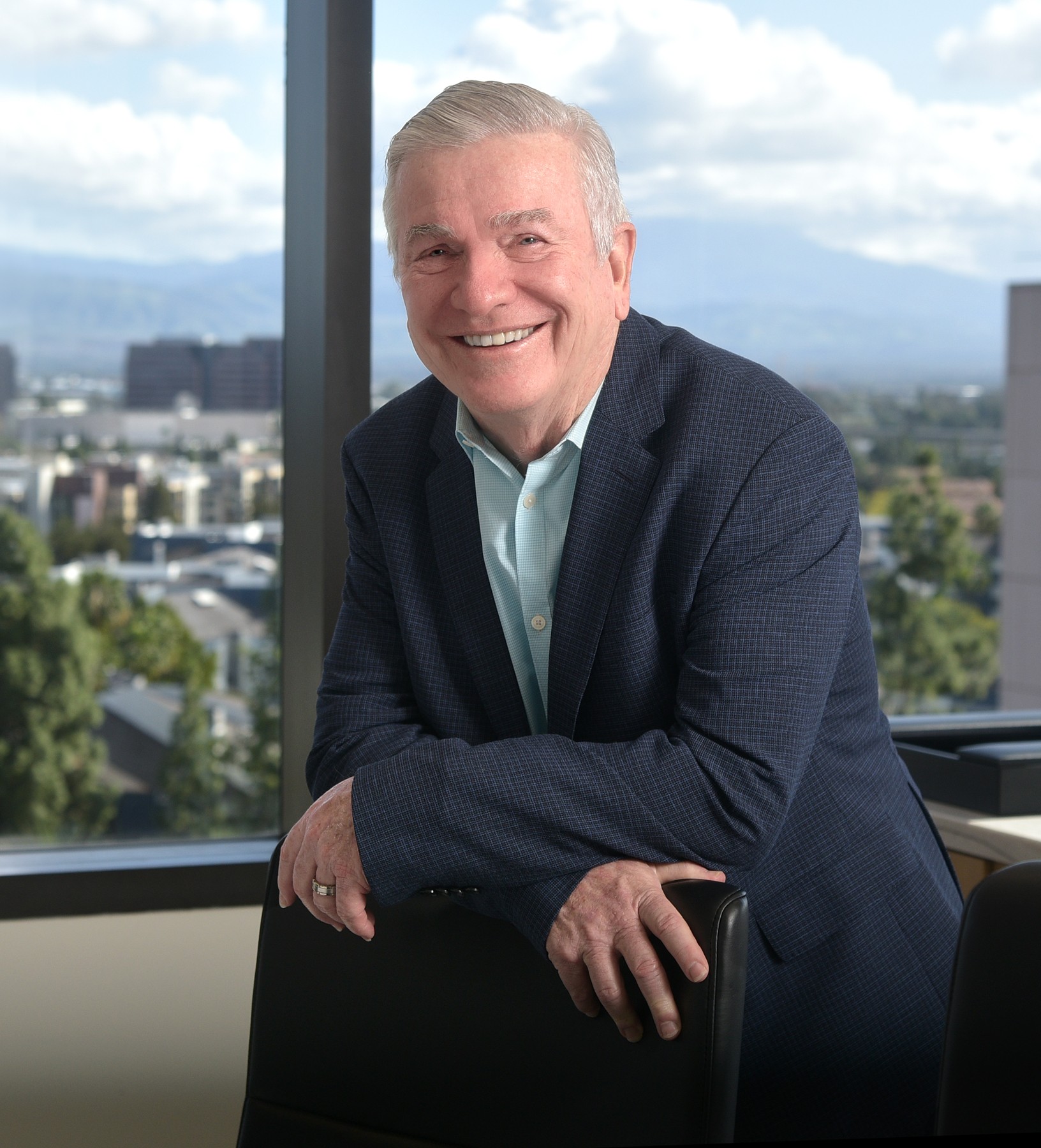
“Most people want to represent the seller because eventually someone will come along and pay the asking price,” he said during a recent interview with the Business Journal.
“It’s kind of like a real estate agent. Probably 95% to 99% of the world wants to advise the seller.
“We reach out to these owners and try to explain who the buyers are,” Harvey said. “Our fees are 100% paid by (the) buyer. It costs the seller nothing to talk.”
Newport Beach-based Harvey & Company LLC isn’t well known among Orange County executives because his firm is often searching for potential deals elsewhere in the country, he said.
Since founding his firm on April Fools’ Day in 1998, Harvey has provided buyers such as equity funds or their portfolio companies with advice on more than 440 transactions, some of which it participates as an investor.
Industry Booming
The M&A industry is exploding for a couple of reasons. Baby boomer owners are retiring and looking to sell their businesses. Plus, the roll-up strategy employed by many growing national buyers is providing returns of 500 to 1,000 basis points above the S&P 500, causing an explosion in PE firms and home offices, he said.
Harvey’s own business is booming, too. It’s gone from advising on 25 acquisitions five years ago to 69 acquisitions last year. It now has 71 employees.
CoolSys Contacts
Harvey recently advised Brea-based CoolSys Inc., one of the county’s largest providers of refrigeration and HVAC services, on the purchase of C.E. Holt Refrigeration Inc., which is based in Charlotte, N.C.
The deal added 100 employees to CoolSys’ market presence in North and South Carolina, Virginia and Georgia.
CoolSys Chief Executive Adam Coffey told the Business Journal that Dave Harvey is “a key ingredient” to its acquisition strategy, which has helped the company on its fast path to growth; it expects to reach $1 billion in annual sales in the next few years.
CoolSys gives Harvey the requirements with respect to verticals served, geography covered, margin profile and company culture, he said.
“Harvey and Co. takes our filters, does the outreach and passes to our internal team only those targets that fit,” Coffey said. “With more than 4,500 potential acquisition targets in the USA for CoolSys, we rely on Harvey & Co. to ‘shake the trees’ and help our internal deal team focus their activity on targets pre-qualified by Dave.
“I’d hazard a guess to say that of the next 10 companies CoolSys buys—seven will have been sourced by Harvey,” Coffey said.
Seller Benefits
Harvey helps acquisitive firms roll up smaller competitors through off-market transactions that don’t involve auctions to the highest bidder.
Why would a seller not immediately retain an agent to get the highest possible price?
“These are mostly family founded businesses,” Harvey said. “When they sell, they care about the purchase price, but it’s not the only consideration.”
The sellers may also take into considerations how employees are treated by the new owners, and whether family members can stay in the business. The owners can also save 2% to 5% of the sale price without an agent, Harvey said.
Solid Moneymakers
Harvey doesn’t seek glamorous high-tech firms; rather his firm looks for “Main Street” manufacturers or service providers that are profitable.
Hot industries nowadays include those providing essential home services like electrical, plumbing and heating services. Out of favor industries are retail stores, restaurants and companies that heavily rely on distributors like Amazon, he said.
Last year, the average acquisition Harvey advised on involved a company that had about $17 million in annual sales, which is small by Wall Street standards.
“We’re below the radar screen of the $100 million to $300 million that are super frothy and have a big auction process,” he said. “When you got a $20 million business, there are less options. It’s not like there are hundreds of buyers.”
The idea for firms like CoolSys is to roll up smaller companies at lower multiples and when sales at the acquiring company gets into the hundreds of millions, the multiples will go up as well, Harvey said.
The sellers who hang onto a piece of equity of the acquirer could benefit from the higher multiples as well, he added.
For example, companies under $50 million in annual sales may get a multiple around five to six times earnings before interest, taxes, depreciation and amortization (EBITDA). Because of the amount of private equity available in today’s market, a seller may get seven times EBITDA.
Larger businesses with sales in the hundreds of millions of dollars might get multiples topping 10 times, which makes them more expensive for private equity.
“You have this arbitrage between what the big guys sell for and what the little guys sell for,” he said. “It’s all about growth—going from medium to large.”
He said his company’s clients don’t always take his advice, such as missing out on a billion-dollar gain on Lumber Liquidators, a flooring retailer, and Power-One Inc., which makes power supplies.
Harvey has expanded to Europe where he opened an office outside of Amsterdam. He’s planning to hire more this coming year.
“Sellers have more options today,” he said. “They only sell to us if they think it’s the best price and the best fit for them and their company.”