

Barneys New York Inc. is winding its way through Chapter 11 and rumors swirl of a restructuring at Forever 21 Inc.
All the while Laguna Beach jewelry company Gorjana & Griffin Inc. is pumping more resources into brick-and-mortar.
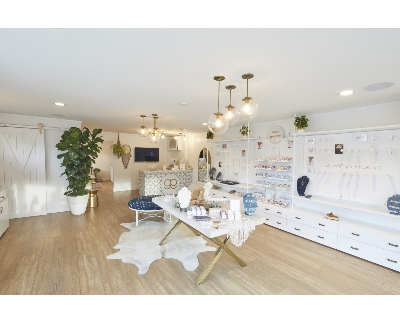
Three years ago the accessories firm, branded as Gorjana, bowed its first shop in its hometown. Today, the company counts 11 stores, with Long Beach and Scottsdale, Ariz. on track to open next month.
The $100 million mark in sales is now looming closer than ever before for the privately held firm, Chief Executive Jason Reidel said.
It’s rapid growth for the business, which has some 150 workers companywide. The expansion finally pushed founder Gorjana Reidel and her husband Jason to take on more space in Laguna Beach for the company’s supply chain operations—they are handled about two doors down from where creative functions remain in the original headquarters outpost along Laguna Canyon Road.
“We were bursting at the seams,” Jason Reidel said.
What’s also bursting is the company’s accelerated retail strategy. Five stores opened last year—a Malibu spot that opened last month is its fourth location in L.A., and the latest—and another five will open this year. Reidel only sees the cadence growing with next year possibly bringing an additional seven to 10 doors.
Reidel pointed to more Northern California growth in addition to deals outside of the state, as he ticked off markets such as Seattle, Chicago, and the Miami area.
Still, they’re not pegging themselves to a target growth figure.
“We don’t sit around and say ‘Hey, look, this is the number to get to,’” Reidel said. “My sense is we’re not anywhere near the ceiling on that just based on if you look at other people in the space. I’m just talking domestic retail. We have a lot of French people in the New York store, Asian customers in the [Irvine] Spectrum store, Persian customers coming to the Glendale and Century City stores. So there’s a multitude of ethnicities that we’re seeing purchasing our product. We see a lot of opportunities.”
With the Gorjana online shop servicing only domestic customers now, international will be a key focus next year, Reidel said.
Warby Parker
The company’s story sits on the opposite end of the spectrum to the retail doom-and-gloom coverage of restructures and store closures.
“There was a point where I was like, ‘What are we doing?’” Reidel said of the company’s physical retail expansion amid the broader industry shifts. “The confidence is coming from the fact that the stores are doing really well. That’s a lot of what’s keeping us bullish on retail. Yes the internet is growing. We all shop more online. I think we’ve all felt the Amazon effect, but when you look at the types of products we’re selling, it’s still experiential.”
The company’s price points—most items run from $25 to $110—are attractive enough for people who want to shop for themselves, but also a great place for gift giving, making an attractive pitch to prospective customers, the CEO said.
That’s exactly what happens at Common Thread on 17th Street in Costa Mesa where shoppers “come in for a gift and have a ‘one for you, one for me mentality,’” said shop owner and buyer Steph Clymer.
Common Thread, which also operates a web store, has carried the line for two years and it’s won over regulars, Clymer added.
“Our clients are obsessed with the design, versatility and quality,” Clymer said. “What really sets Gorjana apart is the ability to be so innovative, while offering a price point that allows so many women to enjoy her pieces and build their collection over the years.”
Maintaining wholesale distribution in over 1,000 retailers’ stores such as Nordstrom, Neiman Marcus and Bloomingdale’s keeps the revenue diverse.
“We look at what we consider could be the jewelry version of [designer glasses retailer] Warby Parker,” Reidel said. “Warby Parker’s done a fantastic job at creating an experience. We’re giving someone the experience of having $300, $500 jewelry for $100. Warby Parker just opened their 110th store. I don’t know if that’s on the horizon for us, but I think that we’re just going to keep opening stores as long as we see great opportunities.”
Unlike the eyewear firm, which is venture backed with a reported $1.7 billion valuation, Gorjana maintains its independence as a private company owned by the couple who started the business knocking on the doors of individual retailers and selling at trade shows.
Next Steps?
That’s not to say investment banks and private equity firms haven’t come knocking. They have. The Reidels just aren’t in any rush to bag a bunch of money just to hit numbers.
“To continue to do it privately, it’s more challenging, but this is the thing, too: You have to grow smarter when you don’t take private equity money from somebody,” Reidel said.
“You have to say ‘no’ more than you have to say ‘yes’ because your margin of error—you don’t really have one. For us, we’ve continued to fund it.
“I think at some point it will make sense and I think it will be less about partnering with someone on a monetary perspective and more from a strategic perspective. If I find I’m having to explain to somebody our business and I have to explain retail, then it doesn’t really go anywhere,” he said.
“We like what we do. I’m not getting up and going, ‘Oh my gosh. I wish I was doing something else.’ We’ve put in 15 years. This is supposed to be the fun part.”
