

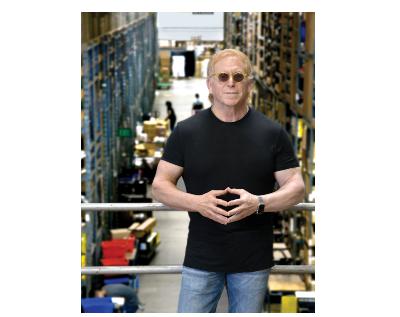
Shortly after moving to California in the mid-1970s, Detroit native Jeff Leonard scooped up a marine blue 1967 Chevrolet Camaro with an 8-track player in the center console.
The then 21 year old had a tough time finding new carpeting for his ride. He finally found a trim shop in Santa Monica to do the job. Then it dawned on him that there was a market gap he might be able to fill, and he started a business selling replacement carpeting for Camaros.
More than 40 years later, Classic Industries in Huntington Beach sells 205,000 parts and accessories for classic General Motors and Chrysler vehicles. Two months ago, it completed its acquisition of City of Industry-based California Mustang Parts and its subsidiary companies, making Classic Industries a seller of the Detroit Three.
California Mustang, founded in 1976, sells restoration parts and accessories for Ford Mustangs and Ford Falcons through sister company California Muscle Parts. It also operates Highway Classics, a wholesale division selling to restoration shops, body shops and parts stores.
Leonard said Classic Industries had planned to include the Ford line, but its growing business made it hard for the company to focus on creating a catalog of Ford parts from scratch. The chief executive declined to share exact revenue figures but said last year’s sales exceeded $100 million.
“We were too busy with our other lines,” Leonard said. “But when [California Mustang Parts] came up for sale, it fast-forwarded our ability to get into it, and it was a much easier way to accomplish our goal than to go out and create a whole new line.”
The deal, struck last year, is proving fruitful. Last week, a customer’s classic glossy royal-blue Ford Mustang was parked outside the retail showroom at company headquarters, packed with customers searching for parts on Tuesday afternoon.
The automotive restoration industry feared millennials were indifferent to collecting classic cars and that once baby boomers aged out it would be the death of the industry. But for the first time last year, millennials were behind more collectible car activity than Generation X and boomer generations, according to a study by Traverse City, Mich.-based Hagerty Insurance Agency, the largest insurer of collectible cars and wooden boats.
Millennials may prefer SUVs like the Ford Bronco, and Cadillacs instead of classic muscle cars, but the study found that nearly every generation of Ford Mustang was a hot-ticket item, along with Chevy Camaros, Corvettes and certain pickups.
Burning Rubber
After moving California Mustang’s operations into its Huntington Beach headquarters, Classic Industries has 300 employees spread across three warehouses. It owns about 200 classic cars, often displaying one in its showroom.
It manufactures in Orange County and Asia, under official licenses from the automakers. Many of the parts are created from the original equipment and modeled to look like exact replicas, including any special markings or logos.
Products are shipped from its office and sold to car enthusiasts, including many celebrities, auto shops and distributors through its website and 12 mail-order catalogs, which average about 600 pages and are tailored to specific makes and models. Classic also operates a wholesale business that even supplies some competitors, which Leonard declined to name.
He said that before it adds a model to its catalog, it considers the production numbers of the car.
“Camaros, Firebirds, Chevelles, Impalas and Novas—there were a lot of production numbers there, so if we produce something, there’s a pretty good shot that we would be successful with the item.”
It stays competitive by analyzing what the next hot classic car will be, studying production numbers and seeing how many companies are making parts for the model.
“Sometimes we create the market,” Leonard said. “[An automaker] may have built 300,000 of a certain car, but no one has built anything for it. If we think there’s an opportunity, we create the basic items a car might need, like carpet, door handles, the headliner, and people start getting interested. We’ve been doing it long enough that we have a feel for what we think is going to be popular.”
Leonard said that when a line is introduced, consumers realize the value of the car will likely rise because parts are now available.
For example, last year it created a catalog for 1978-87 Buick Regals, Grand Nationals and T-Types. Automobile magazine Motor Trend tacked an estimated value for a top-of-the-line 1987 No. 1, or “concours,” Buick Grand National at about $26,000 in 2010; last month the same model was valued at $46,900, according to Hagerty Insurance’s price index.
Old Is New
The company is working to create parts catalogs for more Ford lines, such as the Falcon, Mercury Comet, Fairlane, Galaxie, Ranchero, Torino and various trucks.
It also plans to open an additional out-of-state warehouse in the next year to help shorten shipping times for customers. Leonard said it hasn’t decided which state it will expand to.
He said he’s come a long way from when he launched the business in 1976 in Palm Springs, originally calling it Classic Camaro. He changed the name and moved to Orange County about five years later, seeking an area with a denser population and solid car culture.
“Huntington Beach is great for cars,” he said. “There’s a lot of enthusiasts, lot of car shops, lot of restoration facilities and trim shops, and we supply most of them, so it worked out pretty good being in this area.”
But he says the biggest surprise has been the business’ longevity and the continued excitement of customers when it releases new parts.
He said the benefit of being in the auto industry is that it appeals to everyone, including “the famous and infamous.”
Leonard recalls one eccentric customer who would often visit the showroom in the early 1990s. He owned a Camaro and split his time between Los Angeles and Texas. The customer would also invite Leonard to see his band play in Santa Monica.
“About a year or two later, one of the guys who worked here was like, ‘Hey, you remember the guy who used to come into the showroom—he’s the guy in Waco,’” he said. “We saw his pic, and it was David Koresh. So, anybody and everybody is into cars. It makes no difference what you think or do. People just love those old cars.”
