

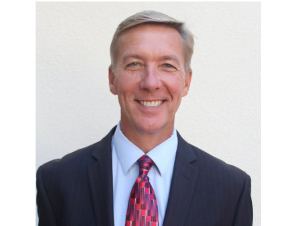
Barry Rondinella greets a guest sans sport coat or suit jacket.
He seems a picture of rest and relaxation, and apart from an office setting on Airway Avenue in Costa Mesa on the other side of tarmac and terminals from John Wayne Airport—whose operations he’s directed for 27 months—the man could be canvassing a JWA concourse, arrivals or departures, on holiday or heading to one.
Don’t believe it.
Far truer to say he’s all business and it’s a pleasure.
Two-plus years into the job, he’s found his sea legs, so to speak—all that concourse strolling, which Rondinella says he actually does at least once a week to interact with passengers—and has a number of projects coming to the kind of fruition open to an operation that doesn’t allow planes at night and pretty much can’t increase the number of those concourse-greeted passengers for the next two-plus years.
“The curfew is a blessing,” he says, referring to prohibitions on departures between 10 p.m. and 7 a.m. and arrivals between 11 p.m. and 7 a.m., Monday through Saturday. Sunday’s cut-off for takeoffs and landings is 8 a.m.
“It prevents us from keeping people up, and we get to work.”
Guest Experience
Projects in-progress include:
• A general plan for general aviation
• Continued pursuit of port-of-entry status
• Planning for 2021, when the passenger cap goes up
That’s on top of the in-progress $102 million work to refurbish and retrofit airport buildings and terminals. The four-year effort concludes in 2019—12 months before the airport can start to increase annual passengers from 10.8 million to 11.8 million.
Much work, to be sure, takes place in daylight. But not all of it—and one gets the slow sense Rondinella is as little a stickler for day versus night—except on takeoffs and landings—as he is for work or play.
This is the guy who in a prior role at Los Angeles International Airport took his staff to Disneyland in the wee hours before it opened to see how “guest experience” is done.
He says the emphasis includes employees from “sheriffs to janitorial”—a lot of patrolling happens during the day, a lot of cleaning at night.
After squaring away “safety and security [and] being a good neighbor,” Rondinella says, “Our focus is there”—that is, on how concourse saunterers like the place.
It is, after all, an airport director’s job to keep multiple objects in the air.
Going Airborne
A general plan for general aviation is the biggest ball—which makes it the heaviest, though it has its share of hot air.
General aviation includes charter carriers, private planes and other elements. It’s 4% of $130 million in John Wayne annual revenue, but it’s a vocal minority: fixed-base operator ACI Jet began its work last April 1 when Orange County supervisors nixed airport staff recommendations on a county RFP and amid legal and Federal Aviation Administration scuffling among the parties involved.
The plan isn’t done and doesn’t yet have to be, and Rondinella’s emphatic that, “We want to reassure the community; it’s not going to dramatically change.”
General aviation land—about 60% of the airport—will be “reconfigured” and on a rolling schedule through the year. The supervisors will decide how to pay for it; review environmental reports from Cincinnati-based Landrum & Brown; choose a final plan; and send the RFQ.
On other issues, Rondinella says, “We’re closer to port of entry than ever before.”
Port of entry will mean federal customs and border agencies pony up the $1.5 million a year related to international travel now borne by the airport. He says legislation wending its way through Congress includes provisions related to it.
“It will make us more competitive.”
Go For Three
It’s not unrelated to “finding out where people want to fly” to prepare for 1 million more passengers in 2021.
Where do they want to fly?
“Hawaii.”
Makes sense. Hawaiian Airlines will start flying daily to the islands from Long Beach Airport in June.
The East Coast—Washington, D.C., New York—is less likely; John Wayne’s short runway—5,700 feet—regularly dissuades airlines.
On passengers generally, Rondinella says “11.8 million is still a cap” and that functionally the airport never reaches the edge of that precipice.
On a cap of 10.8 million it comes in at about 10.4 million and has juggled that ball all year to stay under the limit.
Still, there will be more planes and passengers in a few years, and John Wayne is prepping for that: under the rules, among the community constituents, with plenty of details still up in the air.
“The airport will get bigger,” he says.
