

A Newport Beach manufacturer is poised to become the first equity crowdfunded company to list on the NASDAQ.
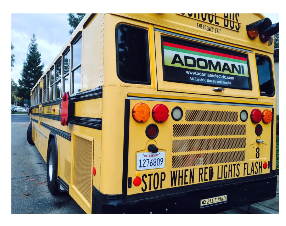
ADOMANI Inc., which converts school buses and other fleets into zero-emission electric and hybrid vehicles, has raised more than $14 million on flashfunders.com and plans to go public this week, trading under the symbol ADOM on the tech-heavy exchange.
It projects an initial market value of about $365 million after selling more than 2.3 million shares at $5 per share as of press time, before the offering closed. The company anticipates net proceeds of about $18.3 million from the offering if the maximum number of shares sell.
The underwriter is Irvine-based Boustead Securities LLC, a sister company of FlashFunders Inc. in Santa Monica.
ADOMANI’s initial public offering is Orange County’s fifth since February after years of drought (see box, page 39).
The company raised funding through a provision in the Jumpstart our Business Startups Act, which was signed into law in 2012 by President Barack Obama and allows crowdfunding to issue securities.
“It’s not a bad way to go,” ADOMANI Chief Executive Jim Reynolds said. “It helps us get our name out there and our story out there.”
Law’s Role
A central goal of the JOBS Act centered on expanding access to capital for entrepreneurs and emerging companies. Under the law’s Regulation A+ of Title IV—adopted by the Securities and Exchange Commission about two years ago—private growth-stage companies can raise up to $50 million from nonaccredited investors, essentially the general public. Typical IPOs raise money from institutional investors, such as investment banks and pension funds, and from accredited investors, or those with annual income above $200,000 or net worth of over $1 million. The SEC estimated in late 2015 that 4% of the U.S. population met that threshold, adjusting for inflation.
Time, cost, compliance and opportunity were the prevailing factors that led ADOMANI to test the emerging funding mechanism.
The offering, which opened in late April, allowed the company to easily surpass more than 300 unique investors, a requirement for every NASDAQ-traded company.
“A lot of them are small investors,” Reynolds said.
Less burdensome disclosure requirements make Regulation A+ offerings cheaper than traditional IPOs and less time-consuming, experts say.
Dan McClory, a managing director in the Irvine office of Boustead Securities, said fees associated with Regulation A+ offerings are a fifth to a third of the cost of a traditional S-1 filing, which can easily surpass $500,000 with big law firms and investment banks handling the workload. They should also shave off months from the process of going public.
It took ADOMANI only four days to secure the NASDAQ-required minimum of $10.6 million on the crowdfunding site, which was one of the first platforms to gain Financial Industry Regulatory Authority Inc. approval to operate and sell securities under the JOBS Act.
FlashFunders typically charges companies 5% of total funds raised.
ADOMANI is among a handful of companies across the country vying for the historic distinction.
“No one has ever used Regulation A+ to list a company on the NASDAQ,” said McClory, who also heads Boustead’s Equity Capital Markets and China business. “They will have a very nice distinction.”
Boustead is working on about a dozen IPOs in various stages of development.
Gregg Amber, a partner at Costa Mesa-based law firm Rutan & Tucker LLP, is closely watching the developments. Several clients have inquired about Regulation A+ funding, but none have started the process.
“I think that’s pretty much the trend nationwide,” he said. “Having a robust Regulation A is good for small and middle-market companies. It has potential.”
It’s so far untapped, though an SEC representative disclosed in February that 171 Regulation A offerings were filed from its effective date in June 2015 through the end of last year. Companies planned to raise $3 billion through the offerings but had only sold $238 million, roughly 8% of the intended goal.
The figures were shared during the 35th annual Federal Securities Institute in Miami.
Industry Challenge
ADOMANI’s tenuous market position and unproven business model in the unstable clean-tech sector carries plenty of challenges on and off the balance sheet.
The company developed a drive train that converts an internal combustion engine into an electric motor assembly. It’s produced a fleet of prototype vehicles, including hybrid and electric conversions of the Ford Mustang, and Ford F-150 and Dodge 1500 Ram pickup trucks but hasn’t generated “any material revenues,” incurring net losses since its 2012 inception, according to its prospectus.
Last year it posted a net loss of $10.7 million, with a working capital deficit of $3.4 million.
The manufacturer employs 10 at its Newport Beach headquarters, a production facility in Orange where it handles research and development, battery testing and prototypes, and at an office in Milpitas.
Its business model relies on partnerships with vehicle manufacturers that may not be suited for high-volume production, and its competitors include notable brands, such as Ford, Volvo, Hino and Lion Bus, which have “substantially greater” financial, engineering, manufacturing, marketing and support services, according to the filing.
A conversion is at least half the $300,000 cost of a new electric bus, according to Reynolds. That’s a pricy proposition for local, regional and state governments, but in states such as California and Massachusetts, subsidies and matching grants from various sources would likely eliminate most, if not all, the upfront cost, primarily leaving maintenance and electricity charges as the biggest expenses for municipalities and businesses.
ADOMANI is close to finalizing several partnerships as it seeks its first orders.
“We don’t have anything locked up yet,” said Reynolds, who envisions that most vehicles will run on electric in 10 years.
Infrastructure to support the shift beyond California has been a major barrier to nationwide adoption, but some of the concerns could ease over the next few years.
A $2.7 billion trust—part of Volkswagen’s $21 billion civil settlements with federal agencies, California regulators and plaintiffs related to its rigged software, which led about 11 million vehicles globally to skirt emissions tests—has been earmarked to support U.S. environmental programs and reduce emissions. The German automaker will also pay $2 billion to promote zero-emissions vehicles.
“That’s a lot of money,” Reynolds said. “That kick-start will get the market going. We need to get ahead of the game right now.”
