

Disneyland Resort has added food and beverage staff, tapped foodie trends, and tied comestibles ever closer to “storytelling” to enhance experiences at its Anaheim campus—and grow guests’ per-capita food spending.
Disneyland Park and Disney California Adventure; Disneyland Hotel, Disney’s Grand Californian Hotel & Spa and Disney’s Paradise Pier Hotel; and company-run areas of Downtown Disney’s retail and restaurant layout employ 7,900 food and beverage workers, up 9% from last year and 27% of its official headcount of 29,000.
Disneyland Resort has more than 150 food sites—about two-thirds quick-service or walk-up locations, the rest table-service, lounges and bars.
It served 10,000 menu items in 25.3 million meals last year—up from nearly 8,500 items and 24.2 million meals in 2015.
Disney Co. doesn’t provide revenue for individual properties—let alone a single area of one—but Business Journal analysis estimates annual revenue from food at Disneyland Resort at $400 million to $500 million.
A resort spokesperson said that if its food service was a restaurant chain, it’d be the 84th largest in the U.S. That’s good for $490 million to $523 million in sales when compared with Chicago-based industry tracker Technomic Inc.’s list of the Top 500 chains ranked by 2016 U.S. sales.
Jeff McNeal, president of hospitality consultant Fessel International Inc. in Arcadia, says the resort takes in about $400 million annual food and beverage sales.
McNeal said a dozen food options across the three hotels (see “Hotel Food” box) bring in $75 million to $100 million, while the two parks generate about $294 million from an estimated 21 million annual guests and a per-capita spend of $14.
“For comps, a museum patron eats and drinks about $2 per visit and Angel Stadium fans about $7,” McNeal said.
Amusement park trade group Themed Entertainment Association in Burbank and global engineers AECOM in Los Angeles put last year’s attendance at about 18 million for Disneyland Park and about 9 million for DCA—attendance figures that support food checks that total more than $400 million a year.
The resort has ESPN Zone at Downtown Disney but for the most part is landlord of its roughly 300,000 square feet rather than restaurateur. Six of Downtown Disney’s restaurants are run by Patina Restaurant Group in L.A., a unit of $3 billion food service and hospitality operator Delaware North Cos. in Buffalo, N.Y.
Food Focus
Disney Co. turned up the flame on a long-range food focus last year when it built Disney Flavor Lab, a 7,000-square-foot test kitchen in Florida.
Last year saw the return of the Food and Wine Festival at Disney California Adventure after a six-year absence; it returned this year for six weeks in March and April.
Festival of Holidays and its “festive foods marketplace” gets an encore this year in November.
A good portion of the resort’s recent food innovations are credited to Mary Niven, now senior vice president for experience development and integration, who reports to resort President Michael Colglazier.
Niven started as vice president of food and beverage in 2000 after four years leading residential dining at her alma mater, the University of California-Los Angeles with the mandate “to reinvent food and beverage,” she said.
UCLA, DCA
Niven dumped food courts and cafeteria lines in favor of bigger kitchens and better preparation—baking, sauteing—for food “cooked individually and presented properly.”
Students “could eat anywhere in L.A. [so we] created experiences”—efforts that eventually dovetailed with her Disneyland duties.
DCA opened in 2001, and Niven, later vice president of the park, got kudos for creative food efforts there.
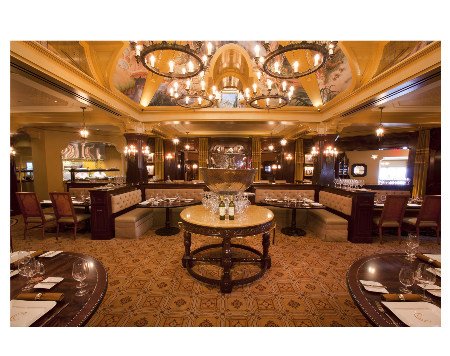
Carthay Circle Restaurant, for instance, which opened as part of a wider 2012 redo of California Adventure, is meant to evoke the Hollywood theater where “Snow White and the Seven Dwarfs” premiered in 1939.
“We understood there was a gap in our demographics” inside the parks, Niven said—a dearth of fine dining—“so we said, ‘OK, this place existed in California at that time; what would it have offered, and how do we translate it?’”
The restaurant recreates period architecture and cocktails and can tap an occasional edgy vibe—Vietnamese street tacos—at the first floor bar, with fine dining on the second story, while connecting to the wider story at the end of Buena Vista Street: red trolley cars, newsboys and barbershop quartets, among other elements.
Story, Place
“We want unique items to support immersive stories,” Niven said.
It can be “a corn dog on Main Street”—“a traditional item” in days past—to “popcorn on the boardwalk” or a cocktail layered with colors keyed to the World of Color lights show.
DCA’s Pacific Wharf “is a riff on types of food you find in California,” and if Cozy Cone Motel in Cars Land sells “chili cone queso”—chili, cheese, corn chips, bread cone—it’s partly an edible pun on orange highway emergency cones.
“We spend a lot of time looking at how people eat” in various areas, said Michele Gendreau, food and beverage director, including when, how much, how often and how people in a group make different food choices—splitting off from and then re-forming as a group.
Route 66
Gendrau said some guests want character dining—“meet the Disney princesses”—and others go for quick bites from a food cart.
The resort has “researched food along Route 66”—the famed U.S. highway—and considered the tension “between indulgence and wellness” in food choices and “location and efficiency,” for instance, which building fits in a given space.
It also practices the restaurant industry’s “limited time offer” approach. A now-gone “dark side/light side” menu at Tomorrowland’s Galactic Grill included pumpernickel buns for burgers on the dark side.
Another LTO: Village Haus in Fantasyland has become the Red Rose Taverne—complete with menu item “The Grey Stuff.” The site’s name and dish refer to Disney’s live action “Beauty and the Beast,” released this spring.
Social Media
Festive food can gin up marketing appeal.
Disney Co.’s Disney Parks Blog posts, a la Instagram, food photos and recipes: a Marvel-themed “Summer of Heroes” event that began May 27, for instance, was preceded by a “Foodie Guide” with snapshots of items like shaved ice offering Spider Venom.
Website Grub Street last month noted the popularity of Groot Bread, a sourdough loaf with eyes of black olives and hair made of jalapeño-cheddar cheese, named for a “Guardians of the Galaxy” character that looks like the child of a Tolkien Ent and a Wookie.
Indie food blogger A.J. Wolfe has turned writing about Disney food into a business. She said her “Disney Food Blog” employs full-time writers who visit the parks to eat and write about it, publishes books on eating at the parks and has been cited by media that includes the Wall Street Journal and NPR.
“We cover the food at the parks and resorts and give potential guests a clear and literal view of what they’re going to get for their money,” she said.
Foodies
The resort also eyes wider foodie trends—more, and more adventurous, eating out—beyond its walls.
Park-goers have close options, from OC-based build-your-own pizza place Pizza Press across the street, to House of Blues at GardenWalk around the corner. Farther afield is the hepcat food hall at Anaheim Packing District.
“They have more choices, and that keeps us on our toes,” Niven said.
Competition also comes from Knott’s Berry Farm in Buena Park, with its Boysenberry Festival in April, and other entertainment options, such as the old-school dinner-and-a-movie.
Annual pass holders sometimes come “Friday night for a date, have dinner and go on one ride,” Niven said.
“People don’t come thinking, ‘Let’s get a churro,’” she said—but food “can be a draw.”
And Disneyland does sell churros (see “End-to-End” box ).
Fresh Fish
Gendrau said a foodie focus can also “bring guests out of their comfort zone.”
Some of that falls to Executive Chef Andrew Sutton, who oversees upper echelon offerings Carthay Circle, Napa Rose Restaurant at Grand Californian Hotel & Spa, 21 Royal in Disneyland Park, and the resort’s pastry making.
An on-site bakery produces 90% of the two parks’ pastries, and its pastry chefs have taken home several awards.
Sutton came to the resort from Auberge du Soleil, a Napa Valley resort, about the same time Niven signed on.
He “lives and eats seasonally” and looks at “blue zones—places where people live a long time,” such as Sicily or Greece—and Loma Linda, Calif., which has a large Seventh Day Adventist community that traditionally hews to healthful eating—to guide food choices.
He asks questions like “how to maximize [the taste] of a cherry or clam?” and “Did I find the right asparagus?” and recalls a 200-pound swordfish—“that thing was so beautiful”—and the resort butcher who “broke it down” for use.
Delivery drivers know tomatoes for his tables don’t get refrigerated.
“They ride in the cab of the truck,” he said. “If you’re going to buy the best, you should take care of it.”
