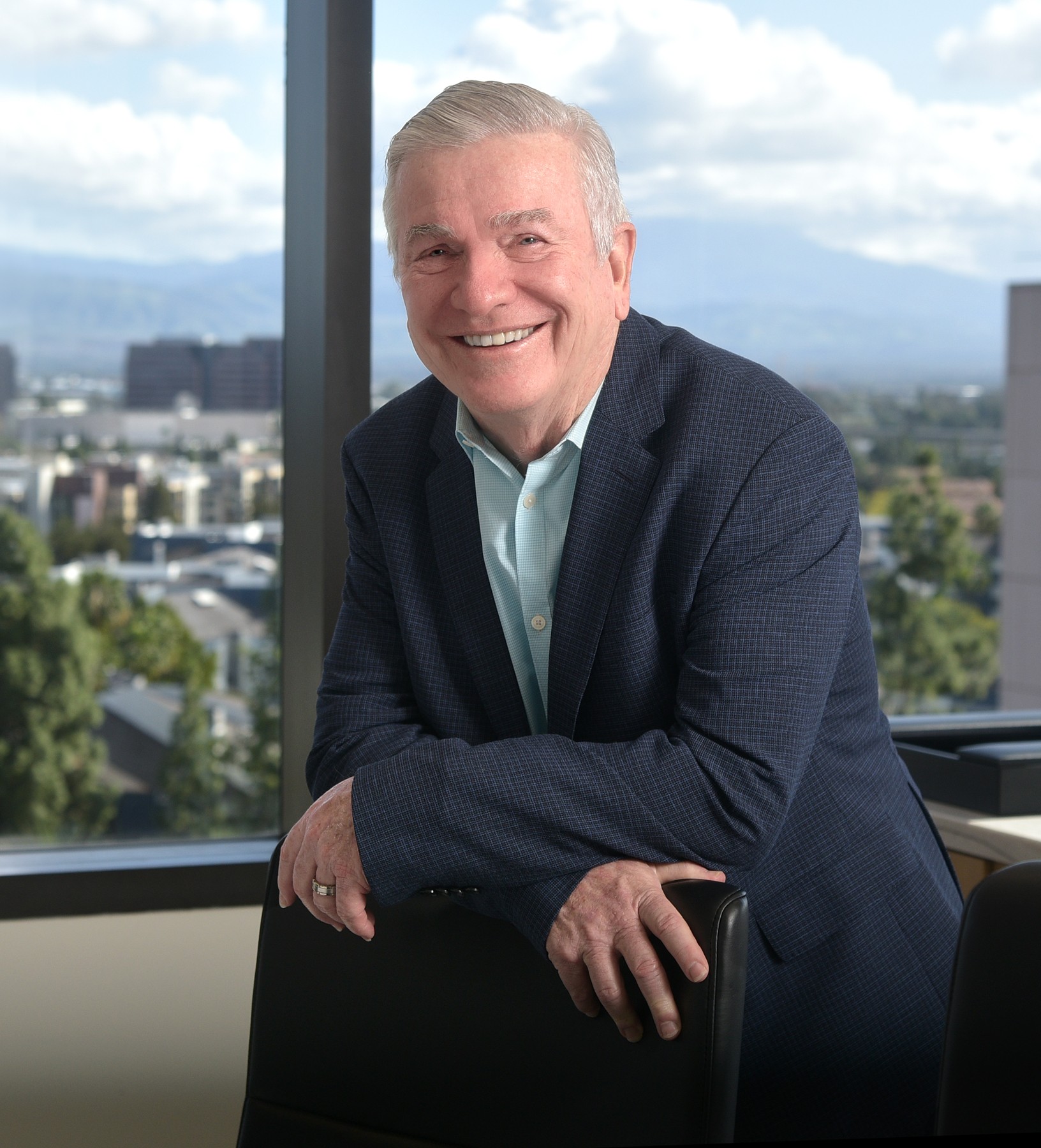
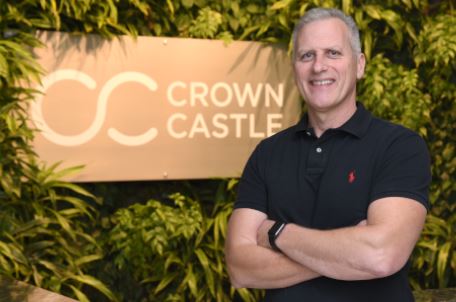
Rod Hanson wants to make sure your next-generation wireless devices will be able to connect to the internet super-quickly in Orange County—what’s known as 5G.
“Instead of taking an hour to download a movie onto your phone, you’ll be able to do it in five seconds,” he said.
“It’s not an evolution. It’s more of a revolution. It’s going to allow really high speeds and bandwidths and low latencies. It will help support a lot of data moving back and forth, virtual reality applications, wearables.”
Hanson is West Coast manager of “small cells” at Houston-based Crown Castle International Corp. (NYSE: CCI), a $46 billion company with 40,000 cellphone towers spread across America.
The company is relatively new to Orange County. It opened an office here in 2015 and has just 24 towers.
Well, that’s changing.
It’s already built or has contracts here to install 1,000 small cells—the newest technology, which fits on top of lampposts, office buildings and other high structures. Think of them as miniature cell towers.
It recently completed installation of 240 small cells in Santa Ana, mostly in its downtown.
It’s also one of the providers of wireless infrastructure at Disneyland Park, and is looking for other large venues where cellphone use is heavy to deploy its technology.
A rival on small-cell deployment offerings, distributed antenna systems and other next-generation wireless technology is Newport Beach-based Mobilitie LLC, which counts Anaheim’s Honda Center among the more notable local sites where its technology is used.
Crown Castle plans to eventually spend tens of millions, maybe even hundreds of millions of dollars, in Orange County to build the infrastructure that supports the newest generation of wireless technology, Hanson said.
Last year, it moved into a 65,000-square-foot office on three upper floors at the 200 Spectrum Center tower overlooking Irvine Spectrum Center mall.
The company now employs 326 in OC, double four years ago, and plans to keep growing.
It’s no coincidence that Crown Castle’s local operations are based in Irvine, which Hanson said is strategically located in the center of Southern California and close to large offices of major customers, including Verizon Wireless, T-Mobile and AT&T Inc.
“We love Irvine,” Hanson said. “The environment from a business perspective is very good. There is a great quality of life and great employees.”
Winning Strategy
Crown Castle was one of the winners of the 1990s battle over cellphone call delivery.
At the time, big investors, such as Bill Gates, bet that satellite companies could provide the connections. Later, it became obvious that satellites, which were promoted as able to provide phone service to the top of Mount Everest, had a major flaw.
“The issue was low-orbit satellites that would re-enter after a few years,” burning up in the atmosphere, recalled Hanson. “It just didn’t pencil out compared with cell towers.”
By contrast, Crown Castle stuck to building cell towers one by one in a tedious process that often ran into opposition from communities that wanted cellphone service without the ugly structures cluttering their neighborhoods.
Sometimes, Crown Castle would find its biggest competitors were customers like Verizon and AT&T.
“They go through periods where they want to build the towers themselves,” he said.
However, the wireless companies often couldn’t defray the costs by sharing the tower with competitors, and they would also have to maintain and upgrade the structures. When they needed capital, they often sold their towers to companies like Crown Castle and Gary Jabara’s Mobilitie, a privately held telecom infrastructure firm that got its start in the cell tower business and now employs about 250 in OC.
$46B Value
Crown Castle became famous on Wall Street as a 100-bagger. Its shares rose from just above $1 in 2002 to a recent price of more than $110 a share.
Hanson missed that run, having joined the company in 2015. He entered the industry in 1992, selling cellphones for Cellular One, a once-prominent brand. For 13 years, he owned RealCom Associates LLC, a wireless site development services company acquired in 2012 by services company Smartlink LLC, the same year he moved to Mission Viejo.
Small-Cell Growth
The growth of cellphone towers most likely won’t match prior years, often because communities want alternatives to the gawky metal frames, Hanson said.
The problem is demand continues to grow. At certain venues, such as stadiums, too many people try to use the same cell site at once, quickly overloading capacity. Carriers are looking to small cells and distributed antenna systems as solutions.
“It’s very difficult to build towers to keep up with the demand,” Hanson said. “The towers aren’t going away. The growth is in small cells.”
Towers will continue to exist because they’re a needed part of the network with small cells to provide a range of wireless services. Moreover, a patchwork of regulations and ordinances that were written with more traditional cell towers in mind can sometimes delay the process when deploying small cells, which has been the case in Orange County.
With a number of states having already adopted legislation to ease the barrier to deployment, and a recent order by the Federal Communications Commission with the same intent, Crown Castle expects to be able to deploy these networks with more efficiency in the near future.
While towers in rural areas can cover three miles, the radius in urban areas can be as small as a tenth of a mile.
By contrast, the radius of a small cell is as small as a block. The small-cell advantage, though, is the close proximity to the customer so that data is processed more quickly at high bandwidth.
The potential of 5G’s increased speed is similar to how Apple Inc.’s iPhone changed the cellphone.
“When I first saw the iPhone, I didn’t really get it,” Hanson said. “I had no idea it would enable applications that would replace things I’ve been using. There will be applications that no one has thought of previously.”
Moat Building
Crown Castle doesn’t rely on proprietary technology for most of its moat. Instead, it’s building a fiber-optic network that’s now 65,000 miles to connect small cells and towers to the internet.
Its expenditure on fiber infrastructure jumped 92% last year to $768.8 million, when its entire capital-expense budget was $1.23 billion.
“Once you’ve built the infrastructure, like the fiber, it becomes difficult for someone to come in and duplicate,” Hanson said. “Other companies can put up 10 or 20 nodes, but we can do thousands of nodes.”
Currently, the company has more than 6,000 small cells in Southern California, including 1,000 in Orange County.
Getting approvals for small-cell deployments varies from city to city; some local municipalities have been more open to approving the technology than others.
“We are the leader” for building 5G in Orange County, Hanson said.
Crown Castle’s growth may help its customers—the wireless cellphone companies—enter markets dominated by cable companies.
Could the fifth-generation wireless be fast enough to enable OC customers to dispense with cable services for television or internet access?
“We will see,” Hanson said. “We’ll let the carriers decide. We wouldn’t be the ones you get bills from.”
“There’s a reason we have a giant presence here. We view it as a very important part of our future.”