

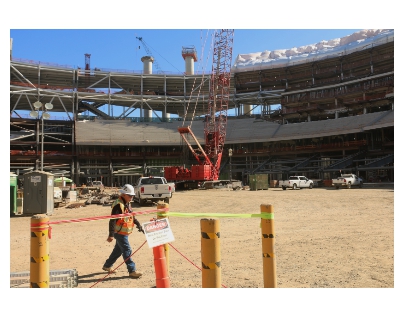
Forty miles northwest of its current headquarters in Costa Mesa, construction on the new home of the Los Angeles Chargers is moving ahead at fast pace.
“Every time I come out here you can just see so much more progress being made on the stadium, in such a short time,” Chargers President of Football Operations John Spanos said during a Sept. 19 media tour of the Los Angeles Stadium in Hollywood Park, in the city of Inglewood.
The nearly $5 billion stadium project—which has seating capacity for 70,240 fans, and could expand to hold up to 100,000 spectators—is scheduled to open in 2020. It’s about 50% completed now.
In addition to the Chargers, it’ll be the home of the Los Angeles Rams. The stadium’s construction is being financed by the ownership of the Rams, and the Chargers will largely act as a tenant at the stadium, although they stand to get a cut of non-football event revenue there.
The entire development’s cost was initially given a $2.6 billion estimate.
Opening day “can’t come soon enough,” Spanos said.
That might not be the news everyone in Orange County wants to hear, particularly civic leaders. The football franchise has set up its base in Costa Mesa’s Hive office complex the past two seasons since moving from San Diego, and has held its training camp in the city.
The Chargers currently play their home games at Carson’s StubHub Center, a converted soccer stadium—by far the smallest venue in the National Football League with 27,000 seats.
It’s about 10 miles closer to OC than the Inglewood site.
The Chargers haven’t indicated whether they plan to decamp their OC operations to Los Angeles once the new stadium opens.
Record-Setting Canopy
Standing deep in the bowl of the stadium, on what will be the 50-yard line in less than two years, it’s easy to see why the Spanos family is eager to see the state-of-the-art project, situated on 300 acres next to The Forum, completed.
On one wing of the stadium a portion of concrete support columns, which will eventually support the largest canopy in the world, stands tall.
The first pick of canopy steel, which weighed 2.4 million pounds, was set about a month ago. The steel compression ring that holds the canopy will include more than 30 picks.
When it’s completed, 38 precast support columns will hold the steel compression ring and a cable net system that will suspend a single-layer of ethylene tetrafluoroethylene, the same fluorine-based plastic used to construct the roof of US Bank Stadium in Minnesota, where the Vikings play.
In all, 309 sections of the plastic, cut in 60-foot by 60-foot sheets, will encircle one of the most dynamic and heralded structures anywhere, while providing an open air space atop the stadium—a first in the NFL.
“The venue is going to be spectacular,” A.G. Spanos, Chargers president of business operations, told the Business Journal.
“The scope and scale is really befitting of Los Angeles. You can walk around and see things that have just not been done before.”
Those new features include the field level built 90 feet below ground, as well as 80,000 square feet of digital signage.
The stadium’s structural retaining wall, which is nearly complete, contains 1,108 miles of steel straps, almost twice the length of the Pacific Coast Highway.
A Demag CC 12600 crane is handling the heavy lifting. The massive machine, transported in pieces by 238 trucks, is one of the largest on the globe with a boom length of 275 feet and a counter weight of nearly 816,000 pounds.
It was assembled over four weeks by two cranes.
The stadium has already attracted some of sport’s most famous events: Super Bowl 56 in 2022, the 2023 College Football National Championship, the World Cup in 2026, and the opening and closing ceremonies of the 2028 Olympics are all expected to be held there.
The economic impact of Hollywood Park—which counts plenty of other development outside the stadium—will likely be measured in billions over decades.
The project includes:
• 2,500 construction jobs around the clock
• 1 million square feet of retail and commercial space each
• 25 acres of parks, lakes and trails
• 2,500 residences
• a 300-room hotel
• a 6,000-seat performance venue
“You’re probably looking at thousands of jobs on this campus,” said Kevin Demoff, chief operating officer and executive vice president of football operations for the Rams. “When you look back to the Forum in its heyday and the racetrack in its heyday, Inglewood was the epicenter of Los Angeles sports and I certainly think it has that chance to be again.”
The stadium will feature 260 luxury suites, more than 13,000 premium seats, and nearly three million square feet of usable space.
Unlike downtown L.A.’s new $350 million Banc of California Stadium, a soccer venue that the Santa Ana–based bank paid $100 million for naming rights for 15 years, the Inglewood project has yet to secure a naming rights sponsor. That price will far surpass that of Banc of California’s deal.
