
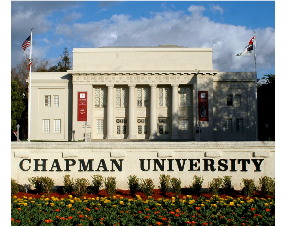
Jobs in Orange County, led by the construction industry, are projected to grow at a “significantly higher” rate than nationwide, according to Chapman University’s latest semiannual economic forecast.
The county’s jobs growth should rise 2.4% this year, similar to 2.3% statewide and outpacing 1.5% nationwide, according to the 40th economic forecast by Chapman’s A. Gary Anderson Center for Economic Research.
“We will add 38,000 jobs this year in Orange County,” economist Jim Doti told an audience of about 1,000 at the Musco Center for the Arts at the university’s Orange campus.
The forecast predicts OC housing will appreciate 7% this year and 5.5% nationally.
The report cites four industries as the source of most of the job growth in the past four years and warned that half of those jobs are relatively low paying. It predicted housing affordability will continue to decline.
Chapman, which a year ago accurately predicted U.S. gross domestic product would increase 2.3% in 2017, put its 2018 forecast at 2.7%, up from the 2.5% predicted in December.
Chapman’s forecasts are often cited in major publications, including the Wall Street Journal and Bloomberg Businessweek.
“This expansion will be the longest in the history of the United States,” Doti said. “When will it end?” As the Federal Reserve raises interest rates three times next year, the yield curve will come closer to an inversion, signaling a possible recession that may affect the 2020 presidential election, he said.
The best leading indicator of a recession is the inverted yield curve, where short-term debt rates are higher than longer term rates, he said. Doti, who helmed OC’s largest private university for 25 years as president, is an economist and disciple of Nobel laureate Milton Friedman.
California’s jobs growth should rise to 17.2 million led by an 8.9% increase in construction, with 72,000 new jobs this year, more than double the 33,000 reported last year.
Here are other forecast highlights:
Construction Leader
Overall, Orange County is projected to employ 1.66 million by year-end, growth led by construction, which “should pick up even more steam in 2018” with a 5.8% job growth rate versus 4.5% in 2017, the report says. The industry should employ 108,000 here by year-end, up from 78,000 in 2013.
Growth is fueled by a pickup in housing permits, which are projected to hit a post-recession high of 11,200 units this year. The report notes that single-family home permits have offset a “sharp decline” in those for multifamily units.
“It is too early to tell whether that decline is related in a significant way to concerns over mounting political pressure to institute rent controls in Orange County,” the report indicates.
Housing affordability, a measure of a family’s ability to afford a median-priced home, should continue to drop from 72.6 in late 2016 to 60 by year-end.
“Despite decreasing housing affordability in the county, we see tight supplies of homes available for sale, contributing to another year of relatively high housing appreciation,” the report says.
Emerging Sectors
About 77% of the 155,000 jobs created from 2013 to 2017 were in four sectors: construction, professional and business, education and health, and leisure and hospitality. Together, they grew jobs 3.9% annually compared to 1.2% growth in all job sectors.
“This disparity speaks to the growing relative importance of these categories in the Orange County economy,” the report indicates.
Average salaries were far higher in construction, $69,576, and professional and business, $66,820, than in education and health, $49,556 and leisure, $26,312.
The disparity “does not auger well for overall income growth,” the report says.
All sectors averaged $58,344.
Personal Income
Total personal income in OC should rise 4.9% to $215.5 billion, the biggest increase since 8% in 2015.
Total taxable sales are projected to climb 2.6% to $65.6 billion, the most since a 4.4% rise in 2014. Service stations will see the greatest increase, 8.1% to $3.84 billion.
A year ago, Chapman predicted inflation at 1.7%, below the eventual 2.1%. It’s predicting 2.7% in 2018.
It predicts the Federal Reserve will raise its benchmark fund rate to 2.25% by year-end and to 3% by the end of 2019.