

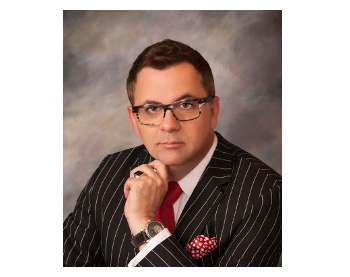
Bradford Rowley started his photography business in the late 1980s, when one-hour photo processing was the speediest way to share memories. Nowadays, despite the glut of selfies overtaking our social media feeds, his portraiture remains relevant—and lucrative.
Rowley’s signature look, which is reminiscent of old-world paintings, can fetch up to $50,000, with most sessions ranging from $5,000 to $20,000. He’s welcomed more than 10,000 clients to his three studios over the years, an array of celebrities and C-suite executives that includes Claudio Del Vecchio, chief executive of Brooks Brothers Group Inc.; Don Ienner, former chairman of Sony Music Entertainment, and Olympic gold medalist Nastia Liukin.
“Our number one demographic is families of college-age children,” Rowley said. “Because of the milestone that that is … and usually at that stage people are in [high-earning years]. Our portraits are not cheap.”
Bradford Renaissance Portraits Corp.’s Costa Mesa studio brings in the most volume, while “average ticket spend is much higher” at New York and Palm Beach locations. Word-of-mouth advertising accounts for most of the business. Case in point: Via del Monte in Palos Verdes.
“I think we have a portrait in every other home on that street,” Rowley said.
Growing Pains
Rowley, who employs 10 at the three locations, generates about $2 million to $3 million in annual revenue. He launched the business after taking a six-month correspondence class in photography.
“Like most new entrepreneurs, especially on the artistic side, I thought that if my work was amazing, then I would be successful,” he said. “So I fell on my face pretty big. I didn’t understand marketing and a lot of other things I should have understood as a businessperson.”
He started out shooting weddings and family portraits on the beach, “like everyone else was doing,” while also maintaining a side gig in construction. He ended up in personal bankruptcy after the recession hit in the early 1990s.
“I had to sell a lot of my equipment,” Rowley said. “The only thing I could afford was one camera, which I purchased in Tijuana, and one background.”
The limitation, “instead of being a weakness, became a strength” that helped him develop a unique style.
All three studios have “the exact same background” painted by “the same artist out of Hollywood.”
He also focused on his passion for artwork by the old masters, the European painters working before 1800.
“All of our portraits are combinations of photography and painting, or are complete paintings,” Rowley said.
The studios offer renaissance finish, where “we go into a little artistry—we lengthen every eyelash, sparkle the eyes—we do everything you expect in a fully retouched picture, but we make it much more three-dimensional, and we bring it to life,” he said.
Another option is the masterpiece portrait, which Rowley described as the “Rolls Royce finish.” The artist digitally repaints the entire portrait, which is then printed on canvas “using the best archival materials” and is “rated for 200 years before any fading begins.” The canvas, which can be life-size, is also topped with “extra layers of hand oil painting and protective lacquer.” Frames are custom-made “from scratch” and feature a hand-engraved, 22-carat gold nameplate.
The elaborate finishing technique was a way for Rowley to buck the digital trend that inspires sharing hundreds of photos on social media in lieu of hanging a few frames around the house.
“It’s interesting—this is the most photographed generation, but it’s also the generation with the least amount of pictures, at least on their walls,” he said, adding that, “Today people feel like they can flip through their cellphone, and they got it covered.”
Rowley’s portraits also stand out from offerings by budget and middle-of-the-road photographers, who, thanks to the simplicity of digital photography, have been replaced by moonlighters—usually a “neighbor who got a digital camera for Christmas,” who really loves photography, and who is going to do the family portrait at the beach for free or substantially cheaper than the rates professionals charge.
“I’ve served as president of our national association and have seen so many studios go out of business,” he said.
“The only photographers who survive are the ones that offer a little bit of a different niche. When I saw this trend coming, [I decided to] do something very high-end that someone would want, that’s beautiful, and that couldn’t be replicated so easily.”
Expansion
Rowley, an Anaheim native, opened the New York studio in 2006, a “city that most mirrored the greater Los Angeles area as far as demographics.”
The Palm Beach location followed in 2011, as “a lot of our New York clients had homes in Florida.” The studio is on Worth Avenue, an upscale shopping and dining district that features sidewalks made of crushed shells and that Rodeo Drive in Beverly Hills was patterned after.
“Every luxury brand that you can imagine is on that street,” he said. “In California, our studio is in the back of a shopping center, very humble. New York was a step up, but to land on Worth Avenue was a huge achievement for us.”
