
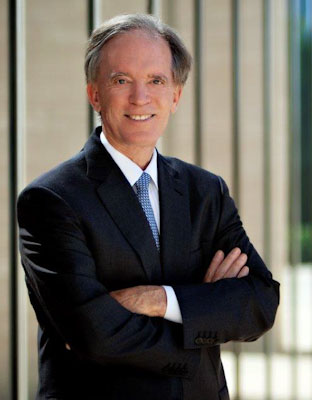
Bill Gross is calling it quits and discusses his career in an exclusive interview with the Business Journal.
The one-time bond king who made Newport Beach-based Pacific Investment Management Co. world famous among investors, last week announced he is retiring as a portfolio manager at Janus Henderson Investors, effective March 1.
“I’m proud of my career,” Gross, 74, said in an exclusive interview with the Business Journal. “I’ve helped a lot of people in terms of total returns.”
Gross departs after his Janus fund suffered a poor performance in 2018 and his assets under management fell in half to below $1 billion, a paltry sum compared to the $2 trillion he oversaw in his heyday at PIMCO.
While his last four years were subpar for Gross, it was the earlier work at PIMCO that made him a legend in the bond world.
According to Bloomberg, PIMCO’s bond fund known as the Total Return Fund generated a 7.8% annualized return during the 27 years that Gross managed it.
The accolades came in fast for the man who made many innovations in bond trading, was inducted into the bond analyst hall of fame and was named by Morningstar as bond manager of the decade for 2000 to 2009.
“A legendary investor, Bill Gross leaves behind him a long history of fixed income innovation and performance,” former PIMCO Chief Executive Mohamed El-Erian said via Twitter.
“Many of his approaches and analytical frameworks continue to be used today by investors around the world.”
“He made a terrific contribution, not just to PIMCO, but to the bond market in general,” said Bill Thompson, who was PIMCO’s chief executive from 1993 to 2009 and is returning as chairman emeritus (see separate story, page 80).
“We had a great run. There were a lot of ups and some downs along the way. That’s the way partnerships are.”
Even PIMCO, where Gross had a contentious falling out in 2014, gave him credit.
“Bill Gross was a pioneer of active bond management who had an enormous influence on PIMCO’s investment process, client returns and the careers of the firm’s talented portfolio management team,” said a statement from PIMCO. “We wish him well in retirement.”
Card Shark
Born in Middletown, Ohio, Gross graduated with a degree in psychology from Duke University in 1966. It was during his last year that he “was scalped in a car accident” and spent many months in a hospital recuperating. He read Edward O. Thorp’s “Beat the Dealer” and practiced blackjack thousands of times to test the theory.
With only $200 in his pocket, he snuck aboard a freight train to hitch a ride to Las Vegas and even had a secret pouch sewed into his pant leg to prevent thieves from robbing him of what little he had.
“I didn’t have money for a bus or plane ticket,” he recalled.
In Las Vegas, he paid $6 a night for a hotel room and played cards for five months, eventually accumulating $10,000. He later met Thorp, who resides in Newport Beach, and said the two have since invested together for stem cell research at the University of California-Irvine.
“We see each other frequently,” Gross said. “I tell him all the time that he’s responsible for my career.”
Naval Officer
In the late 1960s, Gross joined the Navy, where he’d ferry Seals on small landing crafts up the rivers of Vietnam. He said the job, which on occasion involved firefights, was one of the most dangerous in the Navy.
Afterwards, he decided not to return to Las Vegas, believing that his mathematical talents could be better used on Wall Street. He earned an MBA at University of California-Los Angeles by writing a thesis on another Thorp book, “Beat the Market.”
Like many young people in finance, Gross was attracted to the glitz of the equity market. After he joined what was then called Pacific Mutual, he saw the opportunity in bonds.
He recalled often going to a physical vault, finding the paper bonds and clipping out the interest coupons. He convinced Walter Gerken, former chief executive, to take some of the bonds in the vault and trade them.
“He thought I was nuts. That was the start of PIMCO,” Gross said.
At the time, computers were just coming into being and technology was making it possible to more easily trade bonds. One of his best was making $2 million on a single bond trade in the late 1970s.
“I said hell, this is a like playing a football game where there is a huge hole in the line and you can run right through it.”
During PIMCO’s first couple of decades, Gerken became increasingly impressed with Gross and the other co-founders, Bill Podlich, who handled administration, and Jim Muzzy, who directed client services.
“Those guys over at PIMCO were so young when they began that they called me Mr. Gerken. I called them by their first names, Bill and Jim. Now they call me Walt and I call them Mr. Gross, Mr. Podlich and Mr. Muzzy,” Gerken recalled years later on the Pacific Life website. Gerken died in 2015.
Bond Bulls
Gross attributed part of his success to arriving at the right time—the 30-year bond bull market. He watched Treasury bonds, which had 15% interest rates in 1981, gradually fall to 2% by 2012. Bonds increase in value when interest rates decline.
“We caught the great bond bull market in 1981—it continued almost constantly,” he said.
He developed a secular outlook where he would consider the longer term so as to reduce emotions caused by financial markets’ gyrations in the short term.
“Other than taking Xanax, the proper way to control emotions is to take a longer term view of three to five years as opposed to three to five days or three to five months,” he said. “I think that worked very well. You have to have the right outlook.”
Gross’ fame spread and in 1996, he was inducted into the Fixed Income Analysts Society’s Hall of Fame.
“Bill Gross’ methodology arguably has spawned the entire active total return approach to fixed income investing,” John Malvey, president of the Fixed Income Analysts Society, said at the induction ceremony.
Meltdown Profit
Perhaps the most brilliant move for Gross was avoiding the 2008 financial crisis. As early as 2005, Gross gave warnings in his newsletter about subprime mortgages.
He sensed the problems while watching real estate prices rise in Orange County. He sent a team of analysts to cities like Las Vegas, Detroit and Cincinnati to study the market.
“We had 10 analysts at PIMCO who were analyzing corporate bonds. I told them to stop what you’re doing and go out into the United States and pretend to be a buyer of real estate.
“They’d drive around and get a feel for what was going on. Because of that, we learned about all the funny things like liar loans and no-docs and all the shady things that were propping up the housing market.”
Besides avoiding the pitfalls in the subprime mortgage market, Gross also predicted the government would have to pump billions of dollars into the economy to avert a total collapse. He developed a strategy called “shake hands with the government” where PIMCO invested in bond sectors that he believed Washington would be forced to support like government-backed mortgages guaranteed by Fannie Mae and Freddie Mac.
After the government takeover of those two entities was announced in September 2008, the value of the Total Return Fund rose by $1.7 billion in a single day, according to the New York Times.
Gross’ reputation got to the point where in the midst of the 2008 financial crisis, Warren Buffett, the best stock picker of all time, suggested to Treasury Secretary Hank Paulson that Gross should manage securities that were drowning Wall Street, the Times reported.
In 2008, Gross’ Total Return Fund reported a 4.8% gain—beating his benchmark by 950 basis points, an almost unheard of return. In an industry where safer bonds traditionally trail equity returns, he also whipped the S&P 500 Index, which fell 38%.
Within a few years, PIMCO’s assets doubled to $2 trillion.
“It was astounding. It was bigger than Goldman Sachs and Bank of America. PIMCO had more assets under its control than anyone, except BlackRock,” Gross said.
“How do you start in 1971 with nothing and then you got more money than any institution in the world? It still blows my mind.”
The 30-year bull run in bonds ended in 2012 and Gross’ Total Return Fund suffered an uncharacteristic decline in 2013. Turmoil developed at the firm and Chief Executive El-Erian left in 2014, followed by Gross in an acrimonious departure.
PIMCO, rather than face a trial that would reveal secrets such as the multimillion bonuses enjoyed by its portfolio managers, settled in 2017 by paying Gross $81 million, which he donated to his family foundation.
Testament
After a messy 2017 divorce from his wife, Sue, Gross established a new foundation late last year with his children, the William, Jeff and Jennifer Gross Family Foundation. With $390 million in assets, it’s the second largest based in Orange County (see list, page 16). He is managing the foundation’s investments.
For the past four years, Gross’ Janus Henderson Global Unconstrained Bond Fund returned about 1% annually, which Gross said “is not so hot.”
“It didn’t work out well in turns of performance. I still made money; I just didn’t make very much.”
Nowadays, he doesn’t get up at 2 a.m. to look at Japan or European markets.
He said he’s relaxed, playing golf in the desert and planning to go on tours such as a German river cruise ship.
“A Morningstar consultant said I’d made more money for more people than anyone in the world. I don’t know if that’s true,” he said.
Then he pointed out PIMCO’s building in Newport Center that was completed in 2013 and overlooks Fashion Island.
“PIMCO’s got that 20-story building as a testament in part to my contribution.”