

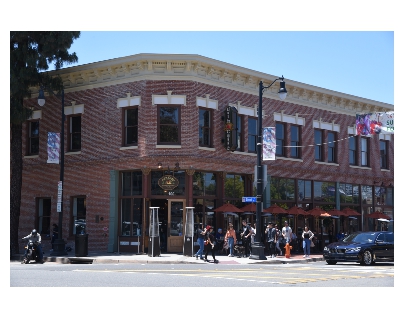
The country may need a good 5-cent cigar, but what the county really needs—based on activity in the city of Orange—is more $5 cups of coffee.
“If you asked me how many coffee shops we had I couldn’t tell you,” said Al Ricci, a longtime real estate agent and Plaza area property owner.
The central OC burg’s Old Towne Orange area, a roughly two-block radius centered circularly around The Plaza and its iconic fountain offers more than a dozen solid opportunities for morning jolts of java from storefronts with the “morning” generally running 5:30 a.m. until midnight.
Including sites specializing in something else—pie or high tea, for instance—there are at least 20 coffee-ready joints in the area (see map, page 50).
Even chicken-and-waffle sandwich maker Bruxie, on the site of a former ice cream stand and with a new diagonal crosswalk at its intersection to facilitate pedestrian traffic from Chapman University across the way, sells a cup of coffee.
More are brewing—Philz Coffee is expected to open this year even as the most recent—Urth Caffé—completed its slow-drip arrival in January after two years of persnickety remodeling of a 130-year-old two-story building, a pour-over process to rival even famously languorous Portola Coffee Lab—which is also there.
It’s not hard to see why businesses are entering this field. Coffee giant Starbucks Corp. (Nasdaq: SBUX) reported each of its coffee stores generated an average $843,000 in fiscal 2018, with an operating income margin of 18%; its location on the Plaza can sometimes be seen being supplied by a truck from Quality Custom Distribution—a unit of Irvine-based Golden State Foods Corp.
Orange is taking the coffee craze to another level.
Structured Parking
“Entrepreneurs look for opportunities,” Mayor of Orange Mark Murphy said.
He and Ricci—who heads Ricci Realty in Orange and North Hills Realty in Tustin, which combined sell about 500 homes a year in some of the pricier parts of central OC—have known the downtown area for nearly half a century.
They’d already seen it change from old-time offerings—JCPenney, Buster Brown, Schwinn, an old movie theater that became a church—to antique shops (see Antique Notion, page 50) with few eateries, such as Watson’s Soda Fountain & Café, dating to 1899, and the Cuban-focused Felix Continental Café, which came along 80 years later.
Then Orange amended city codes to let restaurants pay “in-lieu” fees instead of providing parking spaces. From the ’90s into the early years of the new millennium, restaurants began to open.
“That’s what changed,” Ricci said.
Over the last quarter century, Murphy served on the City Council in all but two of the years and Ricci “put 21 of 46” new restaurants into leases near the Plaza—including redeveloping the location of his own real estate firm, founded in 1977, to make room for several, in 1998.
“We paid $160,000 of in-lieu parking fees to do the food court,” he said. “We would’ve needed a hundred spaces.”
Food Service
More restaurants came.
Citrus City Grille was among the first; others included Francoli’s, which moved from Fashion Island and occupied a closed menswear shop; Gabbi’s Mexican Kitchen, never hanging a sign out front but usually packed inside; and coffee shops, including Blue Frog Bakery, as well as a former location of Diedrich Coffee now a Starbucks.
What didn’t often come and often hasn’t worked out is retail.
It was hoped that restaurants and shops would develop in tandem, so a parking structure was planned, which opened in February to support day-trippers coming to Orange on the train (see More, Free Parking, below).
Some shops have come; a few remain; largely specialty retailers and services.
“We don’t have the demographics” to back big retail, Ricci said. “We try to get other uses and it’s really tough.”
Business owner Mike Escobedo, who’s been involved in the Old Towne area more than 30 years, said, “Some of the better shops have stayed,” noting “good quality” in product and customers make for keepers. He said coffeehouses can compete by keeping to their niche (see Specialties, below).
Escobedo helps his graphic design clients, provides coupons for visitors and indefatigably cheerleads for the area by the bimonthly Old Towne Orange Plaza Review, a free publication—stacks of which he personally delivers to local businesses.
Philz Up
Escobedo says Hilbert Museum, a Chapman University venture near the train station dedicated to California scenes of the 20th century, and Musco Center, also at Chapman, drive business to the Plaza.
“People come to relax, unwind, be pampered,” he said, which means “ice cream, coffee, pie.”
There’s more of the middle one coming.
San Francisco-based Philz has systemwide sales of about $30 million, according to industry consultant Technomic and a restaurant trade journal.
A this-year timeline can sound ambitious given the “Pouring Soon” banner only went up on the site’s green fencing this past spring and the time it can take to get projects built in the area.
Orange Economic Development Manager Susan Galvan said the project was “more a renovation and conforming” project and is entitled. It’s set for the site of a closed auto repair shop that also had a convenience store.
The project timeline is limited by “plan-check” as it advances, but “they could make it by the end of the year.”
Philz is a two-minute stroll from four other coffee sellers: the Filling Station, also a bustling restaurant; Ugly Mug, with its open mic nights catering to younger caffeine addicts and aficionados from Chapman; catty-corner to dessert chain the Pie Hole, in its window touting coffee “Cold Or Hot With Pie Or Not” and on a sidewalk sandwich board “Two Buck Cup;” and Aussie Bean, which replaced an art gallery about three years ago and recently added Chunk-N-Chip ice cream sandwiches to help it compete.
Galaxy’s Urth
L.A.-based Urth was co-founded and is co-owned by husband and wife Shallom and Jilla Berkman, known for an attention to detail and integrating business use with place-based elements, as in their first OC location four years ago in Laguna Beach.
Locals said the building was in disrepair and the Berkmans had a specific vision.
“They wanted to do a lot of interior work,” said Sandy Quinn, president of Old Towne Preservation Association, a nonprofit community group, and former president of Richard Nixon Foundation in Yorba Linda.
“They lifted the roof off, saved the original wood, rebuilt and strengthened it and put the roof back on.”
Urth’s 5,000-square-foot Orange location—its first to sell alcohol—is ornate outside, cavernous in, with curved lines on the façade and ones for coffee consistently streaming onto the sidewalk—sometimes placing patrons closer to the Starbucks than the entrance to Urth’s orbit. Like Disneyland, when travelers get inside, there are a few more switchbacks; a tablet-wielding worker takes orders along the way.
The company’s systemwide sales are estimated around $20 million.
An alley between Urth and the Plaza’s one remaining Starbucks is now an al fresco patio.
Starbucks took over the Diedrich site when it closed in 2006. A second was open for 24 years inside a Wells Fargo bank building.
That Starbucks closed in February.
Antique Notion
After 25 years of food-friendly regulations in the city of Orange, the number of restaurants and coffee shops in the Old Towne Orange area are nearly triple that of antique stores.
Sales volume generated by the foodies favors them over shops like vintage clothing boutiques.
“When a building in Old Towne resells for $3 million, once it transfers, it has to be for higher use,” Al Ricci said. “Nine times out of 10 it’s a restaurant.”
Early in the shift from antiques to restaurants this brought bemoaning, like some of the too-much-coffee chatter today (see Specialties, page 49).
Under prior regulations, antique stores benefitted by being labeled a furniture store, which meant they only needed a ratio of 1 parking space for every 1,000 customers, the lowest amount required, Ricci said.
Non-restaurants these days include contemporary and vintage clothing boutiques, toys and comics, hair salons, a tattoo parlor and a vape shop, as well as Matoska Trading Co., selling Native American items including baubles, blankets and books.
These join longtime denizens the Army-Navy store and about 20 antiques and collectibles stores.
Some might never leave. Ricci said Son Light Christian Center, a church in a former 1,100-seat movie theater on a corner lot across from the planned Philz Coffee, won’t sell.
Others have closed.
“We had a dress shop in Old Towne,” Ricci said. “It lasted four months.”
Traffic—by foot or car—has never supported a large retail presence. Trader Joe’s at one point in the 1990s looked at buying the closed Satellite Market, which was for sale at $650,000, sources said.
The company passed.
Meanwhile, restaurants continue their march.
John Wayne Airport-area restaurant Bosscat is eyeing longtime local business Rod’s Liquor—the last of a collection of about two dozen once owned by the family that now owns and operates the Rodrigo’s restaurant chain; a family spokesperson said a deal isn’t completed yet.
Brewery 1886 is coming to a spot on North Glassell, from the owners of barbecue restaurant Smoqued, two doors down. It will make beer on-site and seat 150.
The previous tenant in the brewery spot was an antique shop.
Ricci said property owners don’t lease to just any restaurant. An idea floated for a Sgt. Pepperoni’s Pizza location was nixed—the Plaza area already has four pizza purveyors, including Pizza Hut, Pizza Press, Blaze, and Zito’s.
Locals have told the Business Journal, however, that what the area needs is a good steakhouse.
Ricci said he’s working on it.
Specialties
Social media chatter appears to be split on the number of coffee shops in the Plaza area.
Facebook groups have urged restraint while community blogs like “I Heart Old Towne” assert that when it comes to coffee there’s no such thing as too much.
Publisher Mike Escobedo described the differences among the shops.
“Starbucks is easiest and efficient for people going to work; Aussie Bean’s for people who have more time and to get work done; Urth Caffé is a social setting in the evening; Portola has its clientele; Pandor offers dessert treats; Ugly Mug still cuts hair [in a salon] upstairs.”
He said full-breakfast sites include “Blue Frog, Kimmie’s, Filling Station,” while specialty sites like Byblos can offer things like “Lebanese coffee; they’ve been there nearly 30 years.”
The coming-soon Philz is “in a perfect location with outdoor seating, between the Plaza and Chapman University.”
On a recent Saturday, Chapman music education student Esther Lin said she favors the type of coffee quaffing where she works, Contra Coffee & Tea. It’s in a building housing 1888 Center, a community group offering a bookstore, gallery and performance space.
“I loved Philz,” she said, but “you had to go out of your way to get it.” Now, “they’re popping up everywhere.”
Still, when it comes to the coffee chains, “we’re all good at what we do” and can success on that basis. Contra sells only cold brew coffee and tea; most “milks” it offers is grain-based. Lin’s position is “brewtender” and she knew what each of a dozen or so taps dispensed, despite their being unmarked.
Realtor Al Ricci expects new coffee offerings inevitably to affect current operators.
The Hoffman Radiator, located a few blocks from Old Towne, sold for $2.7 million in March to Sixth & Pine Development LLC in Long Beach, CoStar Group Inc. records show.
What will be built there?
“My guess is a coffee shop,” a local said.
More, Free Parking
Former Mayor Carolyn Cavecche, who served on the Orange County Transportation Authority board, in 2010 wanted shops and restaurants in the city and a parking structure at the train station, a stop for Metrolink and OCTA buses.
Orange eventually got the structure.
The $30 million, 600-space parking structure at the train station opened in February, under current Mayor Mark Murphy, also an OCTA board member, replacing a 170-space parking lot.
But 500 spaces are for commuters; only 17% of the capacity is given explicitly to visitors to Orange. The mix of schedules, though, can work in local business’ favor: Commuters generally use the parking structure weekdays; visitors are more common evenings and weekends. Murphy said spaces not taken by commuters by 9 a.m. during the week are open for others.
Funding for the first structure came from a variety of sources, including the city and Measure M, the county’s half-cent sales tax.
Orange may next consider a second structure to be built on two sites that currently hold a 10-unit apartment complex adjacent to a fire station.
